Miniature Circuit Breakers (MCBs) are essential components in electrical circuits designed to protect circuits from damage due to overcurrents and short circuits. MCBs offer safety and repair cost savings by automatically breaking the flow of electricity when there are faults. It is important for homeowners, electricians, and engineers to understand the different MCB types and their applications.
MCBs are set to protect circuits using two distinct but complementary mechanisms: thermal and magnetic tripping. Together, they ensure rapid and reliable response to electrical faults.
1. Thermal Trip Mechanism: This is founded on a bimetallic strip—a remarkably clever piece of engineering comprising two metals with dissimilar thermal expansion rates.
When a continuous overcurrent (e.g., too many devices on a single circuit) flows through the MCB, the strip heats, deforms, and trips the breaker.
For instance, a 10A breaker might trip after a few seconds of carrying 15A, protecting the circuit from overheating. The time delay allows for momentary overloads—a brief surge when turning on an appliance, for instance—without unjustified interruption.
2. Magnetic Trip Mechanism: For large-magnitude, instantaneous faults like short circuits, the magnetic mechanism kicks in. A coil in the MCB generates a magnetic field proportional to the current.
When there’s a huge surge (e.g., 100A in a 10A breaker), the field activates a solenoid, tripping the breaker in as little as 0.1 seconds. This is necessary to prevent fires or equipment damage in the case of catastrophic faults.
The tripping characteristics—how quickly a miniature circuit breaker responds and at what multiple of current—decide the type. A Type B MCB, for example, trips between 3-5 times its rated current, while a Type D can handle 10-20 times.
These variations make MCBs appropriate for a broad array of applications, ranging from domestic to heavy industry. Understanding these mechanics is the first step towards learning why there are various types and how they’re applied.
Types of MCBs and Their Applications
MCBs are typed by their tripping curves and are known as Type A, B, C, D, K, and Z. Each handles different multiples of current and is suited to different environments.
Tripping Range: 2-3 times rated current (e.g., 20-30A for a 10A breaker).
Applications: Type A MCBs are extremely sensitive and therefore well-suited for protection of sensitive electronics where even small overcurrents could cause damage. Think of semiconductor-based systems, control circuits, or precision equipment in industrial systems. Their quick tripping prevents costly failures in sensitive equipment.
Use Case: A 6A Type A MCB can protect a server room power supply so that no minor surge fries valuable hardware.
Key Insight: Rarely used in homes due to their sensitivity, Type A works best in specialized environments where immediate fault detection is required.
Tripping Range: 3-5 times rated current (e.g., 30-50A for a 10A breaker).
Applications: The standard in residential and light commercial settings, type B MCBs are in circuits with low inrush currents—lighting, small appliances, and general household wiring are examples. They hit the middle ground of not being too sensitive or too tolerant, avoiding nuisance tripping on brief surges like that from a vacuum cleaner turning on.
Use Case: A 16A Type B MCB for a domestic house safeguards a circuit for LED lamps and ceiling lights.
Key Insight: Type B is the household MCB of choice due to its flexibility and suitability for standard house loads.
Type C MCB
Tripping Range: 5-10 times rated current (e.g., 50-100A for a 10A circuit breaker).
Applications: Type C MCBs are designed for use in commercial and light industrial environments where moderate levels of inrush current are dominant.
They’re ideal for fluorescent lighting, air conditioners, small motors, and office equipment—loads that draw a surge when they’re started but return to normal within a short while. Their increased tolerance prevents them from tripping under normal use.
Use Case: A 25A Type C MCB might protect an office building’s HVAC system, withstanding the motor’s starting surge without switching off.
Key Insight: Type C bridges residential and industrial usage, with mixed-use building flexibility.
Type D MCB
Tripping Range: 10-20 times rated current (e.g., 100-200A for a 10A breaker).
Applications: Type D MCBs are intended for heavy industrial applications and can handle high inrush currents from heavy motors, welding equipment, transformers, and X-ray machines. With their high tripping level, they will not disconnect power during the high surges typical of these loads.
Use Case: A 40A Type D MCB could be used to protect a factory conveyor belt motor, which draws a massive current when it is started.
Key Insight: Type D is more than a home requires but is needed in applications where equipment reliability is critical.
Type K and Type Z MCBs
Type K:
Tripping Range: 8-12 times rated current (e.g., 80-120A for a 10A breaker).
Applications: For motor loads with large inrush currents, Type K MCBs are used in industrial applications to pumps, compressors, and HVAC systems. They have a slightly lower tripping level than Type D, making them more precise for motor protection.
Use Case: A 32A Type K MCB might be used to protect an industrial water pump so that it won’t trip when starting.
Type Z:
Tripping Range: 2-3 times rated current (same as Type A but more sensitive).
Applications: Type Z is the most sensitive, protecting delicate devices like medical equipment, telecom systems, and advanced electronics. It trips on the slightest overcurrent to prevent damage.
Use Case: A 6A Type Z MCB could be used to protect a hospital MRI machine power supply.
Key Insight: Type K and Z are expert but critical, filling gaps that other types cannot.
Selecting the Right MCB
The proper selection of MCB requires careful consideration of several parameters: load type, inrush current, and application environment. Use this step-by-step approach to select the right one:
Identify Rated Current: Calculate the circuit’s operating current under normal conditions. For example, a lighting circuit may need 10A, while a motor can draw 25A. Measure with a clamp meter or check appliance specs.
Calculate Inrush Current: Check if your load has startup surges. Resistive loads (e.g., heaters) have minimal inrush, while inductive loads (e.g., motors) can draw 5-20 times their rated current for a brief period. Check manufacturer specifications for peak values.
Choose Breaking Capacity: Ensure the MCB’s breaking capacity (e.g., 6kA or 10kA) is higher than the system’s maximum fault current. Domestic systems typically need 6kA, while industrial systems might need 10kA or more.
Select Type: Select an MCB type best suited to your load’s inrush demands—Type B for low surges, Type C for medium, Type D for high, and K or Z for special cases.
Practical Example: Suppose you’re installing a small motor in a workshop with a 25A rated current and a startup surge of 125A (5x rated). A Type C 25A MCB with a 6kA breaking capacity fits perfectly, tolerating up to 250A (10x) without tripping unnecessarily. For a home lighting circuit at 10A with no surge, a Type B 10A MCB suffices.
Pro Tip: Always check local electrical codes (e.g., NEC or IEC standards) and consider environmental factors, as high heat can affect tripping performance.
MCB Comparison with Other Protective Devices
MCBs are not the sole players in the market—here’s how they stack up against alternatives:
MCBs vs. Fuses: Fuses are one-time use, melt to break a circuit, and act in seconds. MCBs are resettable, reset by a switch, and trip in 0.1 seconds for short circuits. For a 10A circuit, an MCB offers convenience and speed over a fuse.
RCD vs. MCB: Residual Current Devices (RCDs) detect earth faults (e.g., ground leakage) and protect from shock, tripping at 30mA after milliseconds. MCBs respond mostly to overcurrents and short circuits. Having them side by side—e.g., with a Type B MCB together with an RCD—renders home installations most secure.
MCCB and MCB: Molded Case Circuit Breakers (MCCBs) accommodate larger currents (2500A) and have trip levels adjustable, making them the ideal choice for large industrial systems. MCBs, with a limit of 125A, are simple and serve smaller circuits.
Conclusion
Miniature Circuit Breakers are the unsung heroes of electrical safety, and knowing their types—A, B, C, D, K, and Z—unveils their full potential.
Type B protects homes, Type C powers offices, Type D drives factories, and Types K and Z address specialized needs. By knowing how MCBs work and choosing them for your application, you give protection tailored to your environment. Whether wiring a home or a heavy industry plant, use this information to create safer, more dependable electrical systems.
About OOHMAGE
OOHMAGE stands out as a reliable and innovative electrical equipment supplier, offering a comprehensive range of products and services tailored to meet the diverse needs of its clients.
With a focus on quality, and continuous improvement, OOHMAGE is well-positioned to support your electrical equipment requirements, ensuring safety, efficiency, and reliability in every project.
We are an ISO 9001:2015 certified electrical equipment supplier. With the CE marking, our products are widely used in various applications and ensure high-level safety. Contact us today and get more information on our electrical equipment!
FAQs
How to test an MCB?
Test with a multimeter for continuity between terminals (should be open when tripped, closed when reset). Some MCBs have a test button—press it to mimic a trip. For more comprehensive testing, employ an electrician with appropriate equipment.
Are MCBs suitable for all consumer units?
Most modern MCBs are installed on standard DIN rails within consumer units, but check the unit’s specification for amperage, type, and physical compatibility. Existing units may need adapters or replacement.
Why is an MCB tripping continually?
Nuisance tripping can suggest an overload (too many appliances), a short circuit (dodgy wiring), or a dodgy MCB. Disconnect appliances to test, and inspect wiring or call a professional if it persists.
Can a type D MCB be used at home?
Technically yes, but it’s overkill. Type D’s high tripping threshold might not trip fast enough for minor faults, risking damage. Stick to Type B or C for residential use.
Related Product Selection
Where the project calls for a higher breaking-capacity option within the published range, review the OMB4-63 6kA/10kA MCB series and compare its parameters with the circuit requirements.
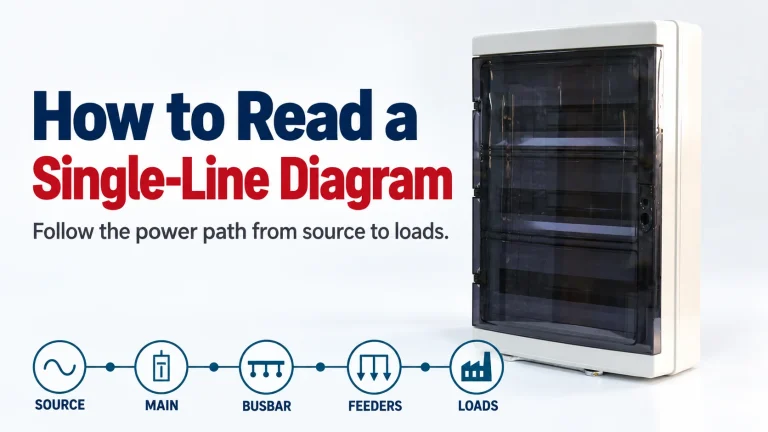
A single-line diagram can look simple and still be difficult to read. One line may represent a multiphase circuit, a small symbol may stand for a major protective device, and a short label may carry the information that determines what equipment belongs downstream. The most reliable way to read a single-line diagram is to follow […]
Figure 1. Three-phase SPD selection starts with system facts, not the largest kA number. A three-phase surge protector should not be selected by the largest kA number on its label. First confirm the system voltage, whether a neutral is present, the earthing arrangement, the installation point, and the required SPD type. Then compare Uc, Up, […]
An AC-only miniature circuit-breaker,you cannot treat it as a DC circuit by default.Confirm before using: If the manufacturer explicitly rates the selected model for the required DC voltage, pole arrangement, polarity where applicable, fault current, and breaking capacity.Some breakers carry both AC and DC ratings, but these alone cannot reflect the actual situation. If the […]