When you plug in your cell phone charger, flip on a light switch, or power your refrigerator, do you ever stop to think what type of electricity is flowing through your home? Is household electricity AC or DC?
Find the answer in the following content!
What Is Household Electricity?
Household electricity is the sort of electricity that comes through wall sockets to your home, energizing anything from your toaster to your television. Yet, the type of current—AC or DC—determines the way the electricity behaves and is delivered to you.
Alternating Current (AC): Imagine AC as a wave: the direction of the electron flow reverses back and forth, typically 50 or 60 times per second (depending on where you are). This cyclical reversal makes AC ideal for sending power over long distances, so it’s the standard for most electrical grids around the world.
Direct Current (DC): Picture DC as a steady stream: electrons flow in one consistent direction. You’ll find DC in batteries, solar panels, and the inner workings of gadgets like your laptop or smartphone. But for powering an entire house through the grid? Not so much.
So, which do you think your house runs on? In almost every case, household electricity is AC, supplied by utility companies through the power grid. This fact affects how we build houses, appliances, and even energy policy. Let’s explore why AC won out and what that will mean for you.
A Brief History: The War of the Currents
To understand why AC is what energizes your home, let’s take a quick journey back to the late 1800s and the “War of the Currents.” This was a conflict between two electrical pioneers: Thomas Edison, the proponent of DC, and George Westinghouse, the proponent of AC with the assistance of inventor Nikola Tesla.
Edison’s DC Vision: Edison believed DC was simpler and safer to utilize for short distances, like powering homes directly from local generators. There was a catch, though: DC couldn’t travel very far without losing a lot of energy.
Westinghouse’s AC Triumph: Westinghouse and Tesla showed that AC could be converted to high voltages for long-distance transmission, then converted down to safer voltages for homes by using transformers. This efficiency won the day.
AC emerged victorious in the war because it addressed a real-world issue: how to transmit electricity from far-away power plants to burgeoning cities and rural areas alike. As noted by Energy.gov, this historical victory laid the foundation for today’s AC-dominated electrical grids.
Standard Household Electricity: AC Rules the Roost
If you’re connected to the power grid—whether you’re in New York, London, or Tokyo—your household electricity is almost certainly AC. According to Wikipedia’s entry on mains electricity, this is the global standard for what’s called “mains electricity”—the power that comes from your utility provider. But while AC is universal, the details vary by region:
North America: Homes are given 120 volts (V) at 60 hertz (Hz), with heavy-duty devices like ovens or dryers being on 240V.
Europe, Asia, and Africa: Typical is normally 230V at 50Hz.
Japan: Exceptional case with 100V, split between 50Hz in the east and 60Hz in the west.
These voltage and frequency variations—how often the current oscillates—matter. Plug a 120V hairdryer into a 230V outlet without a converter, and you might have a dead unit (or worse). Happily, AC’s flexibility allows it to adapt to these local quirks, so it’s an international favorite.
To put these variations into perspective, here’s a handy table of general AC standards around the globe:
This table is a quick guide to understanding why that gadget from abroad might need an adapter—or why it’s humming oddly. AC’s adaptability is evident here, but these variations are a reminder to read appliance manuals before plugging it in.
Exceptions: Where DC Sneaks Into Homes
While AC dominates the grid, there are some exceptions where DC makes an appearance in homes:
Off-Grid Living: Consider solar-powered cabins or remote homes. Solar panels generate DC, and some installations keep it in that state to illuminate the space or power small devices. But even there, most of them convert it to AC to power regular appliances with the assistance of inverters.
Historical Holdouts: In pockets like parts of New York City from Edison’s DC days, a few structures still use DC. These holdouts usually utilize rectifiers to convert arriving AC to DC but are exceptions rather than a rule.
There isn’t a single modern country which uses DC as its standard grid supply. DC’s stronghold is in batteries and specialized systems, not home use.
Inside Your Home: The AC-to-DC Process
Here’s the trick: while your wall sockets supply AC, most of your favorite devices—like phones, laptops, and LED lights—run on DC. How does that work?
Converters at Work: Take a look at your phone charger or laptop adapter. That clunky brick isn’t just for show—it’s a rectifier that converts AC to DC. Inside, it smooths out AC’s waves into DC’s steady flow.
Efficiency Matters: This conversion isn’t perfect; some energy gets lost as heat. That’s why energy-efficient chargers and appliances are a big deal—they minimize waste.
Why AC Reigns for Household Supply
So why has AC lasted over a century? It’s not tradition—it’s science and practicality. DC has no frequency problems and simpler short-range installations, but its disadvantages outweigh them for household grids.
Here are the most important reasons AC is the monarch:
Long-Distance Efficiency: AC can be stepped up to high voltages for transmission (reducing energy loss) and stepped down for home use with transformers. DC can’t be done as simply, so it’s more costly for grids (Energy.gov).
Versatility: From tiny bulbs to gigantic air conditioners, AC powers them all. And, DC can be derived from AC when required, making it versatile (Wikipedia).
Safety Features: AC equipment is accompanied by circuit breakers like miniature circuit breakers and fuses, which cut off power on faults. DC safety is harder to control (ESFI).
Global Infrastructure: Years of AC usage have rendered the world’s power grids, wiring, and appliances AC-compatible. A switch to DC would be a massive, expensive retooling.
What This Means for Us
In a nutshell, our household electricity is AC, delivered through the grid with regional tweaks in voltage and frequency. This matters when you’re buying appliances, traveling with electronics, or even planning energy upgrades like solar panels. While your devices might use DC internally, the power flowing from your outlets is AC—efficient, versatile, and time-tested.
Needless to say, your configuration? Unlikely, but off-grid or in an older building, query your utility company or an electrician. For the rest of us, however, AC is the unsung hero powering our homes.
Key Takeaways: 5 Things to Remember
AC Powers Homes: Household electricity from the grid is nearly always AC, thanks to its efficiency and global usage.
Regional Variations: Voltage and frequency vary—120V/60Hz in the US, 230V/50Hz in Europe—so check for compatibility.
DC’s Role: While AC rules the grid, most appliances initially convert it to DC within.
Why AC Wins: It does long-distance transmission better, is versatile, and safe with existing technology.
Handy Tip: Know your local standard to make more informed appliance use and energy choice.
Wrapping Up
It’s not trivia to know whether household electricity is AC or DC—it’s a window into how your home works. AC’s ubiquity is due to its ability to travel the distance, easily change shape, and power our lives safely. Next time you plug in, you’ll enjoy the story behind those electrons—and how they illuminate your world.
Want to verify your home setup? A simple call to your utility or local electrician can confirm what’s running through your walls. Here’s to smarter, safer energy consumption!
About OOHMAGE
OOHMAGE stands out as a reliable and innovative electrical equipment supplier, offering a comprehensive range of products and services tailored to meet the diverse needs of its clients.
With a focus on quality, and continuous improvement, OOHMAGE is well-positioned to support your electrical equipment requirements, ensuring safety, efficiency, and reliability in every project.
We are an ISO 9001:2015 certified electrical equipment supplier. With the CE marking, our products are widely used in various applications and ensure high-level safety. Contact us today and get more information on our electrical equipment!
FAQ
What’s the difference between AC and DC?
AC (Alternating Current): Electricity moves back and forth, changing direction (e.g., 50 or 60 times per second). It is well-suited for long-distance power transmission.
DC (Direct Current): Electricity flows in one direction constantly. It is used in batteries and electronics like phones and laptops.
How do I know if my home uses AC or DC?
If you are connected to the power grid, it is most probably AC. Check on your utility bill or consult your provider to confirm. Off-grid systems can use DC, but even then, AC typically comes into the picture.
Why do some devices need DC when the grid supplies AC?
Phones, laptops, and LEDs are electronics that function with DC. These gadgets have in-built converters (e.g., phone chargers) that transform AC from the outlet to DC.
Is AC safer than DC for household use?
Both can be hazardous if misused, but AC systems also include stable safety mechanisms like circuit breakers. AC’s ability to step down to safer voltages is what also makes it suitable for homes.
Will we ever switch to DC for household electricity?
Probably not. AC’s advantage for power transmission and the world infrastructure we have today makes AC the preferred system. It would be too expensive and impractical to implement DC for most uses.
Related Product Selection
For product selection, compare the OMC8 AC MCB series with the OMC8-DC MCB series. AC and DC protection devices are not interchangeable; use the model-page parameters for the intended circuit.
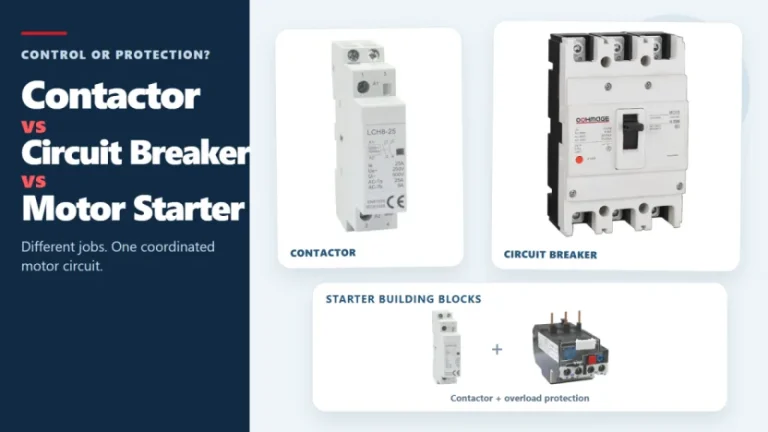
Figure 1. Contactors, circuit breakers, and motor starters solve different control and protection tasks. These three devices often appear in the same motor-control panel, but they solve different problems. A contactor handles frequent, remote, or automatic switching during normal operation. A circuit breaker interrupts abnormal current within its rated capability. A motor starter normally combines […]
The main types of circuit breakers used in low-voltage distribution include miniature circuit breakers (MCBs), molded case circuit breakers (MCCBs) and residual-current devices such as RCCBs and RCBOs. They are not interchangeable. MCBs and MCCBs are selected for overcurrent protection in different circuit roles, an RCCB provides residual-current protection without integral overcurrent protection, and an […]
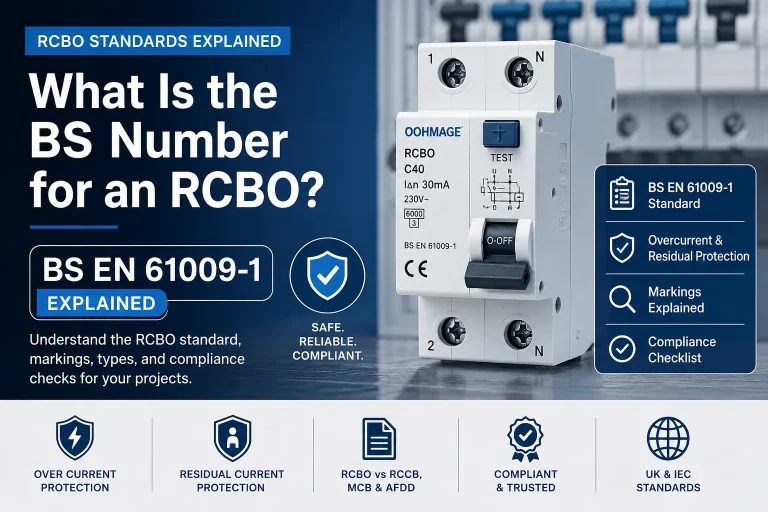
Introduction If you are searching for the RCBO BS number, the answer most commonly required in UK and IEC-based electrical procurement is BS EN 61009-1. This is the principal product standard associated with residual current circuit breakers with overcurrent protection used in residential, commercial, and similar installations. However, merely the BS number is not sufficient […]