MCCB means Molded Case Circuit Breaker, while MCB means Miniature Circuit Breaker. Both devices protect electrical circuits from overloads and short circuits, but they are designed for different current ratings, applications, and installation environments. In general, MCBs are used for residential and light commercial circuits, while MCCBs are used for higher-current commercial, industrial, and equipment protection systems. If you are wondering what MCCB and MCB mean in electrical wiring, this guide explains their functions, applications, differences, and selection factors clearly.
Quick answer: MCCB means Molded Case Circuit Breaker, and MCB means Miniature Circuit Breaker. Use an MCB for smaller final circuits and an MCCB for higher-current feeders, motor circuits, distribution panels and installations that need stronger breaking capacity or adjustable protection.
What Is MCCB?
MCCB stands for Molded Case Circuit Breaker. It is a protective device used to interrupt electrical current when a circuit experiences an overload, short circuit, or other abnormal condition. Compared with an MCB, an MCCB is usually designed for higher current ratings and heavier electrical loads. MCCBs are commonly used in commercial buildings, industrial systems, motor circuits, HVAC equipment, distribution panels, and larger electrical installations.
MCCBs Functionality
MCCBs interrupt the current flow when they detect an overload or short circuit. Most MCCBs use thermal and magnetic protection mechanisms. The thermal element responds to sustained overcurrent, while the magnetic element responds quickly to sudden fault currents. Together, these mechanisms help protect cables, equipment, and electrical systems from damage.
MCCBs Construction
The construction of an MCCB is durable and robust. It has a molded case, which is why it is called a molded case circuit breaker. The external housing protects the internal parts from wear, impact, and environmental stress while also providing insulation. Inside an MCCB, key components may include contacts, an arc chute, and a trip unit. These parts work together to detect faults and interrupt the current when necessary.
What Are the Different Types of MCCBs?
MCCBs are available in different types with specific functions to match the applications. Have a look!
Firstly, the standard MCCBs are appropriate for industrial and commercial wiring.
Secondly, motor MCCBs are appropriate for equipment that requires a motor to operate.
Finally, the ground fault protection MCCBs will identify the faults underneath the surface and interrupt the surface. As a result, the ground fault MCCBs successfully avoid hazards.
MCCB Applications
Engineers install MCCBs in many commercial and industrial applications because they can protect higher-current circuits and larger electrical loads. MCCBs are commonly used in machinery, motor circuits, HVAC systems, distribution panels, and industrial equipment. In commercial buildings, MCCBs help protect main and feeder circuits, reduce downtime, and improve electrical safety. In residential systems, MCBs are usually more common for final branch circuit protection, while MCCBs may be used where higher current capacity is required.
Advantages of MCCBs
Now that you know what is MCCB, let’s learn about some of its advantages.
Firstly, the MCCBs will credibly protect the circuitry and wires from faults. As a result, the probability of damage is reduced. MCCBs also successfully prevent fires.
Moreover, you can adjust the MCCB settings for easy personalization. In other words, the user can modify MCCB for specific applications.
Lastly, MCCBs are very easy to install. They ensure long-term efficiency in operations.
Safety Considerations of MCCBs
Using MCCBs safely requires correct selection, installation, and maintenance. An MCCB should be selected according to the circuit’s rated current, voltage level, breaking capacity, load type, and installation environment. If the MCCB is undersized or incorrectly applied, it may fail to provide reliable protection during overloads or short circuits. For safe operation, MCCBs should be installed by qualified personnel and inspected regularly. In higher-current systems, cable sizing, terminal tightening, ventilation, and coordination with upstream and downstream protection devices are especially important. Proper maintenance helps prevent overheating, nuisance tripping, and unexpected equipment downtime.
What is MCB?
MCB stands for Miniature Circuit Breaker. Miniature circuit breakers (MCBs) are necessary components in modern electrical systems. They break the flow of electricity when they sense abnormal conditions. One of the best features of MCBs is automatic protection. The disconnection avoids future damage to circuits. Moreover, MCBs keep the user and appliance safe.
MCB Functionality
In short, the miniature circuit breakers will identify abnormal current flows like overloads and short circuits. As soon as they identify abnormalities, the breaker disconnects from the circuit. The immediate response time minimizes the probability of mechanical damage and fires. Lastly, the circuit breakers are reset easily. The operations resume normalcy after the circuit breaker addresses the fault.
The Different Types of MCBs
MCBs are available in different types for specific reasons. The diverse range of circuit breakers will protect electrical systems of numerous scales. The types are mentioned below.
Firstly, the type B MCB will trip at low fault abnormalities. They are excellent for residential use.
Secondly, type C will trip at high currents. They are ideal for commercial entities.
Lastly, the type D circuit breakers will sustain high currents. They are most suitable for industrial sites.
MCB Components
A miniature circuit breaker has numerous components that work together to prevent hazards.
The contact will regulate the electrical current in normal conditions.
Moreover, the bi-metallic strip, in addition to the electromagnetic coil, will identify overcurrent and dangerous situations.
The tripping mechanism will separate from the contact. Thus, interrupting the electrical flow. The components work together to guarantee protection.
What Are the Advantages of MCBs?
MCBs have many advantages over traditional fuses.
Foremost, they offer precise and excellent protection. They reduce tripping significantly.
Moreover, the user does not need to replace the MCB after a fault occurs. Unlike fuses, breakers save time and money.
Thirdly, the miniature circuit breakers offer consistent performance. They reduce the probability of electrical fires.
MCBs Installation and Maintenance
Installation and usage of MCBs require experience and planning. The electricians will pick the right MCB type and current rating according to the circuit. Subsequently, the experts will install the circuit breaker to ensure excellent performance and safety.
Later, users can visually inspect the breakers and test them regularly. If issues are identified early, the system can be repaired before more serious damage occurs.
MCB Applications
Miniature circuit breakers are widely used in homes, apartments, offices, retail spaces, and small commercial buildings. They commonly protect lighting circuits, socket circuits, small appliances, and branch circuits inside distribution boards. In light industrial environments, MCBs may also be used for selected control circuits or smaller loads. For higher-current machinery, large motors, and main distribution protection, MCCBs are usually the more suitable option.
The Advancements of MCB
Technological advancements have significantly improved the performance and design of miniature circuit breakers (MCBs). Modern-day MCBs have tripping features that offer excellent protection. Furthermore, you can connect the MCB with smart systems to operate and control them remotely. The innovations are necessary to match the demands of the latest equipment and the demands of today’s consumers.
The Differences between MCCB and MCB
Feature
MCB
MCCB
Full form
Miniature Circuit Breaker
Molded Case Circuit Breaker
Typical current rating
Lower current ratings, often used up to 125A depending on model and standard
Higher current ratings, commonly used for larger loads
Common applications
Homes, offices, lighting circuits, socket circuits, small distribution boards
Commercial buildings, industrial panels, motors, HVAC systems, main distribution circuits
Breaking capacity
Suitable for lower fault-current applications
Suitable for higher fault-current applications
Size
Compact and modular
Larger and more robust
Trip characteristics
Usually fixed trip curves such as B, C, or D
May offer adjustable trip settings depending on model
Cost
Lower cost for small circuits
Higher cost due to larger capacity and advanced protection features
Best use
Final branch circuit protection
Main, feeder, motor, or heavy-load protection
Choosing between MCCB and MCB
Installation
MCB
The knowledge about picking the ideal electrical equipment supplier for the electrical system is important. Installing a miniature circuit breaker is very simple. They are excellent for domestic and small commercial buildings.
The MCBs work well with electrical panels with a DIN mounting process. The simplified replacement and installation reduce time, cost, and labor expenses. They need minimum tools. Even beginners can install MCB correctly without professional help.
MCCB
MCCB has a more complex installation process. Electricians may need to bolt the connections and use suitable mounting accessories based on the MCCB model and panel design. The installation needs expertise and correctness because of its construction and high current rating. Moreover, the experts will calibrate and adjust the MCCB settings for optimal performance in an industrial setting.
Space
MCB
A miniature circuit breaker has a compact design. Therefore, you can install them in spots with minimum area. The small size also means they are easy to connect to existing electrical panels. You do not need to modify the circuits significantly to enjoy the benefits MCBs offer. The compact size is preferred in residential homes where space is restricted, and efficiency is required.
MCCBs
In contrast, MCCBs are large with high capacity. Moreover, they need more space for installation. An MCCB needs proper cooling and ventilation to operate successfully. Therefore, the electricians must factor in the cooling and space requirements. As a result, the MCCBs are excellent for industrial use.
Maintenance and Access
MCB
A miniature circuit breaker needs minimum maintenance. You can easily access it. Moreover, their designs offer clearly understandable visual indicators so you can assess their performance. In addition, resetting them is quite easy as well. The simple features ensure minimum downtime, making it perfect for less stressful settings.
MCCB
On the other hand, MCCBs need constant inspections. You need to maintain the MCCB because of its advanced features closely. Perform regular checks will ensure excellent performance. Moreover, you can detect issues early on. Testing and calibrating are some of the maintained procedures of an MCCB. Lastly, you will need to hire an expert for detailed testing.
Hybrid Approach for Complex Systems
Segmenting Applications
In a hybrid system, an MCB will safeguard each circuit and small loads. On the other hand, an MCCB will protect larger sections and heavy-duty machinery. You can combine the two circuit breakers for personalized protection to match your specific needs. It improves performance and makes the operations more reliable.
System Security
Installing an MCB and MCCB will improve the flexibility of an electrical system. It becomes a lot easier to upgrade and modify as required. You can strategically use the circuit breakers to adapt to altering patterns when you expand operations. As a result, MCBs and MCCBs are scalable components that can endure grander electrical infrastructure.
Budget-friendly
You can install MCB in less critical spots of the operations to save money. On the other hand, MCCBs in more demanding circumstances ensure protection in crucial areas. The cost-effective approach will increase the return on investment. At the same time, MCBs and MCCBs will maintain the performance of the electrical system.
Time to Wrap Up the Discussion
MCBs and MCCBs are both essential circuit protection devices, but they are not the same. An MCB, or Miniature Circuit Breaker, is commonly used for smaller residential and light commercial circuits. An MCCB, or Molded Case Circuit Breaker, is designed for higher-current applications such as commercial panels, industrial equipment, motors, and larger distribution systems. Choosing between an MCB and an MCCB depends on the circuit current, breaking capacity, load type, installation space, and safety requirements. For reliable electrical protection, OOHMAGE provides circuit breakers, distribution boxes, surge protection devices, and related electrical protection solutions for residential, commercial, industrial, and solar applications.
Frequently Asked Questions
What does MCCB mean?
MCCB means Molded Case Circuit Breaker. It is a circuit protection device used to protect electrical systems from overloads, short circuits, and fault currents.
What is the full form of MCCB in electrical?
The full form of MCCB in electrical systems is Molded Case Circuit Breaker.
What does MCB mean?
MCB means Miniature Circuit Breaker. It is commonly used to protect smaller circuits in homes, offices, and light commercial buildings.
What is the main difference between MCB and MCCB?
The main difference is capacity. MCBs are usually used for lower-current branch circuits, while MCCBs are used for higher-current commercial, industrial, or main distribution circuits.
Which is better, MCB or MCCB?
Neither is universally better. An MCB is better for smaller circuits, while an MCCB is better for larger loads, higher fault current, and industrial applications.
Where is MCCB used?
MCCBs are commonly used in industrial panels, commercial buildings, motor circuits, HVAC systems, main distribution boards, and heavy-load electrical systems.
Can MCCB replace MCB?
An MCCB can sometimes be used where higher protection capacity is required, but it should not replace an MCB without checking current rating, breaking capacity, installation space, and system design.
What happens if an MCB is not installed?
Without an MCB or another suitable protection device, overloads and short circuits may damage wiring, cause overheating, or increase the risk of electrical fire.
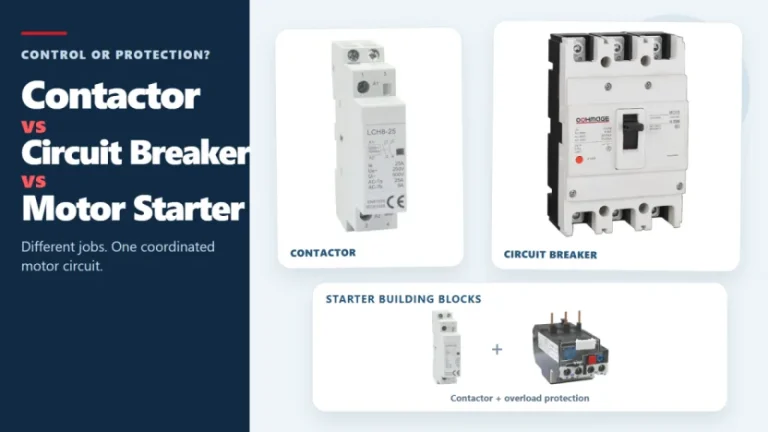
Figure 1. Contactors, circuit breakers, and motor starters solve different control and protection tasks. These three devices often appear in the same motor-control panel, but they solve different problems. A contactor handles frequent, remote, or automatic switching during normal operation. A circuit breaker interrupts abnormal current within its rated capability. A motor starter normally combines […]
Introduction The concept of remote tripping is simple, but in actual operation, project teams often encounter difficulties in specifying the components. The panel factory may require circuit breakers triggered by fire alarm relays, PLC outputs, building management system instructions, or other coordinated control. At this point, “diversion tripping” is only the first step in the […]
The main types of circuit breakers used in low-voltage distribution include miniature circuit breakers (MCBs), molded case circuit breakers (MCCBs) and residual-current devices such as RCCBs and RCBOs. They are not interchangeable. MCBs and MCCBs are selected for overcurrent protection in different circuit roles, an RCCB provides residual-current protection without integral overcurrent protection, and an […]