Can an AC MCB Be Used on DC? A Model-by-Model Compatibility Checklist
Published: Author: Whelve
An AC-only miniature circuit-breaker,you cannot treat it as a DC circuit by default.Confirm before using: If the manufacturer explicitly rates the selected model for the required DC voltage, pole arrangement, polarity where applicable, fault current, and breaking capacity.Some breakers carry both AC and DC ratings, but these alone cannot reflect the actual situation.
If the DC rating can be found on the nameplate and data sheet, stop. Obtain written confirmation from the supplier. Verbal statements and empirical estimates are not acceptable.
Quick Answer: Three Possible Compatibility Results
What the product evidence shows
Selection result
Buyer action
The exact model has an explicit DC rating covering the required conditions
Select a documented DC-rated breaker or obtain a different manufacturer-approved solution
The marking, model code, or data sheet is incomplete or unclear
Compatibility is unconfirmed
Stop the selection and request the current manufacturer data sheet and written model confirmation
How to distinguish AC breakers and DC breakers is not the most important. We should consider whether the exact breaker model matches the real electrical conditions of the DC system.
Why the Same Ampere Rating Does Not Prove DC Compatibility
Make a selection between 32 A AC breakers and 32 A DC breakers, do not only focus on the same normal-current value.It’s not the same as rated operational voltage, and it is also not the same as breaking capacity.
AC current naturally crosses zero once per cycle. This “zero-current point” is critical: the electric arc generated when contacts open can be extinguished exactly at this zero crossing. DC is different. Its current is continuous without this natural zero crossing aid. The arc will last much longer unless the circuit breaker is specifically designed and configured for DC conditions.
This difference can influence the required arc-control design, contact arrangement, number of poles used for the rated duty, polarity requirements, and the breaking-capacity value that applies. It may also affect which connection arrangements the manufacturer permits. Schneider Electric’s guide to circuit-breakers for direct-current applications treats system voltage, current, short-circuit conditions, earthing arrangement, and pole implementation as connected selection inputs rather than interchangeable nameplate numbers.
Mitsubishi Electric similarly cautions that an AC breaker should not automatically be used in a DC circuit because the arc-extinguishing method and trip-device specifications are not necessarily the same. The practical rule for a buyer is therefore simple: compare the required DC duty with the exact manufacturer documentation, not with the front-panel ampere number alone.
AC MCB vs DC MCB: Compare Them on the Same Basis
Check
AC-only MCB
DC-rated MCB
What the buyer should verify
Product marking
Shows an AC rating for the stated duty
Shows a DC rating for specified conditions
Read the full model code, nameplate, and current data sheet
Arc interruption
Designed and rated for the stated AC application
Designed and rated for the stated DC application
Confirm that the manufacturer’s DC rating covers the intended system
Operational voltage
AC voltage and frequency conditions apply
DC voltage conditions apply
Match the system voltage and voltage-to-earth arrangement
Poles and polarity
Uses the manufacturer’s AC configuration
May have DC-specific pole or polarity requirements
Follow the exact model documentation; do not infer a universal connection rule
Breaking capacity
AC value applies under its stated conditions
DC value applies under its stated conditions
Compare the applicable DC value with the prospective short-circuit current
Trip characteristics
Defined by the exact product specification
Defined by the exact product specification
Check the curve and application rather than assuming the curve letter settles compatibility
This table is intentionally free of universal voltage, pole, or kA values. Those values vary by breaker family, model, system arrangement, and manufacturer test conditions.
The 7-Check Model Compatibility Process
The following process is a specification and document review, not an installation procedure.
1.Confirm thereal manufacturer and model code
“63 A”is too vague.You need to obtain complete values:manufacturer, series, full model code, pole version, and any suffix that distinguishes an AC product from a DC product.Acquire them before comparing technical values.
2.Read the AC/DC markings and the current data sheet
To find if there are explicit AC or DC voltage ratings and find if conditions are attached to the sheet.Some models may indicate AC and DC voltage ratings at the same time, but remember: You cannot equate them.
When checking the data sheet, please use the newest one.Do not use the images of unknown origin to make up the numbers.In case you find that the front marking and the data sheet appear inconsistent, please request manufacturer to solve this issue.
3.Match the DC system voltage and voltage-to-earth conditions
“My system is DC 220V.”This is only the beginning. We should also consider the maximum operating voltage and the voltage that each pole must interrupt relative to earth. Provide them to the breaker manufacturer or qualified designer.Only voltage alone is not enough.
4. Verify the required poles and any polarity conditions
DC ratings sometimes are linked to the arrangement of a pole. Certain models even have requirements for pole — they can not be used if it is installed backwards. All arrangement solutions need to be found in relevant production documents. Please do not infer on your own and do not copy wiring diagrams from other series. What is stated in the documents for Series A may not be applicable to Series B.
5. Compare the prospective fault current with DC breaking capacity
Rated current solves what maximum current it can handle. Breaking capacity solves what current it can interrupt when a malfunction occurs. Do not mix them.
First locate this model’s DC breaking capacity value and compare it with the prospective short circuit current in the circuit. If the fault current level is unknown, do not select the circuit breaker — get this value first.
6. Confirm trip characteristics and application conditions
After confirming the AC/DC rating, the matter does not end here.What about load conditions? Is there inrush current during startup? What is the ambient temperature? How does it coordinate with upstream and downstream protection?
Do not only look at one single sentence about “Use D curve for motors and C curve for lighting.” You should also consider about the load and the manufacturer’s trip data.
If you would like to know about the difference between curve terminology and MCB families, see OOHMAGE’s guide to MCB types and trip curves.
7. Verify documents and destination-market requirements
Finally, separate three different questions:
Does the manufacturer sign the required DC duty for the rated product?
Please check whether the document meets the technical requirements of your project?
After installing the whole set of equipment, confirm whether it can pass the acceptance of the target market.
How to Identify Whether an MCB Is Rated for AC, DC, or Both
The front label is the first step, but the final basis shall always be the complete data sheet.
Check the following items one by one:
Manufacturer and full model or ordering code
AC and/or DC voltage markings
Rated current
Pole configuration
Polarity markings, if applicable
Breaking capacity under the relevant AC or DC conditions
Trip characteristic
Referenced product standard and document revision
Manufacturer connection and application conditions
If the seller only provides you with the current rating and curve, but the full model code or voltage marking is vague, do not rush to order. Ask the seller to supply you with the clear label image and the matching manufacturer data sheet.
OOHMAGE currently presents its OMC8 AC and OMC8-DC products as separate series. That distinction helps buyers start in the correct product family, but the series name alone is not the final engineering approval. The selected model and its current documentation must still be matched to the circuit.
Common Specification Mistakes
Comparing only the ampere rating
Two breakers marked with the same current can have different voltage, breaking-capacity, pole, and application ratings. Compare the whole specification.
Reusing an AC breaking-capacity value for DC
An AC kA value should not be treated as a DC value unless the manufacturer explicitly documents the applicable DC rating and conditions.
Ignoring poles or polarity
The required pole arrangement or polarity can be part of the DC rating. Use only the exact model instructions.
Assuming a similar enclosure means an interchangeable product
DIN-rail fit and external dimensions do not prove equivalent arc interruption or electrical ratings.
Treating a product standard as a complete installation approval
Product documentation and local installation requirements answer different questions. Both may need review.
Selecting the product before collecting system information
Voltage, fault current, earthing arrangement, load, and destination-market requirements should inform the product choice—not be added after the model is fixed.
Accepting an undocumented verbal assurance
For a technical procurement decision, request a current data sheet or written manufacturer confirmation tied to the exact model.
What to Send Before Requesting a DC MCB Quotation
A better RFQ reduces repeated clarification and makes model confirmation more reliable.
RFQ field
Why it is needed
Destination market and project type
Establishes the document and application context
DC system voltage and voltage-to-earth arrangement
Supports voltage and pole review
Rated load current
Provides a current-selection input
Prospective short-circuit current
Supports the DC breaking-capacity review
Required pole configuration
Helps identify the correct product version
Earthing or system arrangement
Provides protection and voltage context
Load or application type
Supports trip and application review
Quantity and packaging requirements
Supports the commercial quotation
Required data sheet, report, or certificate
Defines the evidence needed before approval
Preferred model, if one has already been proposed
Allows an exact compatibility check
After these fields are available, buyers can review OOHMAGE’s DCcircuit-breaker range and discuss a documented model rather than starting from a generic “AC breaker on DC” substitution.
OMC8 AC MCB is presented as an AC miniature circuit-breaker series.
OMC8-DC MCB is presented as a dedicated DC miniature circuit-breaker series.
These product pages are starting points for model review, not substitutes for circuit data. Confirm the required voltage, current, poles, fault level, application, destination market, and documentation before specifying or ordering a model.
What This Article Does Not Decide
This checklist does not replace short-circuit calculations, protection coordination, conductor selection, installation design, or review against applicable local requirements. It does not approve a breaker for an undisclosed circuit, and it does not provide terminal wiring or live-testing instructions.
Final device selection should be reviewed by qualified electrical personnel and supported by the manufacturer documentation for the exact model.
Frequently Asked Questions
Can a breaker rated 63 A AC be used on a 63 A DC circuit?
You cannot get answers only by “63 A”. Check whether this model is equipped with explicit DC rating, and you need to confirm whether this rating can cover the voltage, pole and polarity conditions, prospective fault current, DC breaking capacity, and application of your system.
Can an MCB be rated for both AC and DC?
Yes. Some manufacturers may provide the AC duty and the DC duty at the same time. Each rating has its own conditions and limits. Check the complete model code and data sheet, and apply the DC rating only within the documented voltage, pole, polarity, and breaking-capacity conditions.
How do I identify a DC MCB from its label?
Look for the full model code and an explicit DC voltage marking, then verify the pole arrangement, polarity markings where applicable, rated current, DC breaking capacity, trip characteristic, and referenced data sheet. A label photograph should match the manufacturer document for the exact product.
Is breaking capacity the same as rated current?
NO. Rated current is what current it can withstand when operating normally; Breaking capacity is what short-circuit current it can interrupt during a malfunction. Both situations need to be met together.
What information does OOHMAGE need to confirm a DC MCB model?
Provide the DC system voltage, rated load current, required poles, earthing arrangement, prospective short-circuit current, load/application, destination market, quantity, and required documents. If a model has already been proposed, include its complete code and label or data sheet.
Conclusion
The most defensible specification question is not “Can an AC breaker be derated for DC?” It is “Does this exact model have manufacturer documentation that covers the required DC duty?”
Start with the complete model code, then verify the DC voltage, poles and polarity, prospective fault current, breaking capacity, trip characteristics, application conditions, and required documents. If any of those elements is unclear, stop the selection and obtain written confirmation before ordering.
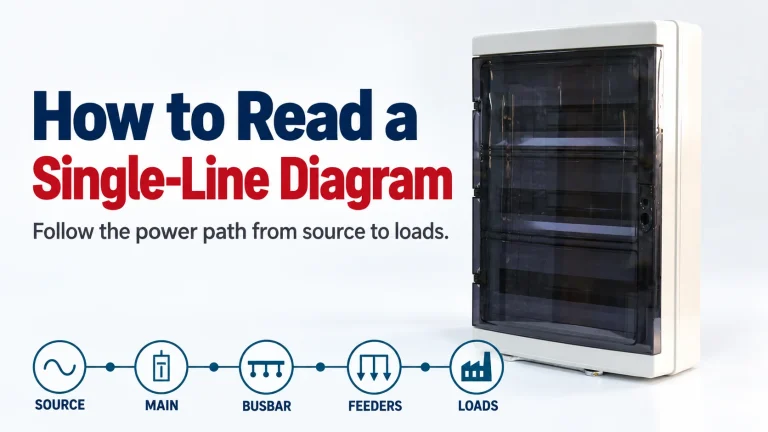
A single-line diagram can look simple and still be difficult to read. One line may represent a multiphase circuit, a small symbol may stand for a major protective device, and a short label may carry the information that determines what equipment belongs downstream. The most reliable way to read a single-line diagram is to follow […]
Figure 1. Three-phase SPD selection starts with system facts, not the largest kA number. A three-phase surge protector should not be selected by the largest kA number on its label. First confirm the system voltage, whether a neutral is present, the earthing arrangement, the installation point, and the required SPD type. Then compare Uc, Up, […]
This buyer‑focused guide compares 2‑pole and 4‑pole RCCBs for single‑phase and three‑phase‑four‑wire systems. It walks you through selecting the correct RCCB type, residual‑current sensitivity and protection coordination. Multiple practical checklists, frequent‑selection mistakes and quotation‑ready specification lists are included to help distributors, panel builders and installers specify the right residual‑current breaker and prevent unwanted tripping.