Whether it is in your home or office, keeping your electrical appliances safe is very crucial. But for this, you need to understand the devices used to safeguard your equipment from any irregularity in voltage.
There are two prominent devices, a Residual current device (RCD) and a Miniature current device (MCD), which are used to save your devices from the overflow of the current. But they both have different functions, applications, and benefits.
This article is a complete guide about RCD vs MCB and their work. You will understand how these devices are useful for you and what the major differences are between them.
What is an RCD (Residual Current Device)?
An RCDs is a device that saves your equipment from spikes in voltage. It is designed to prevent electric shocks and save your appliances from electrical fires. In any case of any fault in the system, RCD has the ability to detect the leak of current and then shut down the power to save you from any injury and your devices from getting damaged.
Types of RCDs
Fixed RCD: They are super-fit RCDs to protect individual or group circuits. It installs directly into the circuit.
Socket-outlet RCD: They are built separately and specifically for the sockets. They provide protection only to those appliances that fit inside the socket for working.
Portable RCDs: they are easy to use. They fit easily into any socket because of their versatility. But they work to protect your appliances temporarily.
What is an MCB (Miniature Circuit Breaker)?
An MCB, also known as a Miniature Circuit Breaker, is a device that protects the system from abnormal conditions like an overflow of electricity or short circuits. It saves your appliances from damage by automatically switching off the electric circuit in such conditions. These Miniature Circuit Breakers are nothing like a DC fuse that needs replacement after a fault. MCBs can be reset manually.
Types of MCBs
Type B MCBs
Type B MCBs are best for light-duty applications like lights, fans, and electrical devices. They are mostly found in homes and residential buildings. The MCBs automatically switch off the circuit when the current exceeds 3 to 5 times the normal operating current.
Type C MCBs
They are mostly used in commercial areas like shops and offices, where the load of electricity is higher than at home. Since they can handle higher electrical currents, they trip when the current goes 5 to 10 times higher than usual.
Type D MCBs
Type D MCBs are used to save the equipment that draws the largest amount of electricity. They are built to handle electrical surges of machinery like large motors, heavy machinery, welding equipment, and transformers. They trip when the current is 10 to 20 times higher than the normal level.
RCD vs. MCB: Common Applications
While the purpose of MCB and RCD devices is the same, their applications are different according to their types.
Application of RCDs
RCDs are the best fit for providing protection for individuals in locations where there are higher risks of electric shocks. It can be like bathrooms or outdoor areas.
Application of MCBs
Miniature circuit breaker manufacturers offer them to provide protection from electric overloads and short circuits. It protects the wiring and the devices connected to the circuits. You will commonly see them in all types of electrical installations.
Differences Between RCD and MCB
Functionality
RCD: It protects people from electric shocks by detecting any leakage of current. Once RCD detects even a small leak of current, it immediately cuts off the circuit.
MCB: It protects wiring and electrical appliances by switching off the circuit when it detects any overload or short circuits.
Protection Focus
RCD: It focuses on human safety. It can quickly turn off the circuit if the current is leaking.
MCB: It mainly focuses on protecting electrical appliances and wiring from faults. It prevents overheating, fire, and damage to electric items.
Operations
RCD: It monitors the flow of electricity between live and neutral wires, which should be equal. If there is any difference between the two, it means the current is leaking from somewhere. It then quickly trips off the circuit and shuts the electricity.
MCB: It automatically detects when there is too much flow of electricity, which can cause overload, or when the wires touch each other, which can result in a short circuit. It interrupts the flow of electricity to prevent any damage.
Resetting Mechanism
RCD: After tripping, it needs to be reset manually. This means someone has to go to the electric panel and turn the switch back on.
MCB: Depending on the model, it has two different features. You can either reset it manually, or it also has an option for an automatic reset.
When to Use an RCD
The following are some of the main reasons for using an RCD.
Human Safety
The RCD can trip before the current even reaches you. It detects the current imbalance in milliseconds to protect you from any electrical shocks.
Earth Leakage Protection
The best thing about RCDs is that they protect from currents that flow somewhere they shouldn’t, like on the ground or through a person. This normally happens with appliances that have higher chances of electrical shocks, like washing machines or outdoor electrical wiring.
Compliance with Safety Regulation
Since water conducts electricity very well, there is a 100 percent chance of getting an electric shock in appliances. Usually, appliances in bathrooms or kitchens need proper protection. That is why it must ensure that certain electrical circuits are legally meeting the safety criteria.
When to Use MCB
Circuit Protection
In commercial and industrial areas, where there is heavy machinery, it is important to install devices for protection. Slight damage in those machinery can lead to big losses or even safety hazards.
Overload Scenarios
MCB automatically trips and shuts down the circuit when the circuit gets too much current. Overloading makes the circuit malfunction. Due to this tripping, the wires need protection from overheating or damage.
Short Circuit Protection
When it senses any wires touching each other, it instantly stops the system and saves from short circuits without causing any serious damage.
Can RCD and MCB be used together?
When it comes to protecting yourself and your expensive heavy machinery, we can’t compromise on any of that. That is why you always have the option of protecting both by using them.
Combination of RCD and MCB
In modern electrical combinations, it is common to use these devices together. This will protect not only human life but also your high-end machinery from any damage.
An RCBO functions as both the RCD and MCB. It protects from electrical shocks and also from overloads and short circuits in a single unit.
RCD vs. MCB: Pros and Cons
Characteristics
RCDs
MCBs
Primary function
It reduces the chances of electrical shocks to zero
It prevents short circuits and overloads before they even occur.
Focus
Designed to protect humans
Used for protecting appliances
Resetting
Need to be reset manually
It can be reset manually and automatically both
Cost
It costs a bit much
It Is less expensive
Usage
Perfect for areas that have high chances of electrical shocks
They can be used in all kinds of installations.
Final Thought
For every electrical appliance, whether it is in the home or any industrial area, there is always a need for protection for both you and your machinery. For this, RCB and MCB play a vital role.
While they both serve the same purpose, they function differently and have different usages, resetting, and focuses. It is very important to understand the difference between the two in order to select the right device that fits your needs.
For ultimate protection for devices and people, it will be a smart choice to use them both together from reliable electric equipment suppliers.
FAQs
Can I use an RCD without MCB?
Yes, you can use any of them separately or even together if you want. It all depends on your preference.
How often should I check my RCD?
If you want to improve your RCD, you should check it at least every three months.
Why should I install RCD in bathrooms or kitchens?
In areas like bathrooms or kitchens, there are more chances of electrical shocks because of the usage of water. That is why it is important to use an RCD in such places.
Does MCB fit with every type of electrical installation?
Yes, MCB can be used in every type of electrical installation, whether it is light appliances like fans or lights in your home or large motor or welding equipment in industrial areas. You can get MCB in all types.
What to do if my RCD keeps tripping again and again even after resetting it?
If your RCD keeps switching off the system constantly, it might be because there is an electrical fault or wiring issue somewhere in your system. You should consult a professional electrician to fix this issue.
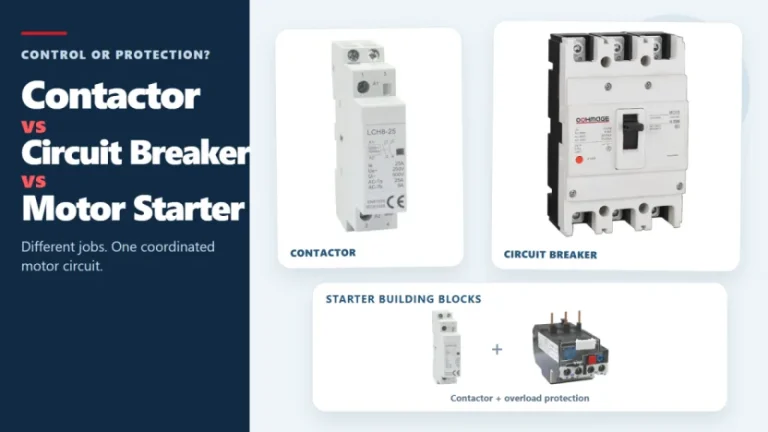
Figure 1. Contactors, circuit breakers, and motor starters solve different control and protection tasks. These three devices often appear in the same motor-control panel, but they solve different problems. A contactor handles frequent, remote, or automatic switching during normal operation. A circuit breaker interrupts abnormal current within its rated capability. A motor starter normally combines […]
Introduction The concept of remote tripping is simple, but in actual operation, project teams often encounter difficulties in specifying the components. The panel factory may require circuit breakers triggered by fire alarm relays, PLC outputs, building management system instructions, or other coordinated control. At this point, “diversion tripping” is only the first step in the […]
The main types of circuit breakers used in low-voltage distribution include miniature circuit breakers (MCBs), molded case circuit breakers (MCCBs) and residual-current devices such as RCCBs and RCBOs. They are not interchangeable. MCBs and MCCBs are selected for overcurrent protection in different circuit roles, an RCCB provides residual-current protection without integral overcurrent protection, and an […]