< img height="1" width="1" src="https://www.facebook.com/tr?id=1523171142290993&ev=PageView&noscript=1"/>
How to Read a Single-Line Diagram

How to Read a Single-Line Diagram

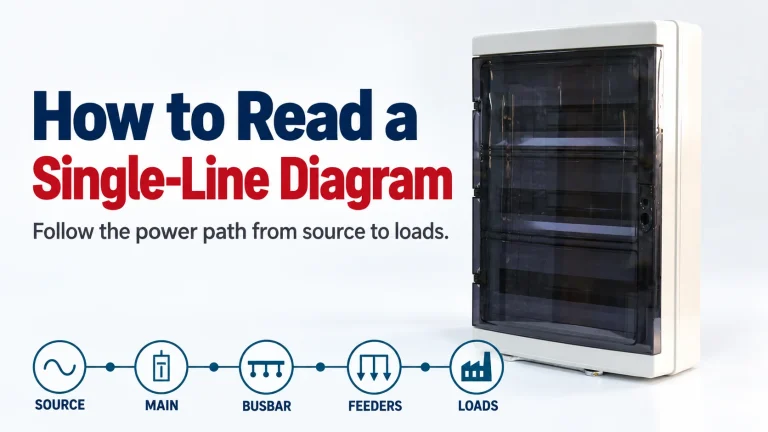
A single-line diagram can look simple and still be difficult to read. One line may represent a multiphase circuit, a small symbol may stand for a major protective device, and a short label may carry the information that determines what equipment belongs downstream. The most reliable way to read a single-line diagram is to follow […]
Read More
3 Phase Surge Protector: 7 Checks Before Buying

3 Phase Surge Protector: 7 Checks Before Buying

Figure 1. Three-phase SPD selection starts with system facts, not the largest kA number. A three-phase surge protector should not be selected by the largest kA number on its label. First confirm the system voltage, whether a neutral is present, the earthing arrangement, the installation point, and the required SPD type. Then compare Uc, Up, […]
Read More
Can an AC MCB Be Used on DC? A Model-by-Model Compatibility Checklist

Can an AC MCB Be Used on DC? A Model-by-Model Compatibility Checklist

An AC-only miniature circuit-breaker,you cannot treat it as a DC circuit by default.Confirm before using: If the manufacturer explicitly rates the selected model for the required DC voltage, pole arrangement, polarity where applicable, fault current, and breaking capacity.Some breakers carry both AC and DC ratings, but these alone cannot reflect the actual situation. If the […]
Read More
2 Pole vs 4 Pole RCCB: How to Choose the Right Type, Sensitivity and Wiring Setup

2 Pole vs 4 Pole RCCB: How to Choose the Right Type, Sensitivity and Wiring Setup

This buyer‑focused guide compares 2‑pole and 4‑pole RCCBs for single‑phase and three‑phase‑four‑wire systems. It walks you through selecting the correct RCCB type, residual‑current sensitivity and protection coordination. Multiple practical checklists, frequent‑selection mistakes and quotation‑ready specification lists are included to help distributors, panel builders and installers specify the right residual‑current breaker and prevent unwanted tripping.
Read More
RCBO vs RCD: What Trips, What Stays On, and What Buyers Should Specify

RCBO vs RCD: What Trips, What Stays On, and What Buyers Should Specify

Introduction The RCBO integrates residual current protection with overload and short-circuit protection, and can independently protect and disconnect individual circuits. While an RCD is a general term for residual current protection devices, it may not include overcurrent protection; in many distribution cabinets, a shared RCD or RCCB needs to be used in conjunction with independent […]
Read More
Why Does an RCBO Keep Tripping?8 Common Causes and a Step-by-Step Diagnostic Checklist

Why Does an RCBO Keep Tripping?8 Common Causes and a Step-by-Step Diagnostic Checklist

Introduction An RCBO on the socket circuit seemed normal after resetting, but the water heater’s switch tripped again as soon as it started heating. In another case, after the distribution cabinet was upgraded, even when all the electrical appliances were unplugged, the same tripping phenomenon occurred. Both circuits were experiencing “frequent tripping”, but the underlying causes […]
Read More
+86-18757092555 Phone info@oohmage.com E-mail Chat on WhatsApp WhatsApp