What is Power Factor and Why It Matters in Electrical Systems?
Published: Author: Conor
What is power factor and why it matters in electrical Systems? The power factor is one of the most relevant yet misunderstood concepts in electrical engineering, directly influencing the costs of energy, the performance of equipment, and the stability of the grid.
An awareness of power factor can enable facility managers, engineers, and executives of any business to maximize their facilities’ electrical efficiency, decrease utility costs, and make their equipment more reliable, regardless of industrial, business, or residential needs.
Understanding Power Factor: The Basics
Power factor can be considered a measure of the effectiveness of electrical power in a system. It is the division of the real power (the power that does work) and the apparent power (the total power fed into the system). The accurate measure of power is in watts (W) whereas the apparent measure of power is in volt-amperes (VA). Power factor is a record somewhere between 0 and 1 and commonly a percentage.
A power factor of 1 (or 100%) means that the power that is fed is being consumed efficiently and no power is going to waste.
A power factor that is less than 1 would indicate that not the entire power is utilized which is usually a result of poor efficiency of the system.
In the perfect case, you would like the power factor to be as close to 1 as practicable. A low power factor means that the system is wasting more power than it should and hence high costs to the energy.
Why Power Factor Matters
Power factor is crucial for several reasons, particularly in industrial and commercial electrical systems. Let’s break down why maintaining a good power factor is critical.
Efficient Use of Power
When the power factor is high, the electrical system is an efficient use of the power. In terms of power factor, low loads require more power to accomplish the same amount of work. This wastefulness leads to the wastage of electrical energy, high consumption of energy, and unnecessary expenses. To industries and large commercial activities, this inconvenience may result in increased operational expenses.
Reduces Energy Losses
When the power factor is low, the electrical current has to move an extra distance to fulfill the required load, hence leading to additional losses as wasted heat. This is especially notable in cases of utilities and energy suppliers due to the high load on power generation and transmission systems resulting from poor power factor. An efficient power factor can mitigate such losses to manageable levels and ensure the efficient delivery of energy with minimal wastage.
Avoids Penalties
In other words, penalties are assessed by utility companies on the consumers with low power factors (compared to large industries and commercial consumers). It is attributed to the fact that poor power factor entails inefficiencies of a power supply system and additional utility costs. These penalties can be avoided by making the power factor better and are often done by making straightforward corrective actions such as the installation of power factor correction devices, like the addition of capacitors or synchronous condensers.
Better Equipment Performance
The power factor has a direct impact on the performance of any electrical equipment. In the low power factor situation, the loads on transformers, generators, and other electrical equipment are escalated. This not only reduces equipment life expectancy but also causes overheating and can result in premature failure. It would be possible to ensure a high power factor, which would increase the efficiency of these systems and make them run more smoothly and reliably.
Types of Power Factor: Lagging and Leading
There are two main types of power factor:
Lagging Power Factor
The commonest is a lagging power factor, where the current in the system lags behind the voltage. This is usually observed in inductive-type systems e.g. inductive motors, inductive transformers, and inductive fluorescent lighting. When such devices are in use, they typically consume a higher amount of reactive power than absolute power, resulting in a power factor less than 1.
Leading Power Factor
Conversely, the direction in which the current leads voltage is known as the leading power factor. This is rarer and usually observed in usage with capacitive loads, e.g. capacitor bank systems. Although a leading power factor is less problematic than a lagging, it may lead to problems in some electrical systems by making the voltage unstable.
How to Improve Power Factor
Power factor improvement is an essential component of the efficiency and cost-effectiveness of an electrical system. Consequently, it is possible to amend a low power factor in several ways:
1. Power Factor Correction Devices
The installation of a power factor correction device, such as a capacitor or inductor, is one of the most common ways to improve the power factor. These devices either give reactive power or absorb it to compensate the inductive or capacitive load resulting in the optimization of the overall power factor.
2. Synchronous Motors
Power factor can be enhanced by utilizing synchronous motors in other instances. These motors can be driven to either inject or consume reactive power as the system requires, thereby driving the power factor towards 1.
3. Proper Sizing of Equipment
The power factor can be enhanced by ensuring that the correct size of equipment is selected to match the electrical load. Any oversized equipment will result in premature over-losses and losses due to inefficiencies, as well as undersized equipment may lead to overloads and a power factor loss.
4. Regular Monitoring
You should regularly track and analyze the power factor of your system. This will help establish how and where corrections should be made to make the system functional. It is also possible to prevent the penalties charged by the utility companies, as well as the wasteful nature of energy, through regular checks.
Low power factor impairs the operation and life expectancy of equipment but also costs a great deal in terms of hard cash. Utilities companies usually levy a higher rate on customers with bad power factors in the industries and other significant areas of commerce. Businesses can save their energy bills by enhancing the power factor. The fact that power factor correction will reduce our reactive power requirement means that the total power usage in the system will decrease, and energy can be used more efficiently.
The following are the benefits that may arise as a result of power factor correction:
Power factor correction can lead to the following benefits:
Reduction in utility costs: Utility savings can be achieved as an improved power factor will mean that companies will not incur energy company penalties, and they will save by paying less for reactive power.
Improved billing efficiency: With fewer losses in the system, they use less energy in terms of the actual energy utilized in the work, and the energy that is wasted is further reduced, resulting in a lower total consumption level.
Optimized energy usage: By taking corrective action on correcting the power factor, there is the ability to have efficient persuasion of the power consumption within the system and this reduces the cost of adding supplementary infrastructure.
Power Factor and Renewable Energy
As renewable energy sources, such as solar and wind, are increasingly incorporated, having an efficient power factor becomes increasingly critical. These energy sources are often unreliable, as they do not deliver power consistently. Such fluctuations may lead to power factor variability, which is inefficient and unstable to the grid.
More powerful types of power factor correction systems (e.g., automatically-controlled systems that continuously adjust the correction according to real-time measurement of the correction) can potentially make the power factor more stable in systems that use a reliable power supply. This is critical for ensuring a stable and consistent supply of power, particularly as additional renewable sources are integrated into the grid.
Final Thoughts
Understanding the power factor and its influence on electrical networks is a crucial starting point for achieving the goal of energy efficiency, reducing expenses, and optimizing the operation of the electrical infrastructure. A high power factor is necessary in industrial and residential environments to ensure energy is utilized or harnessed efficiently.
Not only will it help businesses, industries, and utility companies reduce their operational costs, but it will also increase the lifespan of electrical equipment and help stabilize the grid. The companies can enjoy a lower energy requirement, a decrease in electricity bills, and an improvement in machine efficiency by investing in power factor correction on the one hand and reviewing the system on a routine basis on the other.
You may want to know more about the electrical distribution. Click the following articles to read:
Figure 1. Contactors, circuit breakers, and motor starters solve different control and protection tasks. These three devices often appear in the same motor-control panel, but they solve different problems. A contactor handles frequent, remote, or automatic switching during normal operation. A circuit breaker interrupts abnormal current within its rated capability. A motor starter normally combines […]
The main types of circuit breakers used in low-voltage distribution include miniature circuit breakers (MCBs), molded case circuit breakers (MCCBs) and residual-current devices such as RCCBs and RCBOs. They are not interchangeable. MCBs and MCCBs are selected for overcurrent protection in different circuit roles, an RCCB provides residual-current protection without integral overcurrent protection, and an […]
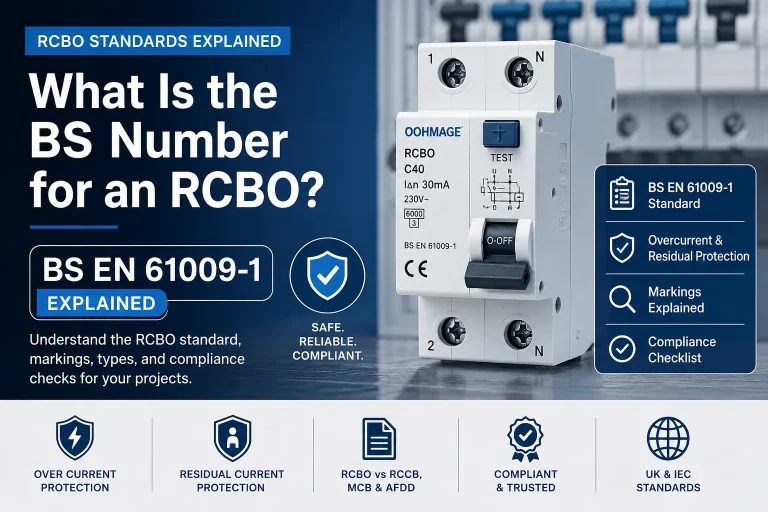
Introduction If you are searching for the RCBO BS number, the answer most commonly required in UK and IEC-based electrical procurement is BS EN 61009-1. This is the principal product standard associated with residual current circuit breakers with overcurrent protection used in residential, commercial, and similar installations. However, merely the BS number is not sufficient […]