Types of Circuit Breakers: How MCB, MCCB, RCCB and RCBO Differ
Published: Author: Conor
The main types of circuit breakers used in low-voltage distribution include miniature circuit breakers (MCBs), molded case circuit breakers (MCCBs) and residual-current devices such as RCCBs and RCBOs. They are not interchangeable. MCBs and MCCBs are selected for overcurrent protection in different circuit roles, an RCCB provides residual-current protection without integral overcurrent protection, and an RCBO combines residual-current and overcurrent protection in one device.
This guide focuses on the low-voltage product families that OOHMAGE supplies. It explains what each device does, where it may fit in a protection arrangement and which details a buyer should confirm before discussing a model or quotation. It does not cover medium-voltage or high-voltage breaker families that fall outside this product scope.
This is a product-family classification guide, not a project-specific circuit-breaker selection study. It does not replace fault-current calculations, coordination work, local-code review or confirmation against the selected model documentation.
What Are the Main Types of Circuit Breakers?
For many low-voltage panels and distribution projects, the practical starting list is:
MCB: overcurrent protection for branch and final circuits;
MCCB: overcurrent protection for feeders, distribution and other applications that require a different frame, rating range or protection arrangement;
RCCB: residual-current protection without integral overcurrent protection;
RCBO: residual-current protection with integral overcurrent protection;
DC circuit breaker: a breaker with published ratings for the relevant DC system and application.
Surge protective devices are frequently discussed beside these products, but an SPD is not a circuit breaker. It serves a different role by limiting surge voltage and diverting surge current within a coordinated protection arrangement.
These names identify product families. They do not by themselves determine the final model, rating, pole configuration, breaking capacity or suitability for a particular installation. Selection still depends on the circuit role, system data, fault conditions, local requirements and the published parameters of the chosen series.
Three Useful Ways to Classify Low-Voltage Breakers
Long lists of breaker names can make selection harder because they mix several classification methods. A clearer approach is to ask three separate questions.
1. What protection function is required?
Overcurrent protection responds to overload and short-circuit conditions according to the design and ratings of the selected device. Residual-current protection responds to an imbalance associated with current flowing through an unintended path. Some devices provide one function; others combine both.
This distinction separates RCCBs from RCBOs. In IEC terminology, an RCCB is a residual-current operated circuit breaker without integral overcurrent protection, while an RCBO includes integral overcurrent protection. The surrounding circuit arrangement must reflect that difference.
2. Where is the device used in the distribution arrangement?
A branch circuit, feeder, distribution incomer and machine circuit do not automatically use the same breaker family. An MCB may be considered for branch circuits, while an MCCB may be considered for feeder or distribution duties where the required frame and protection arrangement differ. The product label alone does not establish suitability; the actual system and coordination study remain important.
3. Is the system AC or DC?
AC and DC applications must be matched to product ratings published for the relevant system. A breaker that has an AC rating should not be assumed to have an equivalent DC rating. DC selection also requires attention to system voltage, pole arrangement, fault conditions and the manufacturer's connection instructions for the specific series.
Keeping these three questions separate prevents common category errors. It also creates a more useful inquiry: instead of requesting “a breaker” without context, a buyer can state the protection function, circuit position and electrical system first.
Quick Comparison of Common Low-Voltage Protection Devices
Device
Main protection role
Common position or use
Confirm before model selection
MCB
Overcurrent protection
Branch or final circuits in suitable low-voltage boards and equipment
Application, system voltage, rated current, poles, trip-curve requirement, breaking capacity, AC or DC use and quantity
MCCB
Overcurrent protection in a different frame and protection arrangement
Feeders, distribution panels, equipment and selected AC or DC projects
System voltage, rated current, poles, required breaking capacity, trip unit, accessories, installation and quantity
RCCB
Residual-current protection without integral overcurrent protection
Circuits where residual-current protection is coordinated with separate overcurrent protection
Electrical arrangement, residual-current requirement, ratings, poles, overcurrent coordination and local requirements
RCBO
Residual-current and overcurrent protection in one device
Individual circuits requiring both functions
Circuit application, ratings, poles, residual-current requirement, breaking capacity, system and market requirements
SPD
Limits surge voltage and diverts surge current; not a circuit breaker
Selected points in a coordinated surge protection arrangement
AC or DC system, installation point, SPD type/project requirement, system parameters, backup protection and documents
The table is a product-family comparison, not a design calculation. A final selection should be checked by a qualified person against the installation, available fault current, conductor and load requirements, coordination needs, local rules and the selected model documentation.
MCB: Branch-Circuit Overcurrent Protection
An MCB, or miniature circuit breaker, is commonly used for overcurrent protection in branch and final circuits. It is frequently installed in distribution boards, control panels and equipment where the selected series is suitable for the electrical system and application.
An MCB is not selected by rated current alone. The buyer may also need to confirm:
AC or DC system and system voltage;
current rating required for the circuit design;
number of poles;
trip curve or operating characteristic required for the load;
required breaking capacity based on the available fault current;
installation and environmental conditions;
accessories or indication requirements;
destination market and applicable documentation;
quantity and packaging requirements.
Trip curves are especially important when loads have different starting or inrush characteristics. However, a letter printed on a breaker is not a substitute for a circuit study. The curve, rated current and breaking capacity must work together with the conductor, load, upstream device and expected fault conditions.
The applicable product standard also depends on the device and intended use. For example, IEC 60898-1 addresses certain AC circuit breakers for overcurrent protection in household and similar installations. Other low-voltage circuit breakers may fall under IEC 60947-2. A model should therefore be checked against its own technical documentation instead of assigning one standard to every MCB by default.
For a sourcing discussion, begin with the application and known electrical requirements. If a panel schedule or single-line diagram is available, it can help identify the roles of the required MCBs without turning the inquiry into a guess based only on ampere values.
An MCCB, or molded case circuit breaker, is commonly considered for feeders, distribution panels, industrial equipment and other low-voltage applications where the required frame, ratings or protection arrangement differ from a typical branch-circuit MCB.
The spelling “molded case circuit breaker” is common in American English, while “moulded case circuit breaker” is common in British and international search. Both refer to the MCCB product category. The final device still has to be chosen from a series whose published parameters match the project.
MCCB selection may involve more variables than a simple product-family comparison:
system voltage and AC or DC application;
rated current and frame requirements;
number of poles;
available fault current and required breaking capacity;
thermomagnetic or electronic trip-unit requirement, where offered by the series;
fixed or adjustable protection settings, where applicable;
isolation, switching and coordination requirements;
auxiliary contacts, shunt trip, undervoltage release or other required accessories;
enclosure and installation conditions;
destination market, required documents and quantity.
Not every MCCB series offers the same ratings, adjustment functions or accessories. A maximum shown on one model page must not be applied to the entire category. AC and DC ratings also need to be checked separately. For DC projects, use a model with published DC parameters and follow the manufacturer's specified pole and connection arrangement.
Breaking capacity deserves explicit confirmation. It describes the breaker's ability under specified short-circuit conditions and must be considered against the prospective fault level and the relevant rating definitions. It should not be selected from a generic rule of thumb or an unverified reading from a basic meter.
When requesting a quotation, include the required current, voltage, poles, breaking capacity, trip-unit preference, accessories, application, quantity and destination market. That information makes it possible to compare the suitable MCCB series without presenting an unsupported universal range.
RCCB: Residual-Current Protection Without Integral Overcurrent Protection
An RCCB is a residual-current operated circuit breaker without integral overcurrent protection. It monitors the balance of current in the conductors that pass through its sensing arrangement and operates when the residual-current condition reaches the device's specified operating criteria.
The phrase “without integral overcurrent protection” is essential. An RCCB should not be described as if it automatically replaces the overcurrent protection required for the circuit. The electrical arrangement must include suitable overcurrent protection and coordination where required.
An RCCB discussion should identify:
the intended residual-current protection function;
electrical system and circuit arrangement;
rated current and poles;
required residual operating characteristics;
the separate overcurrent protection and coordination arrangement;
destination-market and installation requirements;
quantity and documentation needs.
Residual-current device terminology and requirements can vary between markets and applications. The product type, operating characteristics and installation method should be confirmed against the selected model and local rules. An article can explain the device's role, but it cannot determine the protective arrangement for an unknown installation.
This distinction is also useful for procurement. If the project list simply says “RCD,” the buyer should confirm whether the requirement is for an RCCB without integral overcurrent protection, an RCBO with integral overcurrent protection, or another residual-current device defined by the project specification.
RCBO: Residual-Current and Overcurrent Protection in One Device
An RCBO is a residual-current operated circuit breaker with integral overcurrent protection. It combines the residual-current function and overcurrent protection within one device for the circuit it serves.
That combined role can simplify the product-family decision, but it does not remove the need to confirm ratings and system details. An RCBO inquiry should normally include:
destination market and documentation requirements;
quantity and packaging requirements.
The choice between an RCBO and an arrangement using an RCCB with separate MCBs is a system and project decision. An RCBO can provide both functions for an individual circuit, while an RCCB-plus-MCB arrangement separates the residual-current and overcurrent devices. The appropriate option depends on circuit organization, coordination, continuity requirements, panel design, local rules and the products specified for the project.
Do not assume that every RCBO has the same residual-current type, trip curve, pole arrangement or short-circuit rating. Compare the actual series and model documentation. If the inquiry concerns a distribution box, include the number of circuits, available layout and any device-width or busbar requirements known to the panel designer.
An SPD is not a circuit breaker. In IEC 61643 terminology, a low-voltage surge protective device is intended to limit surge voltage and divert surge current. It is selected and coordinated as part of the wider protection arrangement for transient overvoltage.
This matters because a circuit breaker and an SPD answer different questions. A breaker is selected for its specified switching and protection functions under the applicable conditions. An SPD is selected for the surge environment, electrical system, installation point, protection arrangement and its own published ratings.
An SPD inquiry may need the following information:
AC, DC or photovoltaic system;
system voltage and earthing arrangement where relevant;
installation point and required protection stage;
SPD type or test class required by the project;
available upstream or backup protection arrangement;
required poles or protection modes;
destination market, quantity and technical documents.
Do not copy an AC SPD rating into a DC or photovoltaic application. Use a product series intended for the relevant system and confirm the model parameters and coordination requirements.
A useful shortlist begins with the project, not with a collection of similar-looking devices. The following sequence can make an inquiry more efficient.
1. Define the circuit role
State whether the product is intended for a branch circuit, feeder, incomer, machine, control panel, distribution board, solar/DC circuit or another identified position. If several devices are required, list each position separately.
2. Identify the protection function
Clarify whether the circuit needs overcurrent protection, residual-current protection, both functions in one device, or surge protection as part of the wider arrangement. This separates MCB/MCCB, RCCB/RCBO and SPD requirements before model selection begins.
3. Provide the electrical data already known
Include system voltage, AC or DC use, rated current, poles, required breaking capacity, trip characteristic, residual-current requirement and any known coordination or accessory needs. Do not invent missing values; mark them for confirmation.
4. Add order and market information
State the quantity, destination market, packaging or branding requirements and required technical or certification documents. Documentation should be checked for the selected series and order rather than assumed from a general category statement.
5. Confirm the selected series before ordering
Compare the shortlist with the published model parameters, drawings and required documents. Resolve differences in voltage, poles, rating definitions, dimensions, connection arrangement or accessories before the quotation and order are finalized.
What are the most common low-voltage circuit breaker types?
Common low-voltage types include MCBs for branch-circuit overcurrent protection and MCCBs for feeder, distribution and other applications that require a different frame or protection arrangement. RCCBs provide residual-current protection without integral overcurrent protection, while RCBOs combine residual-current and overcurrent protection.
What is the difference between an MCB and an MCCB?
Both are circuit breakers used for overcurrent protection, but they are commonly applied in different circuit roles and product arrangements. The choice depends on the system voltage, current, poles, fault level, required breaking capacity, trip characteristics, accessories, installation and the published parameters of the selected series.
What is the difference between an RCCB and an RCBO?
An RCCB provides residual-current protection without integral overcurrent protection. An RCBO includes residual-current and overcurrent protection in one device. An RCCB therefore needs to be considered together with the circuit's overcurrent protection arrangement.
Is an SPD a type of circuit breaker?
No. An SPD is not a circuit breaker. It is used within a coordinated protection arrangement to limit surge voltage and divert surge current associated with transient overvoltage.
Can an AC circuit breaker be used in a DC system?
Only use a breaker in a DC system when the selected model has published DC ratings and is installed according to the manufacturer's DC connection requirements. Do not assume that an AC rating applies to DC use.
What details are needed for a circuit breaker quotation?
Provide the application, circuit role, AC or DC system, voltage, current, poles, required breaking capacity, trip or residual-current requirement, accessories, quantity, destination market and required documents. If some values are not yet known, provide the diagram or application information available and identify what still needs confirmation.
Discuss Your Product Requirements
The correct product family is the first decision, not the last. Once the protection function and circuit role are clear, compare the actual MCB, MCCB, RCCB or RCBO series against the system and order requirements.
Send your application, known ratings, quantity and destination market to discuss a practical low-voltage protection product shortlist.
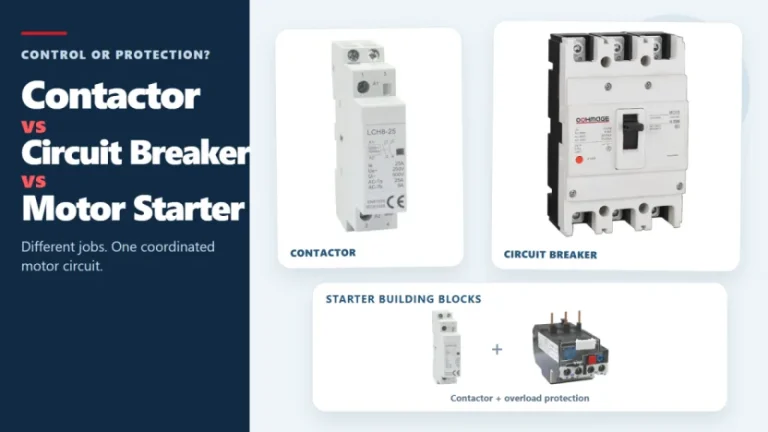
Figure 1. Contactors, circuit breakers, and motor starters solve different control and protection tasks. These three devices often appear in the same motor-control panel, but they solve different problems. A contactor handles frequent, remote, or automatic switching during normal operation. A circuit breaker interrupts abnormal current within its rated capability. A motor starter normally combines […]
Introduction The concept of remote tripping is simple, but in actual operation, project teams often encounter difficulties in specifying the components. The panel factory may require circuit breakers triggered by fire alarm relays, PLC outputs, building management system instructions, or other coordinated control. At this point, “diversion tripping” is only the first step in the […]
Introduction The kA rating refers to the maximum short-circuit current that a circuit breaker can safely interrupt under specified conditions. For MCCB, this value constitutes a part of its interrupting capacity rather than its normal rated operating current. Choosing the correct kA rating helps to prevent the circuit breaker from malfunctioning when the fault current […]