Do you have an idea of what is electrical distribution? Electrical distribution is the vital process that delivers electricity from high-voltage transmission lines to homes, businesses, and industries, powering everything from lights to electric vehicle chargers.
Read the following content, and this guide will give you an answer.
What is Electrical Distribution
Electrical distribution is the final stage of delivering electricity to end-users, bridging the gap between high-voltage transmission systems and consumers like households, offices, and factories.
It involves a network of substations, transformers, power lines, switchgear, and meters that ensure electricity reaches customers at safe, usable voltages.
The process is divided into primary distribution, which delivers high-voltage power (typically 11kV–33kV) to large industrial or commercial users, and secondary distribution, which steps down voltage (e.g., 120V–240V) for residential and small commercial use.
Distribution systems are designed for reliability, safety, and efficiency, adapting to local needs and infrastructure.
Primary vs Secondary Distribution
Primary Distribution: High-voltage lines carry electricity from substations to large consumers or secondary networks. Common voltages include 11kV, 22kV, or 33kV, depending on the region.
Secondary Distribution: Low-voltage lines deliver power to homes and small businesses, typically at 120V (U.S.) or 230V (Europe). (Learn more about Low Voltage Systems)
Types: There are three main types of distribution systems: radial, ring, and network (mesh). Radial systems are simpler and used in rural areas, while ring and network systems offer greater reliability in urban settings.
Electricity flows through a three-stage grid: generation, transmission, and distribution.
Power plants generate electricity, which is sent over long distances via high-voltage transmission lines (69kV–765kV) to minimize energy loss. The distribution system then takes over, transforming and delivering this power to end-users.
The Distribution Process
Substations: Step-down transformers reduce transmission voltages to primary distribution levels (e.g., 11kV).
Distribution Lines: Overhead or underground lines carry power to neighborhoods or industrial zones.
Service Drops: Individual connections deliver electricity to homes or businesses, often via meters to track usage.
Safety is critical, governed by standards like OSHA 1910.269 (U.S.) and IEC guidelines globally, which mandate practices like grounding (read more about Grounding in Surge Protection) and equipment maintenance to protect workers and consumers. The process ensures electricity is reliable, safe, and accessible.
Developed Nations: Focus on smart grids, EV support, and renewable integration (e.g., California’s grid upgrades).
Developing Nations: Prioritize electrification and loss reduction (e.g., India’s Saubhagya scheme, which electrified 26 million households).
Africa: Off-grid solar and microgrids expand access in rural areas, bypassing traditional grids.
Case Studies:
U.S.: California’s grid supports 1 million EVs with dedicated charging infrastructure.
India: Reduced distribution losses from 30% to 15% through metering and upgrades.
Africa: Kenya’s off-grid solar powers 1.5 million rural households.
Final Thoughts
Electrical distribution is the backbone of modern energy systems, delivering power reliably and safely to billions.
From smart grids to EV charging, it’s evolving to meet sustainability and resilience goals. Explore related topics like transmission or renewable energy to deepen your understanding, or try our interactive grid simulator below.
FAQ
What is electrical distribution and why is it important?
Electrical distribution is the process of delivering electricity from high-voltage transmission lines to end-users like homes, businesses, and factories. It ensures that power reaches consumers safely, efficiently, and at usable voltages.
What’s the difference between primary and secondary distribution?
Primary distribution carries high-voltage electricity (typically 11kV–33kV) to industrial and commercial users. Secondary distribution steps this voltage down (e.g., to 120V or 230V) for residential and small business use.
What are the main types of electrical distribution systems?
There are three main types:
Radial systems (simple, cost-effective, but prone to outages)
Ring systems (looped for backup paths, common in urban areas)
Network or mesh systems (interconnected for high reliability, used in cities and critical infrastructure)
How is electricity transmitted and distributed?
Electricity is generated at power plants, transmitted over high-voltage lines, then stepped down at substations. Distribution lines then deliver electricity to neighborhoods and buildings through overhead or underground cables.
What modern technologies are shaping electrical distribution?
Smart grids, renewable energy integration, electric vehicle (EV) infrastructure, energy storage, and microgrids are transforming how electricity is distributed for better efficiency, reliability, and sustainability.
Why are smart grids important in modern distribution systems?
Smart grids use sensors, automation, and data analytics to monitor power flow, reduce outages, improve response times, and integrate renewable energy sources more effectively.
What challenges do distribution systems face today?
Key challenges include aging infrastructure, grid reliability during extreme weather, and adapting to variable power from renewables. Solutions involve grid upgrades, smart technologies, and decentralized energy resources.
What safety standards apply to electrical distribution?
In the U.S., OSHA 1910.269 and IEEE standards govern worker and system safety. Globally, IEC standards are widely used. These ensure proper grounding, equipment maintenance, and safe operation procedures.
Figure 1. Contactors, circuit breakers, and motor starters solve different control and protection tasks. These three devices often appear in the same motor-control panel, but they solve different problems. A contactor handles frequent, remote, or automatic switching during normal operation. A circuit breaker interrupts abnormal current within its rated capability. A motor starter normally combines […]
The main types of circuit breakers used in low-voltage distribution include miniature circuit breakers (MCBs), molded case circuit breakers (MCCBs) and residual-current devices such as RCCBs and RCBOs. They are not interchangeable. MCBs and MCCBs are selected for overcurrent protection in different circuit roles, an RCCB provides residual-current protection without integral overcurrent protection, and an […]
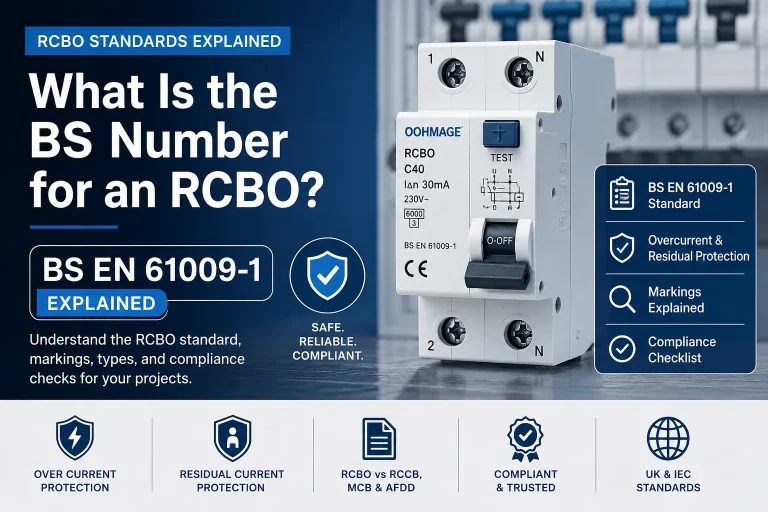
Introduction If you are searching for the RCBO BS number, the answer most commonly required in UK and IEC-based electrical procurement is BS EN 61009-1. This is the principal product standard associated with residual current circuit breakers with overcurrent protection used in residential, commercial, and similar installations. However, merely the BS number is not sufficient […]