What Is the BS Number for an RCBO? BS EN 61009-1 Explained
Published: Author: Joanna
Introduction
If you are searching for the RCBO BS number, the answer most commonly required in UK and IEC-based electrical procurement is BS EN 61009-1. This is the principal product standard associated with residual current circuit breakers with overcurrent protection used in residential, commercial, and similar installations.
However, merely the BS number is not sufficient as a basis for approval or procurement decisions. Engineers, distribution cabinet manufacturers, and the procurement team must also evaluate the rated current, residual operating current, breaking capacity, equipment type, and relevant conformity certificates. Referencing standards is only one aspect of ensuring overall compliance.
This guide explains the meaning of the BS standard number for RCBO and its connection with the IEC and EN systems. It also introduces how to interpret the markings on actual equipment and clarifies how to verify in actual purchasing scenarios whether the products comply with the standards.
What Is the BS Number for an RCBO?
The RCBO BS number most commonly referenced in UK projects is:
BS EN 61009-1 BS EN 61009-1
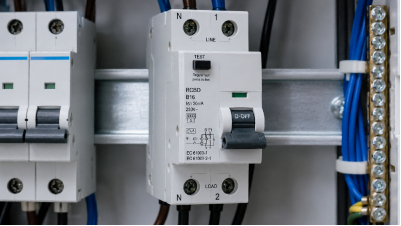
An RCBO (Residual Current Breaker with Overcurrent protection) combines two protective functions in a single device:
Residual current protection (earth leakage protection)
Overcurrent protection (overload and short-circuit protection)
The “BS EN” prefix indicates British adoption of a European Norm, while “61009” identifies the product family for RCBOs. The “-1” part typically refers to general requirements for devices of this category.
In terms of procurement, this number helps identify the product standard series, but it does not guarantee its applicability to all installation scenarios. The buyer is still required to confirm:
Rated current (In)
Residual operating current (IΔn)
Breaking capacity (Icn)
Tripping curve and pole configuration
Manufacturer declaration and certification scope
For practical RCBO selection guidance, related product information can be found here: RCBO
What Does BS EN 61009-1 Cover?
The BS EN 61009-1 standard specifies the general performance and safety requirements for RCBOs (Residual Current Operating Circuit Breakers with Overcurrent Protection) used in domestic and similar fixed installations.
In practical engineering terms, it typically covers:
Operating characteristics under residual current conditions
Overcurrent protection behaviour under overload and short-circuit conditions
Dielectric and insulation performance
Temperature rise limits during continuous operation
Mechanical endurance (switching cycles)
Marking and identification requirements
Type testing and routine testing conditions
This standard does not specify specific installation rules, but rather ensures that the RCBO exhibits predictable characteristics under the specified test conditions.
For instance, a purchasing engineer who is responsible for specifying RCBOs for British distribution boards might make the following request:
BS EN 61009-1 compliance evidence
Test reports for specific breaking capacity
Manufacturer declaration matching the exact model number
This ensures that the equipment is not only correctly identified, but also has the necessary, verifiable documentation that meets the project requirements.
BS EN 61009 vs IEC 61009-1: What Is the Difference?
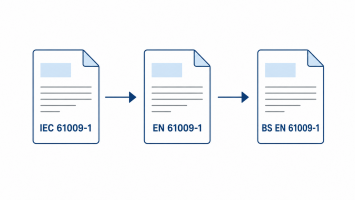
The RCBO standard exists in multiple adoption layers:
IEC 61009-1 IEC 61009-1 – International base standard
EN 61009-1 – European adoption
BS EN 61009-1 – British national adoption
These standards are structurally consistent, but their prefixes indicate the jurisdictional area over which the standards have been adopted and promulgated.
In procurement practice, this matters because:
UK project specifications often explicitly require BS EN standards
European tenders may reference EN standards
International projects may accept IEC standards with local deviations
A common verification mistake is assuming equivalence guarantees approval. In reality, engineers must compare:
Edition year and amendments
Certification scope for the exact model
Any national deviations in the project specification
How to Read the Standard and Safety Markings on an RCBO
Understanding the markings of RCBO products is crucial for verifying whether the equipment meets the standards stated in its declaration.
These markings are usually found on the label on the front of the device, on the side casing, on the packaging, or on the technical parameter table; however, the level of detail provided by different sources may vary.Practical RCBO marking checklist:
Manufacturer name and model number
Applicable standard reference (e.g., BS EN 61009-1)
Rated current (In)
Residual operating current (IΔn)
Breaking capacity (Icn)
Rated voltage (Ue)
Frequency rating (Hz)
Tripping characteristic
Pole configuration (1P+N, 2P, etc.)
RCD type (AC, A, F, B where applicable)
Terminal or line/load orientation
Certification or conformity reference (if applicable)
In procurement, it is often encountered that the rated current (for example, 40A) and the remaining working current (for example, 30mA) are confused. It should be noted that these two values represent completely different protection functions and must not be confused.
In addition, the product labels must be checked against the manufacturer’s technical parameter table and the conformity declaration. Just having printed marks is not sufficient to pass the project approval.
RCBO, RCCB, MCB, and AFDD Standards Compared
Even though the functions are similar, the product standards followed by different protective equipment are still different.
Device
Main Function
Common Standard
RCBO
Overcurrent + residual current protection
BS EN 61009-1
RCCB
Residual current only
BS EN 61008-1
MCB
Overcurrent protection only
BS EN 60898-1
AFDD
Arc fault detection
BS EN 62606
The modular protection device may involve multiple functional requirements, but this does not replace the necessity of conducting system-level coordination analysis during actual installation.
Does the BS Number Change for Different RCBO Types?
The basic standard BS EN 61009-1 remains the reference for most types of RCBO, but depending on the design type, additional requirements may apply.
Type B RCBO
For the smooth DC residual current, type B equipment may introduce additional performance considerations. In certain cases, depending on the design scope, reference standards such as BS EN 62423 may also be applicable.
Double-Pole RCBO
Pole configuration does not change the core product standard. However, electrical system compatibility and switching arrangement must still be verified.
Bidirectional RCBO
Bidirectional suitability is not guaranteed by the BS number alone. Line/load directionality, internal design, and manufacturer instructions must be checked.
AFDD Combined RCBO
When arc fault detection is integrated, the device may need to comply with both RCBO and AFDD-related standards. Always confirm the declared conformity scope for the exact model.
How to Verify RCBO Compliance Before Purchasing
Before approving an RCBO for procurement or installation, a structured verification process is recommended.
Procurement checklist:
Match model number across datasheet, label, and certificate
Confirm BS EN 61009-1 reference on official documentation
Review rated electrical values against project specification
Check breaking capacity suitability for system fault levels
Verify RCD type compatibility (AC, A, F, B)
Confirm test report scope applies to the exact model
Review certification body details where applicable
Ensure batch traceability for quality control
Validate manufacturer technical support availability
Compliance should always be tied to the exact model, not a generic product family description.
Which Standard Should Buyers Use in the UK and IEC Markets?
In the UK, project specifications commonly reference BS EN standards, meaning BS EN 61009-1 is the expected baseline for RCBOs.
In other IEC-aligned regions:
EN standards may be used directly in European specifications
IEC standards may be referenced in international tenders
Local national deviations may apply depending on grid authority rules
Importantly, compliance is not automatically transferable between regions. A device accepted in one market may still require additional certification evidence in another.
How OOHMAGE Can Support RCBO Selection and Documentation
In practical procurement workflows, buyers often need more than a standard reference. They may require:
Model-specific datasheets
Certification and test documentation
Configuration guidance for panel design
Sample units for validation
Project-based quotation support
The coordination between engineers and suppliers in the early stage helps to reduce specification errors and ensures that the selected RCBO complies with the electrical and technical documentation requirements.
Final Thoughts
In projects in the UK and those based on IEC standards, the most commonly cited BS standard related to RCBOs is BS EN 61009-1. However, this standard should only be regarded as a starting point for selection, rather than the sole basis for determining compliance.
The actual selection requires comprehensive consideration of the equipment’s rated parameters, verified supporting documents, system failure levels, and the specific requirements of the project. Before making the final purchasing decision, engineers must ensure that the specific model’s compliance proof is confirmed.
RCBO BS Number FAQs
1. What is the BS number for an RCBO?
When referring to RCBOs (Residual Current Breakers with Overcurrent Protection), the most commonly cited BS standard number is BS EN 61009-1; this standard sets out the general requirements for such breakers in electrical installations in the UK and those based on IEC standards.
2. Is an RCBO covered by BS EN 61009-1?
Yes, most standard RCBOs used in residential and similar applications are designed and tested according to BS EN 61009-1. However, buyers must confirm the exact model’s compliance documentation.
3. What is the difference between BS EN 61009-1 and IEC 61009-1?
IEC 61009-1 is the international base standard, while BS EN 61009-1 is its British adoption. The technical requirements are aligned, but the prefix reflects regional publication and adoption.
4. Is BS EN 61008 for an RCBO or RCCB?
BS EN 61008-1 applies to RCCBs (residual current devices without overcurrent protection), not RCBOs.
5. Does a Type B RCBO need an additional standard?
In some cases, Type B functionality may require additional standards depending on design and manufacturer declaration. Always verify the datasheet for the exact compliance scope.
6. How can a buyer verify RCBO compliance?
The buyer should cross-check the model, data sheet, test report and certification documents to ensure that they comply with the requirements of the BS EN 61009-1 standard and the project specifications.
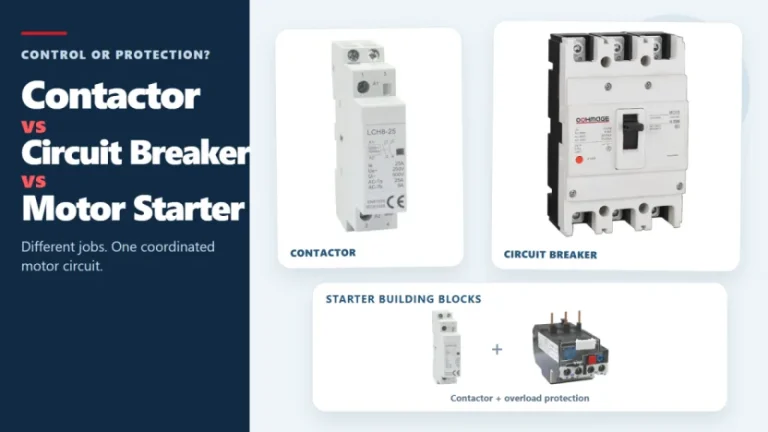
Figure 1. Contactors, circuit breakers, and motor starters solve different control and protection tasks. These three devices often appear in the same motor-control panel, but they solve different problems. A contactor handles frequent, remote, or automatic switching during normal operation. A circuit breaker interrupts abnormal current within its rated capability. A motor starter normally combines […]
The main types of circuit breakers used in low-voltage distribution include miniature circuit breakers (MCBs), molded case circuit breakers (MCCBs) and residual-current devices such as RCCBs and RCBOs. They are not interchangeable. MCBs and MCCBs are selected for overcurrent protection in different circuit roles, an RCCB provides residual-current protection without integral overcurrent protection, and an […]
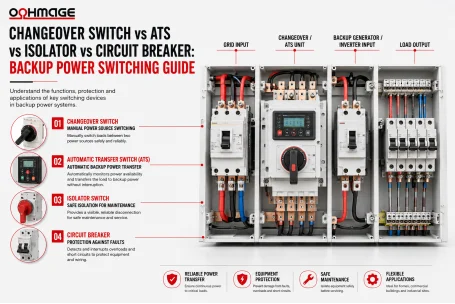
Introduction When a small factory experiences a power outage during production, the backup generator immediately starts up; at this point, the electrical team needs to perform load switching, while also ensuring that no reverse power supply (reverse feed) is sent to the grid and that maintenance personnel do not come into contact with live equipment. […]