What Is a Shunt Trip? How It Works in Circuit Breakers and What Buyers Should Specify
Published: Author: Joanna
Introduction
The concept of remote tripping is simple, but in actual operation, project teams often encounter difficulties in specifying the components. The panel factory may require circuit breakers triggered by fire alarm relays, PLC outputs, building management system instructions, or other coordinated control. At this point, “diversion tripping” is only the first step in the specification.
The functions of diversion tripping instructions, protection tripping, and status signals are different. This guide explains their principles, compares related components, and provides a practical quotation list. This article does not cover terminal-level wiring or renovation methods. The final selection, installation, and testing must strictly follow the product documentation and be confirmed by professional project review.
What Is a Shunt Trip Circuit Breaker?
The phrase “shunt trip circuit breaker” commonly describes a circuit breaker fitted with a compatible shunt-trip release. The release is an accessory linked to the breaker’s trip mechanism. When the specified external control supply is applied to the shunt-trip coil, the accessory actuates the mechanism so that the breaker’s main contacts open.
The important distinction is what the shunt trip does not do. It is not the device that measures load current and decides that an overload or short circuit has occurred. Those protective functions belong to the breaker and its trip unit or protective mechanism. The shunt trip adds a separate command path for opening the breaker from an external control system.
This distinction matters during procurement. Two breakers with similar current ratings may use different accessory families, mounting arrangements, control voltages, or installation permissions. Official manufacturer documentation therefore ties shunt-trip releases to specific breaker ranges rather than treating them as interchangeable parts.
Related OOHMAGE category: MCB accessories. Use the category for accessory context only; exact shunt-trip compatibility should be confirmed from a current product-level record.
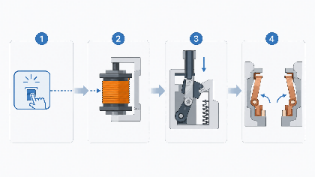
How Does a Shunt Trip Release Work?
Shunt tripping is a mechanical action triggered from the outside. The control circuit does not need to replicate the overload or short-circuit detection functions of the circuit breaker; it only needs to send instructions to the auxiliary device, which then acts on the circuit breaker mechanism.
Issue an external command.
The external trip request is sent through relays, alarm interfaces, PLC outputs, or BMS commands, etc. The acceptable signal sources and interfaces must be confirmed according to the project and accessory documentation.
The shunt trip coil is energized
The accessory obtains its specified control voltage. The AC/DC type, voltage range, load capacity, and allowed control methods must be verified based on the specific accessory, rather than inferred from the experience of other circuit breaker series.
The release action triggers the trip mechanism
The electrical energy in the coil is converted into the movement of the deactivation release device, which acts on the trip mechanism of the circuit breaker.
The main contacts of the circuit breaker open
The circuit breaker enters the trip/open state according to its own design, cutting off the main power path. The reset and re-closure operations must be carried out in accordance with the manufacturer’s documentation of the selected circuit breaker and accessory.
Although the manufacturer’s documentation supports the aforementioned universal sequence, it also reveals an issue that buyers must confront when comparing across brands: although the functions are the same, the implementations vary. ABB refers to the relevant module as “split-tripping” and describes it as having remote disconnection capabilities; Mitsubishi distinguishes the split-tripping from the status indicator and under-voltage accessories; Schneider Electric’s documentation also lists its split-tripping accessories by circuit breaker families and control power supplies.
These examples repeatedly point to the same conclusion: the functions are universal, but the implementation methods depend on the specific model.
Shunt Trip vs a Standard Breaker Trip
The standard protection trip is triggered by the internal protection system of the circuit breaker, while the parallel trip comes from an external command. Both can ultimately disconnect the same set of main contacts, but the triggering sources and selection logic are completely different.
Point
Shunt trip
Standard protective trip
Trigger
External control command applied to a compatible release
Breaker protection senses a condition covered by its protective function
Primary purpose
Remote or coordinated opening command
Protection against specified electrical fault/overcurrent conditions
Sensing source
External control system or command circuit
Breaker trip unit or protective mechanism
Selection implication
Confirm accessory compatibility and control details
Confirm breaker ratings, trip characteristics, and protection requirements
One of the common purchasing misunderstandings is to regard the shunt trip as an enhancement of the overload or short-circuit protection function of the circuit breaker. However, this is not the case. The circuit breaker itself still needs to be independently selected based on factors such as system voltage, rated current, fault conditions, pole number, protection characteristics, and other requirements, and is unrelated to whether a remote tripping accessory is equipped.
Shunt Trip vs Undervoltage Release vs Auxiliary Contact
These accessories often appear simultaneously in the same circuit breaker series, but they have different functions. The table below distinguishes between remote tripping, voltage-dependent tripping, status signals, and the protection functions of the circuit breaker itself.
Function
Typical trigger
Result/action
Primary purpose
Buyer must check
Common ordering mistake
Shunt trip
Specified external control voltage energizes the release
Initiates breaker opening
Remote or coordinated trip command
Exact breaker family/model, accessory code, control supply, installation arrangement
Ordering only by coil voltage or assuming cross-series compatibility
Undervoltage release
Control/supply voltage falls or is removed according to the specific device design
Causes or maintains trip/open behavior as designed
Voltage-dependent release/interlock function
Exact UVR documentation, voltage behavior, breaker compatibility, reset/reclose conditions
Treating it as the same function as a shunt trip
Auxiliary contact
Breaker mechanical state changes
Changes a signalling contact state
Remote indication/interlocking/status feedback
Contact function, ratings, state logic, compatibility
Expecting an auxiliary contact to open the main circuit by itself
Standard protective trip
Breaker protection detects a covered electrical fault/overcurrent condition
Breaker opens through its protective trip mechanism
Circuit protection
Breaker rating, trip unit, fault duty, coordination and project requirements
Assuming a shunt-trip accessory replaces protection selection
The current accessory manual of Mitsubishi Electric clearly explains these differences: The auxiliary switch is a status indicator accessory, the shunt trip unit is a remote electrical trip device, and the under-voltage trip unit is an independent voltage-dependent function. The specific performance parameters still need to be based on the current technical documentation of the selected manufacturer.
Where Are Shunt Trips Used?
The pilot-operated trip function is used in scenarios where the circuit breaker needs to be disconnected by an external command rather than waiting for its own overcurrent or short-circuit protection to activate. The application of this function should be determined by the project control concept rather than based on the general assumption that “all installations require remote tripping”.
Possible system-design examples include:
Remote emergency shutdown, where an approved control system is intended to command a breaker open.
Alarm or protective relay commands that are designed to initiate disconnection as part of a coordinated control sequence.
PLC or building-management-system control where the breaker family and accessory are specifically intended for that interface.
Coordinated equipment shutdown sequences in industrial or commercial systems where breaker opening is one step in a wider control strategy.
This is merely an example and does not represent a universal requirement. Whether the flow control protection can be applied, enforced, prohibited, or implemented in what manner, depends on the specific equipment, system design, target market, and applicable project requirements.
What Buyers Must Confirm Before Ordering
A reliable trip-activated circuit breaker quote should be based on the precise circuit breaker model and control requirements. Simply stating “I need a 24V trip-activated circuit breaker” is usually not sufficient, as the same nominal control voltage may correspond to different accessory series, and not all circuit breakers support the same accessories or installation methods.
Buyer input
What to provide
Why it matters
Evidence to check
Exact breaker identity
Manufacturer, series/frame, model or catalog reference; clear nameplate photo when available
Accessory fit is tied to the breaker family and design
Current breaker/accessory catalog or datasheet
Required function
Remote trip / coordinated opening requirement
Prevents confusion with UVR, auxiliary signalling, motor operator, or protective trip
Project functional specification
Control supply
Required control voltage and whether AC or DC
Coil/control variants are product-specific
Exact accessory documentation
Accessory compatibility
Factory-fitted or permitted field-installation arrangement
Not all accessories are interchangeable or retrofit-permitted
Manufacturer instructions and accessory table
Breaker selection inputs
System voltage, rated current, poles, fault-duty/protection requirements
Shunt trip does not replace normal breaker selection
Breaker datasheet and project design
System interface
Relay, PLC, BMS, alarm, or other command source at a functional level
Ensures the intended command can be reviewed without guessing wiring
Control philosophy / interface documentation
Destination and documentation
Target market, requested documents, approvals if required
Requirements vary by product and market
Current product records and project requirements
Commercial details
Quantity, required timing, packaging or identification needs
Supports an accurate RFQ without implying availability
Supplier quotation review
When selecting a miniature circuit breaker, the compatibility of accessories must be based on the exact product series. According to the current MCB product line of OOHMAGE, some series support accessories such as shunt tripping, but the specific accessory models still need to be confirmed at the specific product level. The same principle applies to the selection of MCCB: it must be based on the precise circuit breaker frame/model and the current accessory data, and cannot be directly applied across different series.
Common Shunt-Trip Specification Mistakes
Most specification errors come from treating the accessory as a generic coil rather than part of a specific breaker system. Avoid the following shortcuts:
Confusing remote trip with overload or short-circuit protection. The shunt trip commands opening; it does not replace the breaker’s protective function.
Confusing a shunt trip with an undervoltage release. Their trigger logic and intended functions are different.
Ordering by control voltage alone. Voltage is only one field; the breaker family, accessory code, AC/DC type, and installation arrangement also matter.
Assuming cross-series or cross-brand compatibility. Similar-looking accessories can have different mechanical interfaces, electrical characteristics, or approvals.
Assuming any breaker can be retrofitted in the field. Field installation permission and procedure must come from the exact manufacturer documentation.
Assuming universal timing, duty, reset, or remote-reclose behavior. These details vary by breaker and accessory design and should not be generalized.
Misinformation GuardrailA shunt trip is an externally commanded trip function. It should not be described as a generic overcurrent detector, a substitute for the breaker trip unit, or a universally interchangeable accessory. Control voltage, duty, reset behavior, retrofit permission, and compatibility must be checked for the exact product.
RFQ Checklist for a Shunt-Trip Breaker or Accessory
The following replicable blocks are specifically designed for distributors, cabinet manufacturers, OEM purchasers, and technical purchasing teams. When making inquiries, providing these fields can reduce back-and-forth communication and provide suppliers with sufficient background information to facilitate compatibility reviews.
Copyable RFQ TemplateBreaker manufacturer: Breaker series / frame: Exact model or catalog number: Nameplate photo attached: Yes / No Required function: Remote shunt trip Required control voltage: Control supply: AC / DC Factory-fitted or field-installed preference, if known: System voltage / rated current / poles, if relevant to breaker selection: Destination market: Quantity: Required documentation: Project timing / required delivery window: Additional control-system notes:
If the circuit breaker model is not clear, clear photos of the nameplate and available project information should be provided instead of guessing the part code. OOHMAGE can review the information and discuss the subsequent selection, but compatibility, supply, certification and installation permits must be based on the current product-level documentation.
Compatible shunt trip device. When the external control power is turned on, it will drive the release coil to act, triggering the circuit breaker trip mechanism, thereby causing the circuit breaker to open. This command source can be part of an approved control system. The required voltage, AC/DC type, load, and interface parameters, etc., all depend on the selected accessory and the circuit breaker series.
Does a shunt trip protect against overload or short circuit?
No. The trip by de-energization only provides an external command path for breaking the circuit breaker, rather than its overload or short-circuit detection functions. The circuit breaker and its protection trip system still need to be selected based on the system voltage, current, fault load, protection coordination and other project requirements respectively.
Is a shunt trip the same as an undervoltage release?
No. The circuit breaker trip is usually triggered by applying a specified control voltage, while the under-voltage release operates according to different voltage-dependent functions based on the product design. The specific action characteristics, reset conditions, and control values must be confirmed by referring to the current manufacturer’s documentation of the selected circuit breaker and accessories.
Does a shunt trip need a separate control power supply?
The shunt trip coil requires the control power specified by this accessory. Whether the power is independent of other systems, how it is obtained, and the configuration of the command circuit are all issues that need to be addressed at the project level. It should be based on the specific circuit breaker/accessory documentation and qualified control system design, rather than adopting the default general solution.
Can a shunt-trip accessory be added to any MCB or MCCB?
No. The circuit breaker trip accessories are usually bound to specific circuit breaker series, frame and accessory interfaces. Some support on-site installation, while others may require different installation methods. It is necessary to consult the current MCB/MCCB model technical documentation to confirm compatibility, accessory codes, control power supply and installation permissions.
Can a shunt-trip breaker be reset remotely?
Don’t make such an assumption. The shunt trip device is only responsible for triggering the disconnection; the reset and re-closure depend on the circuit breaker design, accessory configuration, and any independent operating mechanism. If remote reset or re-closure is required, this should be clearly stated and the complete solution should be verified by the documentation of the selected manufacturer.
What information is needed for a quotation?
When making an inquiry, please provide the following information:
Manufacturer of the circuit breaker, specific series/model;
Required remote tripping function, control voltage, AC/DC type;
Target market, quantity and required documents;
Please attach clear photos of the nameplate as much as possible.
If you need to select the circuit breaker simultaneously, additional information such as system voltage, rated current, pole number and project protection requirements is also required.
Final Thoughts
The parallel trip function provides an external control means for the compatible circuit breakers for tripping. Its basic working principle is simple, but the specific specifications are not like this: the circuit breaker series, accessory codes, control power supply, installation method and operation behavior all need to be verified for specific products. Please handle the remote trip function separately from the conventional protection and status signals, and confirm the compatibility with a complete RFQ (Request for Quotation) before placing an order.The parallel trip function provides an external control means for the compatible circuit breakers for tripping. Its basic working principle is simple, but the specific specifications are not like this: the circuit breaker series, accessory codes, control power supply, installation method and operation behavior all need to be verified for specific products. Please handle the remote trip function separately from the conventional protection and status signals, and confirm the compatibility with a complete RFQ (Request for Quotation) before placing an order.
For related accessory categories, review OOHMAGE MCB accessories, or contact OOHMAGE with the exact breaker identity and control requirement for product-level review.
The main difference between RCCB Type A and Type AC is the residual-current waveform they are designed to detect. Type AC responds to sinusoidal alternating residual current. Type A also responds to pulsating DC residual current under its declared conditions. Schneider Electric’s technical FAQ explains this distinction. These labels do not mean that one RCCB […]
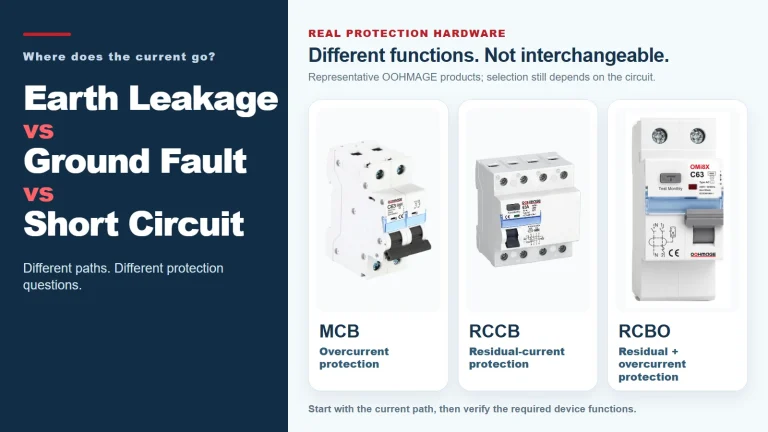
A report of “leakage,” a “ground fault,” or a “short” is not yet a diagnosis. Each term points to a current path, and each path may call for a different protection function. Earth leakage means current has left the intended live and neutral paths; it may be normal in electronic equipment or may indicate deteriorated […]
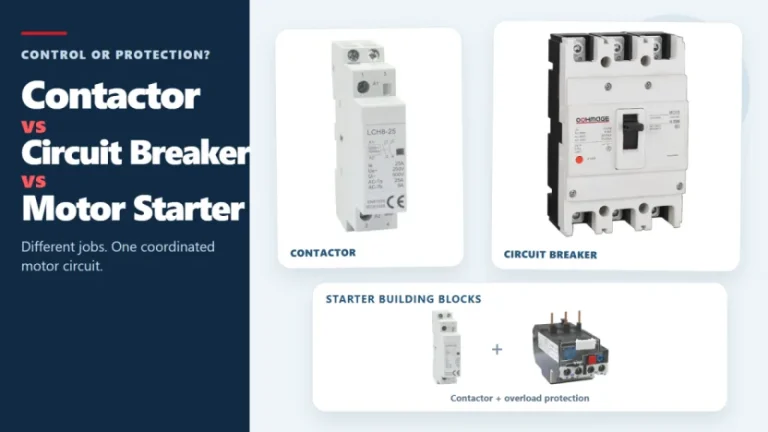
Figure 1. Contactors, circuit breakers, and motor starters solve different control and protection tasks. These three devices often appear in the same motor-control panel, but they solve different problems. A contactor handles frequent, remote, or automatic switching during normal operation. A circuit breaker interrupts abnormal current within its rated capability. A motor starter normally combines […]