Fuse Holder vs Fuse Switch: Differences, Uses, and Best Choice for You
Published: Author: Conor
When it comes to electrical protection, choosing the right components is essential for safety and performance. That’s why “Fuse Holder vs Fuse Switch” is a common comparison among engineers, electricians, and end-users. While both play crucial roles in circuit protection, they serve different purposes and applications. Understanding their differences will help you make the best choice for your needs.
What is a Fuse Holder?
A fuse holder is a device used to secure and connect a fuse to an electrical circuit. The primary function of a fuse holder is to hold the fuse in place and ensure proper electrical contact. It acts as a protective enclosure, allowing a fuse to disconnect from the circuit when it blows, preventing further damage or hazards.
A typical fuse holder consists of:
Body: The casing that holds the fuse in place and prevents it from coming into direct contact with other components.
Terminals: Metal contacts at both ends that connect the fuse holder to the circuit.
Fuse Contacts: Where the fuse connects within the holder, allowing electricity to flow through when the fuse is intact.
How It Works
The fuse holder connects the fuse in series with the electrical circuit. When an overload or short circuit occurs, the fuse element inside the fuse blows, interrupting the flow of electricity. The fuse holder ensures that the blown fuse is easily replaced without the need for complex disconnection procedures.
Types
There are several types of fuse holders, including:
Cartridge Fuse Holders: Typically used in higher current applications.
Blade Fuse Holders: Common in automotive applications, offering easy installation and removal.
Panel-Mount Fuse Holders: Installed directly into a panel or enclosure, offering secure mounting for fuses.
What is a Fuse Switch?
A fuse switch combines a fuse and a switch into a single unit. It allows the user to manually disconnect power to the circuit while also protecting it from overload or short circuits. A fuse switch is typically used in situations where the circuit may need to be regularly turned off or switched on while maintaining protection against electrical faults.
Key components of a fuse switch include:
Switch Mechanism: A lever or button that allows the user to control the circuit’s power manually.
Fuse Element: Similar to a fuse holder, the fuse inside the switch disconnescts the circuit when an overload or fault occurs.
Housing: The casing that protects the fuse and switch components.
How It Works
The fuse switch operates by interrupting the flow of electricity when a fault occurs, just like a fuse holder. However, it also enables manual control over the circuit. The switch allows users to turn the circuit off for maintenance or emergency situations without removing the fuse itself, offering more flexibility compared to fuse holders.
Types
Common types of fuse switches include:
Load Break Fuse Switches: Designed to interrupt current flow under load conditions.
Isolator Fuse Switches: Used for isolating electrical systems for safety during maintenance.
Switch Disconnector Fuse: A switch that can disconnect both the fuse and the power supply.
Key Differences Between Fuse Holders and Fuse Switches
While fuse holders and fuse switches both serve the purpose of protecting electrical circuits, they differ in their functionality, design, installation, and use cases.
Fuse holders are simpler, designed mainly to house and protect the fuse in a circuit, providing a reliable way to disconnect the circuit when the fuse blows. However, they do not offer manual control over the circuit.
Fuse switches combine fuse protection with the ability to manually isolate or disconnect power. This makes fuse switches ideal for applications where both protection and the ability to disconnect power for maintenance or safety purposes are needed. The fuse switch is more complex and often more expensive due to its added functionality.
Below is a detailed comparison of the two:
Aspect
Fuse Holder
Fuse Switch
Functionality
Protects circuits by holding a fuse and disconnecting the flow when the fuse blows.
Protects circuits while also allowing manual control to disconnect or isolate power.
Design
Simpler design, typically a casing that holds the fuse.
More complex, integrates both fuse protection and a switch.
Installation
Easier installation, typically requires minimal wiring and space.
More complicated installation due to the added switch mechanism and wiring requirements.
Safety
Provides safety by disconnecting power when the fuse blows but lacks manual control.
Offers enhanced safety with manual disconnection, allowing operators to isolate faults.
Cost
Generally more affordable due to the simpler design.
Typically more expensive because of the added features and functionality.
Use Cases
Ideal for residential, automotive, or simple circuits.
Best suited for industrial, commercial, and high-power systems where frequent switching is needed.
Maintenance
Requires fuse replacement when blown.
Allows for easy maintenance with the ability to disconnect and isolate circuits.
When to Use a Fuse Holder
Best Applications
Residential Wiring: Fuse holders are commonly used in home electrical systems where protection is required but manual switching is not frequently needed.
Low-Voltage Circuits: Fuse holders are ideal for circuits operating at lower voltages where simple protection is sufficient.
Automotive Systems: Blade fuse holders are commonly used in cars and trucks to protect electrical systems.
Advantages
Simplicity: Fuse holders are easy to install and maintain, requiring little to no manual intervention after installation.
Cost-Effectiveness: They are more affordable than fuse switches, making them a good choice for basic protection.
Reliability: They provide effective protection for circuits without added complexity.
Limitations
No Manual Switching: Fuse holders do not offer manual control over the circuit, which may be necessary for some applications.
Replacement Needed: When a fuse blows, it needs to be replaced, and the circuit cannot be restored until the fuse is changed.
When to Use a Fuse Switch
Best Applications
Industrial Systems: Fuse switches are ideal for industrial applications where the system requires frequent maintenance or need to be isolated.
High-Power Circuits: Used in circuits that require regular switching or disconnection in addition to overload protection, such as in high-voltage systems.
Commercial Electrical Systems: Fuse switches are used in commercial buildings where power isolation is necessary for safety and maintenance.
Advantages
Manual Control: The built-in switch provides the ability to isolate or disconnect power, which is useful for troubleshooting and maintenance.
Versatility: Suitable for situations requiring both protection and manual control over the circuit.
Safety: The ability to isolate a faulted circuit quickly reduces the risk of damage or fire.
Limitations
Cost: Fuse switches are generally more expensive than fuse holders due to the added switch mechanism.
Complexity: They require more space and more complex installation than simple fuse holders.
Fuse Holder vs Fuse Switch: Which is Best for You?
In a residential system, a fuse holder is ideal for basic electrical protection. Home electrical systems typically deal with lower power loads and don’t require frequent maintenance or switching. A fuse holder provides the necessary protection against overloads, ensuring that the circuit is disconnected when the fuse blows. Its simplicity and cost-effectiveness make it the perfect choice for household appliances, lighting circuits, and general residential wiring.
In contrast, an industrial facility presents a different set of needs. In industrial settings, the demand for electrical reliability and frequent maintenance is much higher. A fuse switch would be more appropriate here, as it not only provides protection against electrical faults but also offers the flexibility to manually disconnect the power. This feature is particularly useful in facilities that require regular servicing or shutdowns for safety or maintenance. Fuse switches are designed for higher power circuits and provide both protection and the ability to isolate parts of the system when needed, making them an essential choice for industrial applications.
When choosing between a fuse holder and a fuse switch, consider the following factors:
Application: What kind of system are you protecting? Simple circuits may only require a fuse holder, while more complex systems might benefit from a fuse switch.
Maintenance Needs: If regular maintenance or isolation of the circuit is required, a fuse switch may be the better choice.
Budget: If cost is a major concern, fuse holders offer an affordable solution. However, fuse switches provide more features and control.
Circuit Power and Voltage: High-power circuits may benefit more from a fuse switch due to the need for manual disconnection and better control.
Decision-Making Tips
If your system requires manual control and frequent disconnection, go with a fuse switch.
For simple protection and cost-efficiency, a fuse holder is likely sufficient.
Conclusion
In conclusion, both fuse holders and fuse switches provide critical protection for electrical systems, but each has its specific use cases. Fuse holders are ideal for simple applications where protection is the primary concern, while fuse switches offer more flexibility and manual control, making them suited for systems requiring frequent isolation or maintenance.
When making your choice, consider the complexity of your system, your safety needs, and your budget. Both devices will keep your circuits safe, but selecting the right one for your needs will ensure maximum efficiency and protection.
Not sure which is best for your system? Contact us to get personalized recommendations for your fuse protection needs.
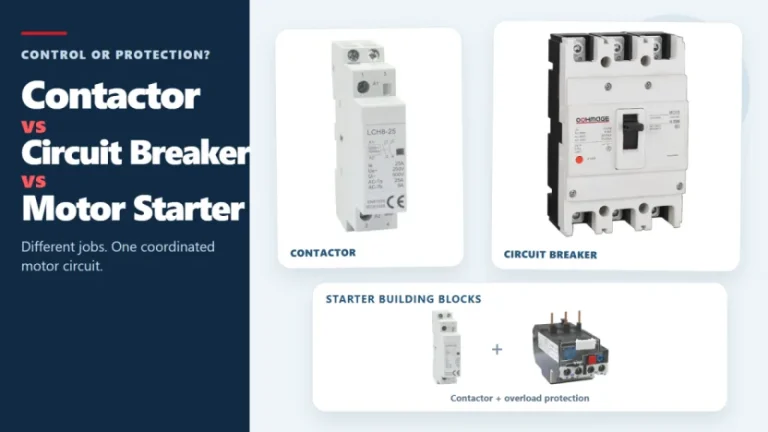
Figure 1. Contactors, circuit breakers, and motor starters solve different control and protection tasks. These three devices often appear in the same motor-control panel, but they solve different problems. A contactor handles frequent, remote, or automatic switching during normal operation. A circuit breaker interrupts abnormal current within its rated capability. A motor starter normally combines […]
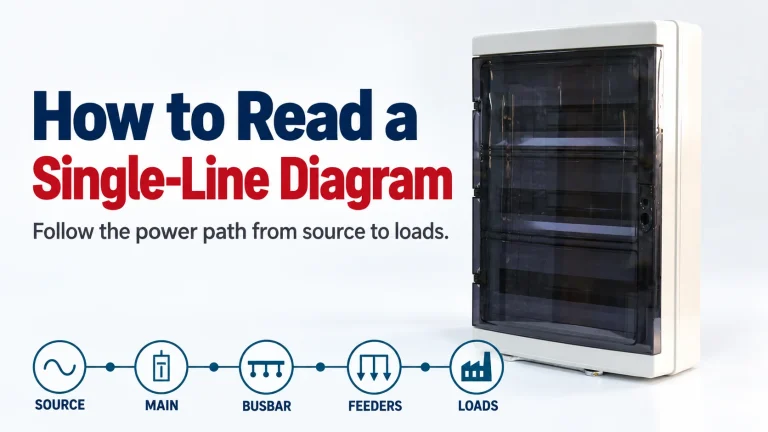
A single-line diagram can look simple and still be difficult to read. One line may represent a multiphase circuit, a small symbol may stand for a major protective device, and a short label may carry the information that determines what equipment belongs downstream. The most reliable way to read a single-line diagram is to follow […]
Figure 1. Three-phase SPD selection starts with system facts, not the largest kA number. A three-phase surge protector should not be selected by the largest kA number on its label. First confirm the system voltage, whether a neutral is present, the earthing arrangement, the installation point, and the required SPD type. Then compare Uc, Up, […]