Distribution Box vs Distribution Board: What Is the Difference?
Published: Author: Conor
The terms distribution box and distribution board often overlap. Both can describe equipment that receives an incoming electrical supply and organizes outgoing circuits, usually with switching and protective devices. The preferred term depends on the country, applicable standard, project specification and whether the buyer needs an empty enclosure or a complete assembly.
This means there is no reliable global rule that a “box” must be small and a “board” must be large. Before selecting a product, confirm the circuit layout, way count, electrical ratings, enclosure requirements, internal components and local installation rules.
Distribution Box and Distribution Board at a Glance
Question
Distribution box
Distribution board
How is the term commonly used?
Often used for an enclosure or compact circuit-distribution product
Often used for an assembly that distributes power to outgoing circuits
Is the meaning universal?
No. Project and regional usage varies.
No. It may overlap with distribution box, consumer unit or panelboard in some markets.
Can it be supplied empty or populated?
Either is possible; confirm the quotation scope.
Either is possible; confirm the quotation scope and assembly details.
What should be confirmed?
Way count, internal space, mounting, cable entry, IP requirement and included parts
A distribution box is an enclosure used to organize electrical protection and distribution components. Depending on the product and order scope, it may be supplied as an empty enclosure or configured with selected internal parts.
For a project quotation, confirm:
required way count and circuit schedule;
enclosure size and internal component dimensions;
surface-mounted or flush-mounted installation;
cable entry direction and gland requirements;
indoor or outdoor environment;
required ingress-protection level;
empty enclosure or populated assembly;
quantity, labeling, packaging and required documents.
The enclosure alone does not determine the ratings of a complete assembly. If breakers, busbars, terminals or wiring are included, their specifications must also be confirmed.
A distribution board receives an incoming supply and distributes it to outgoing circuits through an organized arrangement of switching and protective devices. The exact construction varies by application and market.
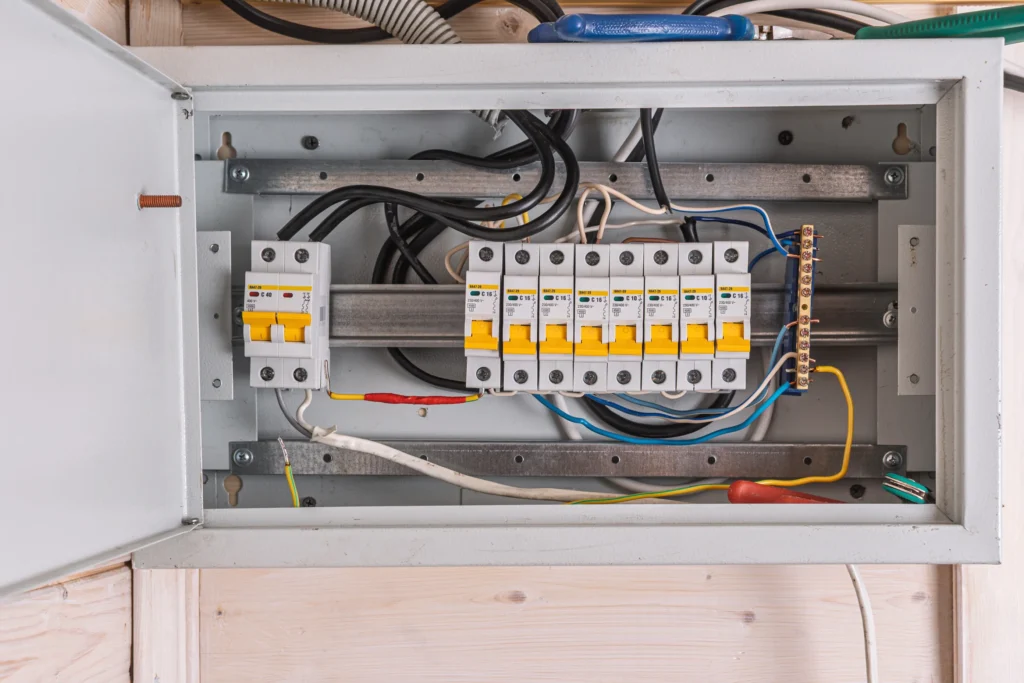
Typical elements may include:
an enclosure and mounting structure;
a main switch, isolator or incoming protective device;
busbars or distribution blocks;
outgoing MCB, RCCB, RCBO or other specified devices;
neutral and protective-earth terminals;
internal wiring, labels and cable-entry provisions.
Not every product includes all of these elements. Ask for the confirmed BOM, panel schedule or product specification instead of assuming that “distribution board” means a fully assembled panel.
The Main Difference Is the Confirmed Project Scope
The practical difference is usually found in what the project requires and what the supplier includes—not in the words “box” and “board” alone.
Empty enclosure or complete assembly
An empty enclosure provides space and environmental protection for separately selected devices. A populated assembly may add busbars, protective devices, terminals, wiring and labels. The quotation should state which parts are included.
Way count and usable internal space
Way count helps narrow the product range, but it is not the only sizing factor. Device width, wiring space, terminals, cable bending radius and future circuit requirements can affect the final enclosure choice.
Electrical ratings and protection layout
For a populated board, confirm the system voltage, phase arrangement, rated current, prospective short-circuit conditions, incoming device, outgoing protective devices and coordination requirements. Final design and local compliance should be confirmed by qualified electrical personnel.
Installation environment
Indoor, dusty, damp and exposed outdoor locations can require different enclosure protection and installation details. An IP code classifies protection provided by an enclosure against access, solid objects and harmful water ingress. It should not be treated as an unrestricted “waterproof” guarantee or an immersion rating unless the exact classification supports that use.
Certification and technical document support can be discussed according to the confirmed product series and order requirements. Before shipment, outgoing inspection can be arranged according to the product category and order requirements. Warranty support is confirmed in the agreed order terms.
Is a distribution box the same as a distribution board?
The terms can overlap, but they are not always interchangeable. Their meaning depends on regional usage, the project specification and whether the product is an enclosure or a complete electrical assembly.
Is a distribution board always larger than a distribution box?
No universal size rule separates the two terms. Use the required circuits, device layout, electrical ratings, enclosure conditions and applicable standard to select the product.
Does a distribution board include circuit breakers?
It may, but this must be confirmed. Some quotations cover only the enclosure, while others include protective devices, busbars, terminals, wiring and labels.
How many spare ways should a distribution board have?
There is no single percentage suitable for every project. Spare capacity should follow the project design, expected expansion, device dimensions, thermal considerations and applicable local requirements.
What should I send for a quotation?
Send the way count, system voltage, phase arrangement, incoming and outgoing device requirements, installation environment, mounting method, quantity and destination market. Include a panel schedule, single-line diagram or BOM when available.
Request Model Confirmation
If your project uses “distribution box,” “distribution board,” “DB box” or another regional term, send the actual circuit and enclosure requirements rather than relying on the name alone. Contact OOHMAGE with the required way count, layout, quantity and documents for model confirmation and quotation.
Only “solarcombiner box” in your quotation is far from sufficient. What should be connected to the box? A PV string or an inverter output? They match different jobs. The price and enclosure size can be considered at a later stage. What connects to the input is the top priority. To be more specific, a DC combiner […]
Learn how to choose the right distribution box for your home or workshop. Discover sizing rules, component selection, and strict electrical safety standards.
Electrical safety is never something to cut corners on—especially when circuits are exposed to rain, dust, or harsh outdoor conditions. That’s why weatherproof junction boxes are essential. Whether you’re wiring patio lights, powering irrigation systems, or managing circuits in a factory, the right enclosure ensures connections remain both safe and compliant with industry standards. In […]