How to Choose the Right Distribution Box for Your Home or Workshop
Learn how to choose the right distribution box for your home or workshop. Discover sizing rules, component selection, and strict electrical safety standards.
Read More

Only “solarcombiner box” in your quotation is far from sufficient. What should be connected to the box? A PV string or an inverter output? They match different jobs. The price and enclosure size can be considered at a later stage. What connects to the input is the top priority.
To be more specific, a DC combiner box which is responsibility for collecting PV string circuits, is normally upstream the inverter. An AC combiner box brings together compatible inverter output circuits or microinverter AC branches after conversion. They only collect circuits and are not responsible for converting DC to AC. The final selection for your project depends on the system design: Use DC, use AC, or both. Situations also exist in which no separate external combiner box is used.
The word “combiner” describes a circuit function. The AC or DC designation identifies the electrical duty for which the assembly and its components must be suitable.
| Comparison | DC combiner box | AC combiner box |
| Incoming circuits | PV string circuits | Inverter outputs or microinverter AC branches |
| System position | On the PV side of the inverter | On the AC side of power conversion |
| Main task | Collect designated DC circuits for an inverter input arrangement | Collect compatible AC generation circuits for the next distribution or connection point |
| Information to confirm | String arrangement, voltage and current limits, input grouping and protection requirements | Inverter output data, branch arrangement, phases, voltage and protection requirements |
| What the name does not prove | Number of independent outputs, MPPT compatibility or fitted protection devices | Compatibility with every inverter, monitoring platform or AC installation |
There is a reason why the ABB lists solar string combiner assemblies and AC recombiner applications.
Both of them can be used in PV system, but they handle different matter. Therefore, they should not be treated as two names of the same box.
Looking along the flow of the energy path makes it clearer when judging the type of device. On the DC side, PV strings feed into the DC combiner box, then flow to the specified inverter input. On the AC side, the compatible inverter output circuits proceed to the AC combiner box or other combining components, and are then connected to the next distribution point.
As referred to here is the basic path, do not seem it as the complete wiring diagram.
They do not show protective conductors, disconnecting arrangements, meters, individual protective devices or all the connections required for an installation.
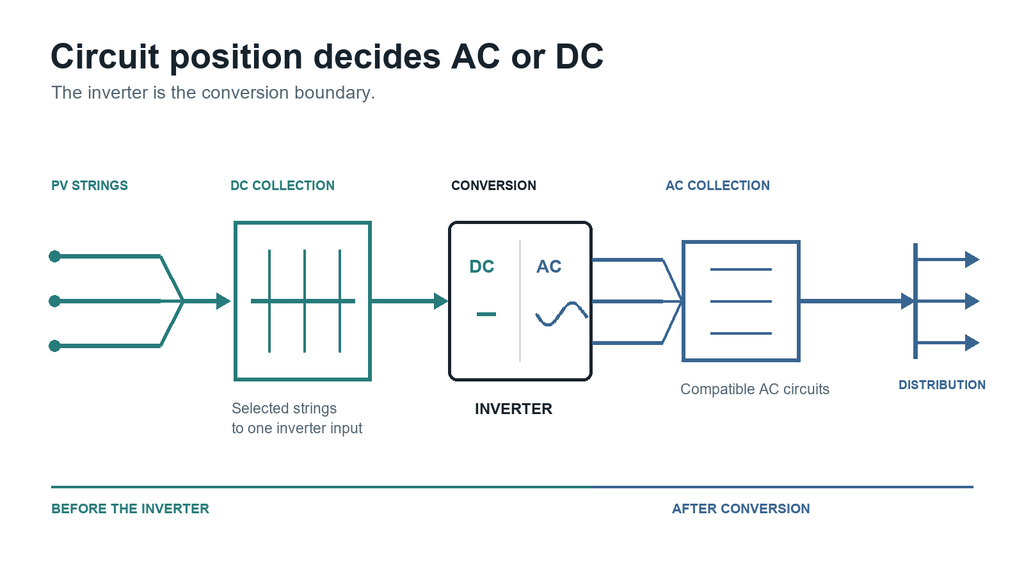
Simplified energy path: DC collection occurs before the inverter; AC collection occurs after conversion.
Design approach decide which strings need to be combined together, and bill of materials tell you the contents within the box. Based on the publicly data, some complete product integrate fuse protection, surge protection, switch, monitoring within the box. The specific configuration still depends on the product. ABB’s solar combiner range shows another way of the factory-built product, which shows it is not the universal component list for all suppliers.
During procurement, do not stop at “How many inputs are available?” We also need to know: Which inputs are electrically combined and where each output is intended to connect. These two items need to be verified in the assembly drawing and terminal schedule.
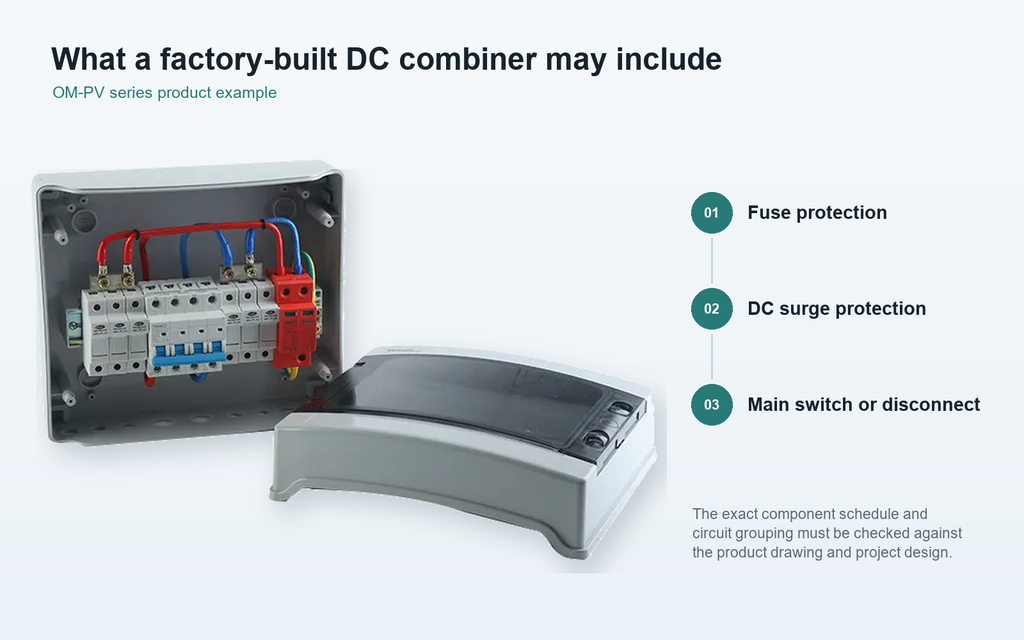
Example of a factory-built DC combiner assembly; the exact component schedule depends on the product and project.
For the AC side, what the AC combiner box received is AC generation circuits. In a microinverter system, conversion occurs at the microinverters, so their branch circuits are already AC when they reach the collection equipment. Enphase’s IQ Combiner installation documentation provides one manufacturer-specific example of AC branch collection.
That example also shows why compatibility matters: an integrated combiner can have specified equipment, cabling and monitoring requirements. Its instructions do not establish compatibility for another brand or a different system. When buying AC collection equipment, identify the inverter family and the required electrical and communication interfaces.
In the following sections, we will not discuss the installation steps, we will clarify the issues with three procurement scenarios. You can work out the contents for designers and suppliers to confirm from these scenarios.
Start with the DC arrangement. To confirm if the project design allow the PV strings enter the inverter directly, or does it require an external assembly? If it need an external assembly, the input grouping, output arrangement and component ratings must match that design.
The same quantity of PV modules may match different electrical layouts. Therefore, do not select the box based on the quantity of module; What truly determines connection method is how to place strings, and the input of inverter arrangement.
How many connectors on the inverter can’t indicate the method of dividing the PV strings. You should first know each input belong which maximum power point tracker, and then get to know the connection method that permitted by the manufacturer.
SMA’s polystring guidance indicate that: In the specified design conditions, what requirements shall be met if multiple PV strings need to be combined. There is a clear prerequisite, do not combine arbitrary strings or to join independent tracker circuits together.
Ask supplier for a wiring diagram is more useful then “two inputs, two outputs”. The diagram can tell us the input match which output, the “two inputs, two outputs” is not equal to the two paths remain separate. It is important when compare a protection box with independent circuits against an assembly that actually combines them.
Start with the AC arrangement. Identify each source circuit, its electrical characteristics, and the intended downstream connection. The project designer should specify whether the collection function belongs in a separate AC combiner or another suitable assembly.
ABB’s solar application guidance includes switching and protection for AC recombiners in string-inverter architecture. For a proprietary microinverter system, use the system manufacturer’s documentation to determine the approved collection equipment and interfaces.
A DC combiner upstream does not answer this AC collection question. Equally, AC collection downstream does not determine whether the array needs an external DC box. Assess the two sides separately.
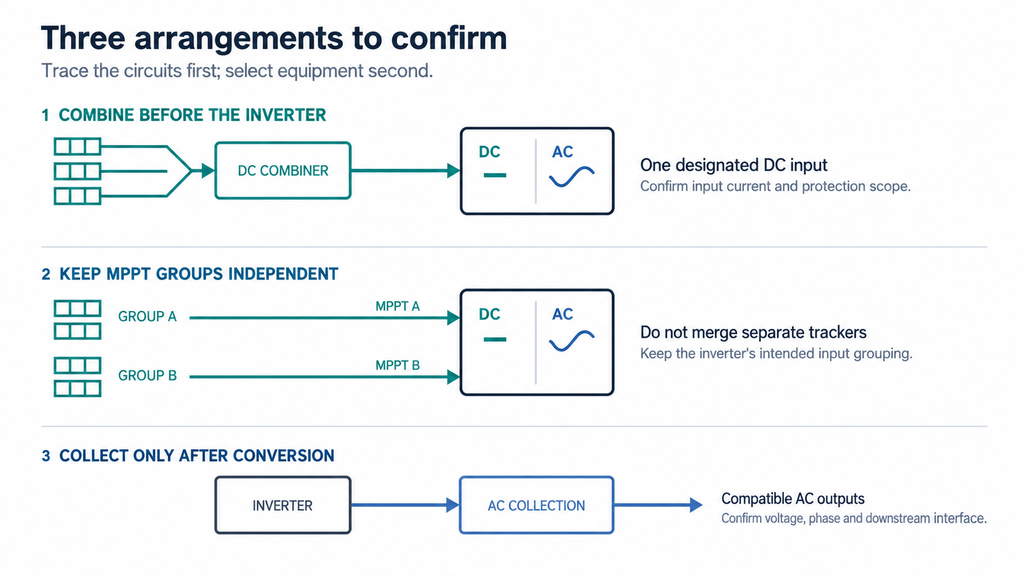
Three procurement scenarios point to different confirmation questions.
Clarify one thing first: What the box receives and what the box out put. “Four string inputs combined into one output” is for convergence, but “four separately protected paths” is four independent paths which is protected. They have different tasks. Supplier can verify the terminal schedule and internal grouping against the project drawing.
By virtue of suitable enclosure dimensions, you may think that the box has already been correctly selected. However, if the circuit inside can not match the predetermined inverter’s connection method, it can’t be used. During procurement, what takes priority is the internal layout.
The complete assembly must be suitable for its declared AC or DC application. Confirm the exact component schedule and manufacturer ratings rather than assuming suitability from a similar voltage number, matching dimensions or the appearance of a breaker.
The product label should lead to a specific drawing and data sheet. Ask which protection and switching functions are included, which remain elsewhere in the system, and what project information the supplier needs to verify the proposed configuration. Changing an internal component is a design matter, not a cosmetic substitution.
For a DC box, the key interface is the inverter’s specified input arrangement. For an AC box, it is the generation branch and downstream collection arrangement. Some systems also depend on particular communication or monitoring equipment.
Supply the exact inverter model and relevant manual with the enquiry. A statement that a box is “for solar” does not resolve these interface questions. Manufacturer-specific limits and connection requirements remain part of the selection.
Describe where the box will be mounted and the conditions it must withstand. Ask the supplier for documented enclosure suitability and installation requirements, including cable-entry arrangements and any limits that affect the chosen location.
Also make the delivered scope explicit. An empty enclosure, a populated protection box and a documented combiner assembly are different purchases. Request a component list and drawing so that quotations can be compared on the same basis.
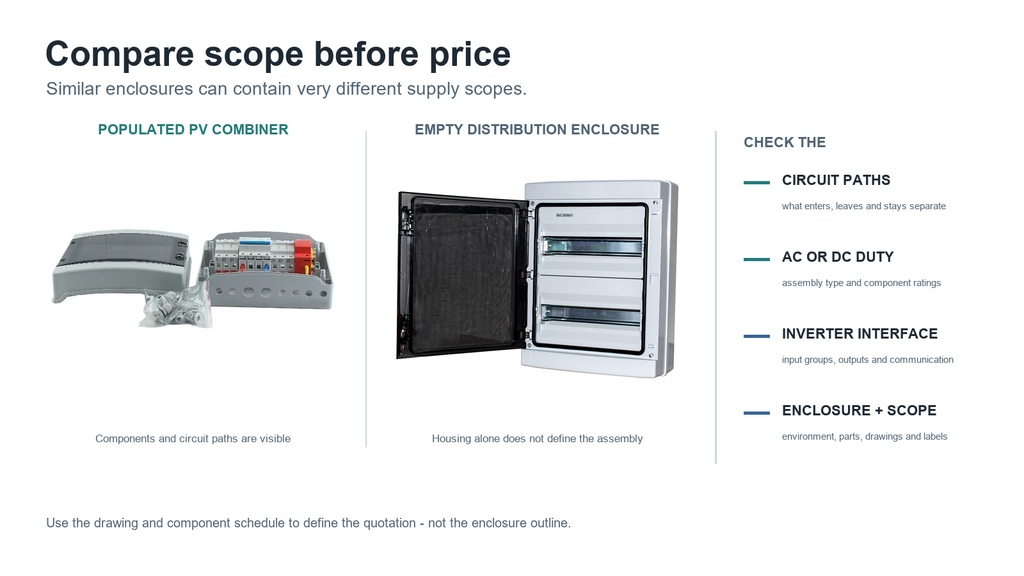
Four quotation checks: circuit paths, electrical duty, compatibility, and delivered scope.
Before the inquiry, a complete specification is not necessary. You can send the present data to supplier, and mark what content needs to be confirmed by the engineer. Ask the supplier to respond item-by-item to each point.
| Enquiry field | Useful information to provide |
| Required function | DC string collection, independent DC protection paths, or AC output collection |
| System equipment | Exact inverter or microinverter model and relevant documentation |
| Circuit arrangement | Single-line diagram, input count, output count and intended grouping |
| Electrical requirements | Project voltage and current data; required protection and switching functions |
| Installation conditions | Mounting location, environmental conditions and cable-entry requirements |
| Supply scope | Empty or populated enclosure, component list, drawings and required supporting documents |
| Order details | Quantity, destination market and project-specific documentation requirements |
This table serves only an auxiliary purpose; please use it with the supplier’s response. If the quotation deliver a complete set of equipment with full documentation, but another only provide enclosure dimensions and several components, the price is nonsense. Align both parties’ scope of supply, then talk about the price.
Before choosing the DC side for your project, you can refer to “OOHMAGE’s PV combiner box range”, send circuit layout together with inverter data. And ask the supplier for the latest diagram and product datasheets.
No. It is the inverter’s job to convert DC to AC, not the combiner box. The combiner box is responsible for collecting the pre-designed circuits. Therefore, recognize the differences between DC and AC.
Yes, where the design calls for combining on both sides of conversion. The DC side and the AC side deal with different circuits. Whether a box is required or not, no matter how it is configured, it should follow the system design. There is no rule that every PV project must install two types of combiner boxes at the same time.
Seeing “string inverter”, do not rush to judge if you need a DC combining box. What you need to focus on is the arrangement of the inverter’s input, the configuration allowed for use and the protect requirement of your project. Some layouts allow strings to feed into inverter directly, or other specified external equipment.
Do not assume so. Check the complete assembly’s declared application, component ratings and system compatibility. So long as the duty is different, the verification by manufacturer and project is necessary. Applying new labels or changing a component cannot prove it is applicable.
The system power can be included in the RFQ documents, but it can only provide context. If you wonder how many circuits there are, how to group them, and what assembly you need, you should add the model of inverter and the circuit arrangement. Only when the supplier is equipped with complete documents, can its recommendations and quotations be valuable.
Ask what is the input of the box first: It is PV string circuits, or AC generation circuits? Finalize this direction, then verify the input grouping, output path, equipment compatibility and delivered scope.
If you are sourcing a PV/DC combiner box, send OOHMAGE your project requirements with the inverter model and available drawings. Final circuit design and installation should be verified by the qualified project professional against the selected equipment’s instructions and applicable local requirements.
Continue with the matching product range and the supporting selection guides below.