Components of Industrial Control Panels: A Complete Guide for 2025
Published: Author: Conor
Industrial control panels are the command centers of modern manufacturing, managing power, automation, and safety across production systems. Found in factories, power plants, and process facilities, they house components such as PLCs, relays, HMIs, and circuit breakers that keep equipment running efficiently.
According to MarketsandMarkets, the global industrial automation market is projected to exceed USD 265 billion by 2025, driven by Industry 4.0 adoption and smart factory upgrades 1. Today’s systems integrate IIoT connectivity and real-time monitoring, enabling predictive maintenance and remote operation—from automotive assembly lines to energy plants. This guide explores the essential components of industrial control panels.
Understanding the Structure of an Industrial Control Panel
An industrial control panel is more than just a metal enclosure—it’s a precisely engineered system that organizes and protects the electrical components controlling machinery and processes. Typically, a panel is divided into two key sections: the power section and the control section.
The power section handles energy distribution through circuit breakers, fuses, transformers, and power supplies. It delivers the correct voltage and current to motors, sensors, and actuators while ensuring safety through proper grounding and overload protection. For instance, in a packaging plant, circuit breakers isolate faulty conveyor motors to prevent system-wide shutdowns.
The control section, on the other hand, houses logic and communication devices such as PLCs, relays, and contactors, which execute automation commands. These devices communicate with HMIs or SCADA systems to monitor operations, trigger alarms, or adjust machine parameters in real time.
Most panels are mounted on a backplate with DIN rails and wire ducts to ensure clean wiring and easy maintenance. Depending on environmental conditions, the enclosure may carry NEMA or IP ratings to protect against dust, water, or heat.
As factories evolve toward smart automation, panel layouts are becoming more modular, compact, and connected—supporting real-time monitoring, energy management, and predictive diagnostics.
Major Components of an Industrial Control Panel
An industrial control panel brings together electrical, electronic, and communication components into a centralized system that manages power, automation, and safety. Each component plays a specific role, from delivering stable power to interpreting data and controlling machinery.
Every control panel begins with reliable power management. Components such as circuit breakers, fuses, surge protectors (also known as surge suppressors), and transformers ensure the system operates safely under varying load conditions.
Circuit breakers protect against overloads and short circuits by interrupting the power flow during faults.
Fuses serve as secondary protection, sacrificing themselves to prevent component damage.
Surge protectors guard sensitive electronics from voltage spikes, a common threat in plants using heavy machinery.
Transformers convert incoming line voltage (e.g., 480V AC) into lower control voltages (typically 24V DC).
For example, in a pharmaceutical manufacturing line, power protection ensures delicate sensors and PLCs are shielded from electrical disturbances caused by high-torque mixers or refrigeration units.
At Oohmage, we offer a full range of circuit breakers, fuses, and transformers engineered for reliability and performance. Including miniature circuit breakers, molded case circuit breakers, and residual current circuit breakers — designed for fast response times, durable operation, and consistent safety under demanding industrial conditions. Our current transformers (CTs) provide accurate current measurement and monitoring, enabling effective power management and system diagnostics in modern automation systems.
2. Power Distribution System
Once power is stabilized, it must be distributed efficiently to various control and field devices. This is achieved through busbars, power terminals, and distribution blocks.
Busbars provide low-resistance paths for current distribution while minimizing heat buildup.
Distribution blocks help organize multiple circuit connections, reducing wiring complexity.
Terminal blocks ensure neat, accessible connections for maintenance.
In a robotic assembly cell, modular power distribution allows multiple robots and sensors to be energized independently—simplifying troubleshooting and system expansion.
3. Programmable Logic Controller (PLC)
The PLC is the brain of the control panel. It executes logic sequences, processes sensor data, and sends control signals to actuators. PLCs can monitor thousands of inputs and outputs simultaneously, making them indispensable in automated environments.
In a food packaging facility, for example, a PLC synchronizes conveyor speed, sealing temperature, and labeling machines to ensure consistent product quality.
Modern PLCs support Ethernet/IP, Modbus TCP, and Profinet protocols for high-speed communication and easy integration with other systems.
4. Relays and Contactors
Relays and contactors act as the switching devices that control high-current loads using low-voltage signals from the PLC.
Relays are used for small loads or logical isolation.
Contactors handle higher power, such as motor control or heating elements.
For compact and energy-efficient installations, Oohmage offers the OMMF Type AC Modular Contactor. It’s ideal for lighting, HVAC, and industrial automation systems where consistent performance and modular design are essential.
5. Motor Drives and Starters
Industrial processes often rely on motors for motion and material handling. Components such as Variable Frequency Drives (VFDs) and soft starters control motor performance and protect against electrical stress.
VFDs adjust motor speed and torque by varying the frequency of the supplied voltage, reducing energy consumption by up to 30%.
Soft starters gradually ramp up motor voltage during startup, minimizing mechanical wear and inrush current.
In an HVAC control system, VFDs dynamically regulate fan speed to maintain temperature and pressure balance while saving energy.
6. Communication and Networking Devices
With the rise of Industry 4.0, communication components have become a vital part of control panels. Ethernet switches, fieldbus modules, gateways, and routers enable connectivity between PLCs, sensors, and enterprise systems.
Ethernet-based communication (e.g., Profinet, EtherCAT) ensures faster, more reliable data transfer.
Industrial gateways allow data from legacy systems to be integrated with modern IoT platforms.
For example, a car manufacturing plant may use Ethernet switches to connect hundreds of PLCs and HMIs, providing real-time production analytics across multiple lines.
7. Human-Machine Interface (HMI)
The HMI acts as the visual and interactive interface between the operator and the machine. It displays real-time process data, alarms, and performance metrics, allowing personnel to make informed decisions. Common types include touchscreen panels, industrial PCs, and web-based dashboards.
For example, in a bottling line, operators can use an HMI to adjust filler speeds, view maintenance alerts, or track production counts—all in real time.
8. Terminal Blocks, Wire Ducts, and DIN Rails
Efficient wiring is critical for reliability and serviceability.
Terminal blocks organize and connect incoming and outgoing wires securely.
Wire ducts route cables neatly, ensuring safety and easy access.
DIN rails serve as standardized mounting systems for electrical components.
Proper cable management not only prevents overheating but also simplifies maintenance — crucial in industries such as pharmaceutical packaging, where downtime can be costly.
9. Enclosure, Backplate, and Grounding
The enclosure is the protective shell of the control panel, shielding internal components from dust, vibration, and moisture.
NEMA and IP ratings define the level of protection required based on the environment (e.g., IP66 for outdoor, NEMA 4X for washdown areas).
The backplate supports all components and dissipates heat.
Grounding ensures safety by preventing electrical shock and interference.
In a marine or offshore environment, stainless steel NEMA 4X enclosures resist corrosion while maintaining compliance with UL 508A standards.
How to Design and Build a Reliable Industrial Control Panel
Designing a reliable industrial control panel isn’t just about assembling parts — it’s about creating a system that’s safe, efficient, and adaptable for future automation needs. Whether it’s a control unit for a packaging line, robotic cell, or energy facility, careful planning and high-quality components are the foundation of long-term reliability.
1. Evaluate Operational Requirements
Start by defining your control objectives. Determine the functions your system needs — for example, speed control for conveyors, temperature regulation, or multi-axis motor synchronization. Identify your input/output (I/O) requirements, power ratings, and communication protocols such as Ethernet/IP, Modbus, or Profinet. Clear specifications prevent overdesign and ensure each component fits seamlessly into the automation network.
2. Assess Environmental Conditions
Control panels must be designed for their working environment. For harsh industrial spaces, use NEMA 4X or IP66-rated enclosures to protect against dust, water, and corrosion. Consider ambient temperature, humidity, and vibration when selecting wiring, enclosures, and cooling systems. For example, panels in outdoor power stations require reinforced sealing and efficient ventilation to maintain performance stability.
3. Choose Compatible Controllers and Logic Devices
Your Programmable Logic Controller (PLC) or Industrial PC (IPC) defines how the system interprets and executes automation commands. Select a controller that matches the process complexity — from compact PLCs for simple sequences to modular systems for large production lines. Ensure compatibility with sensors, HMIs, and drives to enable seamless communication and system diagnostics.
4. Select Reliable Power Supply and Protection Components
A stable power foundation is critical to panel longevity. Choose circuit breakers, fuses, and transformers that meet your voltage and current requirements, protecting the system from surges or overloads.
5. Incorporate Safety and Scalability
Include protective relays, emergency stop circuits, and grounding to maintain operator and equipment safety. As production demands grow, plan for scalability by leaving space in the enclosure for future I/O modules or drives. Modular panel design simplifies expansion without complete reconfiguration.
6. Validate and Document Your System
Before deployment, conduct functional, continuity, and insulation resistance tests to confirm performance. Document wiring schematics, component data sheets, and safety certifications for future maintenance and audits.
A well-designed panel not only powers today’s operations but also supports the smart factories of tomorrow
OOHMAGE: A Reliable Choice for Your Electrical Needs
When planning an electrical installation, consulting qualified professionals helps identify the right equipment — but choosing a trusted supplier matters just as much.
OOHMAGE stands out as a leader in electrical safety solutions, offering high-quality circuit breakers, fuses, transformers, and isolator switches for diverse industrial applications. Contact us to power smarter, safer, and more efficient control panels for your operation.
FAQs
Why are circuit breakers and fuses important in control panels?
Circuit breakers and fuses protect control panels from electrical overloads, short circuits, and surges. They safeguard equipment like PLCs and sensors, ensuring stable power delivery and preventing costly downtime in industrial automation systems.
How do transformers work in industrial control panels?
Transformers in industrial control panels step down high voltages (e.g., 480V) to safe control levels like 24V DC or 120V AC. This ensures that relays, contactors, and PLCs operate efficiently and safely in automation systems.
How can I make my industrial control panel more efficient in 2025?
Use high-quality components such as Oohmage circuit breakers, fuses, and transformers, integrate smart PLCs and IIoT connectivity, and ensure proper cable management. Designing for modularity and remote monitoring improves efficiency, scalability, and uptime in 2025 automation systems.
Source
1: MarketsandMarkets—“Industrial Automation Market by Component, Solution, and Industry — Global Forecast to 2025.”
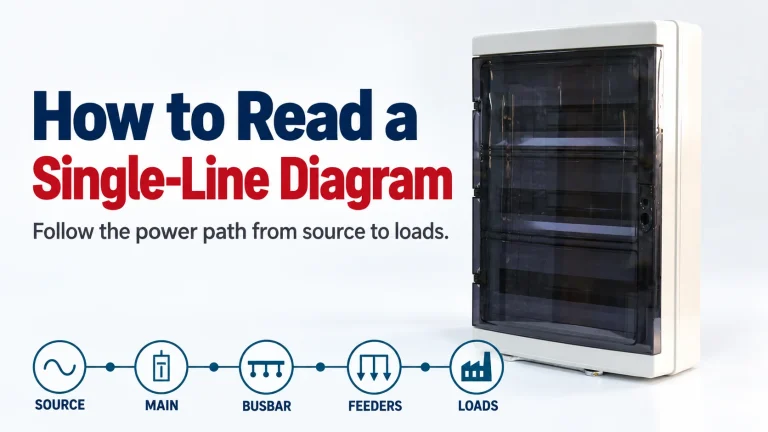
A single-line diagram can look simple and still be difficult to read. One line may represent a multiphase circuit, a small symbol may stand for a major protective device, and a short label may carry the information that determines what equipment belongs downstream. The most reliable way to read a single-line diagram is to follow […]
Figure 1. Three-phase SPD selection starts with system facts, not the largest kA number. A three-phase surge protector should not be selected by the largest kA number on its label. First confirm the system voltage, whether a neutral is present, the earthing arrangement, the installation point, and the required SPD type. Then compare Uc, Up, […]
An AC-only miniature circuit-breaker,you cannot treat it as a DC circuit by default.Confirm before using: If the manufacturer explicitly rates the selected model for the required DC voltage, pole arrangement, polarity where applicable, fault current, and breaking capacity.Some breakers carry both AC and DC ratings, but these alone cannot reflect the actual situation. If the […]