< img height="1" width="1" src="https://www.facebook.com/tr?id=1523171142290993&ev=PageView&noscript=1"/>
Electrical protective devices are necessary because they prevent overcurrent, short circuits, and overloads. The devices ensure that the electrical systems continue to perform safely. They will automatically identify and stop faulty conditions from worsening. The safety devices protect humans, staff, machinery, and wires. If you are wondering about the MCB meaning, Miniature Circuit Breakers are crucial safety devices that protect the wiring from overloads. The device automatically trips when it senses a fault. The MCBs ensure system integrity in residential, commercial, and industrial buildings.

MCBs vs. Fuses

When one compares the MCB to the conventional fuse, the breakers have many advantages that make them a better choice for modern electrical systems.
  1. First, the user can reuse and re-program MCBS without replacing them, which saves time and money. Unfortunately, you cannot do it with a fuse.
  2. In addition, the miniature circuit breakers are accurate and credible. They will trip at exact current levels and provide better circuit safety.
  3. Thirdly, the breakers have easy manual installation. It reduces downtime, and you do not need to experience the hassle of installing fuses.
  4. Also, MCBs will sustain many faults without disturbing the performance. They will not degrade and have a longer lifespan than the fuses.
  5. Lastly, MCBs are versatile. They can be used in different applications because they can withstand numerous current ratings. They are more adaptable than fuses, which saves you from repetitive purchases.

Types of MCBs

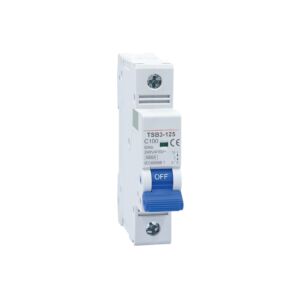
MCB

Type B – Residential Properties and Small-Scale Industrial Units

Type B MCBs are intended to trip the currents 3 to 5 times more than their average capacities. Miniature circuit breakers are common in residential properties and small-scale industrial units to stabilize the current and make it more predictable. The MCBs will protect the wires from short circuits and overloads. As a result, home wiring stays safe. When used in a residential setting, Type B miniature circuit breakers are perfect for safeguarding wires from heating, lighting, and damaging household appliances. Furthermore, the breakers supervise low current flow, making them appropriate for sensitive environments. You can use them in home offices and small working areas to prevent uneven current flow.

Type C – Commercial and Industrial Units

Type C MCBs will trip if 5 to 10 times more current passes through the circuit. They are used in industrial and commercial units where a surge of current is expected. The MCBs are appropriate for areas with lots of installed motors or fluorescent lights. The MCB will protect the environment from regular moderate current surges. Commercial buildings benefit from Type Cs because they can sustain the rushed requirements of office buildings, retail stores, and small assembly lines. The powerful design ensures the circuits and wiring are protected from the rough conditions of the commercial site. Downtime and machinery damage is minimized.

Type D – Heavy-Duty Industrial Equipment

Type D MCBs trip when 10 to 20 times the current passes through the circuit. Therefore, they are excellent for heavy-duty manufacturing sites. The breakers are commonly discovered in environments with large motors and transformers. Type Ds are also present near large-scale electrical equipment. Their purpose is to prevent circuit overloads and shot wiring. Type Ds help machineries with strong starting currents to perform well. Common examples are cranes and large compressors. Furthermore, the breaker’s ability to regulate electrical surges protects the machinery from damage.

Other Types of MCB – Types A, K, and Z

Type A MCB

Type A MCBs (Miniature Circuit Breakers) will trip at currents 2 to 3 times their average current. Their sensitivity to current makes them perfect for sensitive equipment, such as electronic circuits and semiconductor devices. Type A MCBs are preferred for settings where even minor surges can cause huge damage. These MCBs are not commonly used and are mostly suitable for highly sensitive electronic circuits. They are excellent in environments that require precision because protecting delicate equipment is necessary. Industries that rely on sensitive machinery and medical facilities with electronic devices will benefit from Type A MCBs.

Type K MCB

Type K MCBs trip at currents 8 to 12 times the current. They are suitable for industrial applications with high incoming currents, such as transformers and heavy-duty motors. The breakers offer reliable protection in environments where surges are common. Type K MCBs prevent equipment damage so the system stays stable. Industries with manufacturing lines and large-scale processing plants use Type K MCBs to ensure operational efficiency. They can handle extreme surges without unnecessary tripping, supporting continuous operation. They also reduce downtime and protect expensive industrial equipment from wiring faults.

Type Z MCB

Type Z MCBs will also trip at currents 2 to 3 times the average current. Like the Type A MCBs, they have the same characteristics. Type Z protects sensitive equipment in specialized applications where the industry demands precision. Type Z MCBs are often found where delicate electronic devices are commonly used. Aerospace and high-tech manufacturing install Type Z MCBs for their many advantages. The breakers ensure the electronic systems remain functional.

Applications of MCBs

Electrical Panels

Electrical Panels The different MCB types are necessary near electrical panels because they offer protection from short circuits and overloads. The MCBs immediately stop the flow of current to prevent further damage to the wires and connected devices, ensuring safe operations. The MCBs aid in maintaining electrical panels in residential, commercial, and industrial environments. MCBs near electrical panels allow engineers to inspect and repair the components easily. The breakers are specifically helpful when the panels involve complicated circuits and multiple wires. The MCBs’ modular design makes them highly versatile.

Lighting Systems

Lighting Systems MCBs are installed in different lighting systems to prevent accidents that can cause fires or harm the equipment. The breakers automatically disconnect the circuit from the overcurrent. MCBs maintain a high level of safety and are reliable in residential, commercial, and industrial environments. Installing MCBs reduces the chances of dangerous outcomes while ensuring the service continues. MCBs also make it easy to manage the circuits. The engineers can separate the sections that harm the system. MCBs make it easy to supervise large-scale lighting systems found in buildings, factories, and outdoor installations.

Industrial Equipment

Industrial Equipment MCBs also protect heavy-scale industrial machinery and equipment. The breakers can expertly sustain high current loads and interrupt the flow of electricity when the system experiences overloads. MCB types will prevent equipment harm and significantly reduce downtime. The durability and internal composition make them ideal for environments where machineries experience stress, strong vibrations, and temperature changes. MCBs positively influence the machinery and contribute to equipment safety.
Ground Fault Trip Mechanism

MCBs that offer ground fault features will identify earth faults using their mechanism. Interruptions occur when the path between a live conductor and the ground is disturbed. The system is at risk of fire or electrical shock. Ground Fault MCBS will intentionally trip the system to prevent damage. The MCBs keep the staff and equipment safe. Ground Fault MCBs are commonly found in hospitals, labs, and residential areas. The breakers respond quickly to situations and shifts in environments. They prevent circumstances from escalating.

Benefits of Using MCBs

Enhanced Safety for Electrical Systems

Miniature circuit breakers improve the safety of the electrical system. The component disconnects the system during short circuits and overloads. As a result, the MCB prevents fires and machinery damage, making the environment safer for industrial, residential, and commercial entities. In addition, MCBs protect the building against electrical faults. The breaker safeguards human and intangible assets. MCBs are precise in their functions, so they are compatible with modern systems. Finally, the MCBs adhere to all regulations to ensure system integrity.

Durability and Reliability Compared to Fuses

Secondly, MCBs are quite reliable and durable. They are a lot better than traditional fuses. The engineers must replace the fuse regularly. On the other hand, they can reset or reuse circuit breakers. The MCBs are more budget and environmentally friendly. Their credibility offers non-stop protection. Moreover, fuses worsen over time. In contrast, MCBs are consistent. The internal mechanism can withstand numerous faults without disturbing the system’s performance. Therefore, MCBs are ideal for industrial use where electricity can endanger staff, buildings, and machinery.

Convenience of Manual Resetting

One of the reasons MCBs are popular is because you can manually reset them. After the overload has tripped the circuit, you can toggle a switch to resume the regular flow of electricity. You can successfully fix the circuit without replacing components, wiring, and switches. Secondly, manually resetting the MCB improves the efficiency of the operations. Engineers can improve and fix the faults. Subsequently, the electricians can resume the functions. The breaker reduces the repair time for restoring a system. In gist, MCBs are practical and very user-friendly.

Wide Range of Applications

MCBs are versatile devices useful for many applications. Their usage ranges from homes to industrial plants. Furthermore, the breakers work with lighting circuits, electrical outlets, and heavy equipment. The MCBs are adaptable for specialized systems as well, such as renewable energy stations and data centers. The breakers offer precise monitoring and credible protection. The engineers can integrate the circuit breakers with different setups for a flexible approach.

How to Choose the Right MCBs?

Understanding the MCB meaning is just as important as knowing how to pick the right circuit breaker. With the right choice, the system will experience better safety. Moreover, the operations are reliable and efficient. Continue reading to learn about the crucial factors before buying a breaker.

Current Rating

mcb The breaker’s current rating shows its ability to sustain electrical overload without tripping. Therefore, the expert suggests picking an MCB with a high rating that corresponds with the maximum current. Thus, the circuit does not experience unnecessary interruptions.
  • Firstly, you must evaluate the total current consumption of the connected devices.
  • Secondly, you must ensure that the breaker rating matches the load of the circuit.
  • Finally, don’t forget to factor in future load expectations when choosing the circuit breaker.

Application Type

The application type also influences the decision when selecting the right breaker. Residential, commercial, and industrial settings have unique requirements. Therefore, the demand for electricity will vary as well. Engineers choose the breaker that offers the best performance and optimal safety.
  • In short, you must identify the environment and nature of operations.
  • Also, the user must match MCB specifications to the machinery demands.
  • Lastly, you must account for heavy machinery such as ceiling lights and HVAC systems.

Sensitivity

The MCB meaning of sensitivity is the ability to identify and correspond to faulty circumstances. High-sensitive breakers are crucial for circuits present in electronics. On the other hand, lower-sensitivity breakers are sufficient for general reasons. Here is the breakdown:
  • The user must identify the need for low or high sensitivities
  • In addition, you must check the sensitivity of the electronics.
  • Don’t forget to evaluate the safety requirements of the system.

Compatibility

Compatibility between the breaker and electrical fixtures is a crucial factor. The breaker needs to fit into the panel seamlessly while working with the components. The strategy will prevent installation issues in the future.
  • Foremost, you must check the dimensions and the mounting needs.
  • Also, check the electrical qualities match with the system.
  • Lastly, contact the electrical equipment supplier to verify the compatibility with the devices.

Introduce MCBs into the wiring

MCBs are crucial for modern electrical systems. Compared to conventional fuses, they offer security, credibility, and convenience. In addition, the breakers safeguard equipment from overloads. They are reliable and efficient in numerous applications. Safety circuitry and wiring are impossible without MCBs today.

FAQs

What are the reasons for installing MCBs?

Miniature circuit breakers are substitutes for fuses. They protect the wiring from additional current. Moreover, the MCBs have automatic switches that open when a high current is flowing through the circuit. You can set a higher value to increase endurance.

Which metals are used in miniature circuit breakers?

MCBs are made of brass and steel, but they are also manufactured with steel and copper. The component, the bimetallic strip, safeguards from high currents because it takes a long time to get heated. In addition, the MCB contains a solenoid, which is a spring that regulates the current flow.

Are MCBS used for safety?

MCBs are electrical and mechanical devices that safeguard the circuit from overload and short faults. Moreover, MCBS identifies flaws in the wiring and circuits that adversely impact their performance. They also come with an automatic on-and-off switch to pause the flow of current without manual interference.

How to pick an MCB current rating?

In addition to matching the circuit and the number of poles, you must ensure that the breaking capacity is equal to or greater than the capacity of the wiring. Moreover, the current setting of the breaker must be less than 80% of the short-circuit capacity.

Do you need an MCB for an air conditioner?

An individual MCB is necessary to power a continuous power supply to the air conditioner. However, compressor breakdowns, relay issues, and power failure will prevent the AC from working.

Related Product Categories

  • MCB Accessories — Check auxiliary and installation options that complement the selected miniature circuit breaker.
Previous Post

Circuit Breaker vs. Fuse: A Comparative Guide

Next Post

AC Surge Protective Device: Protect Homes and Offices

Related Posts

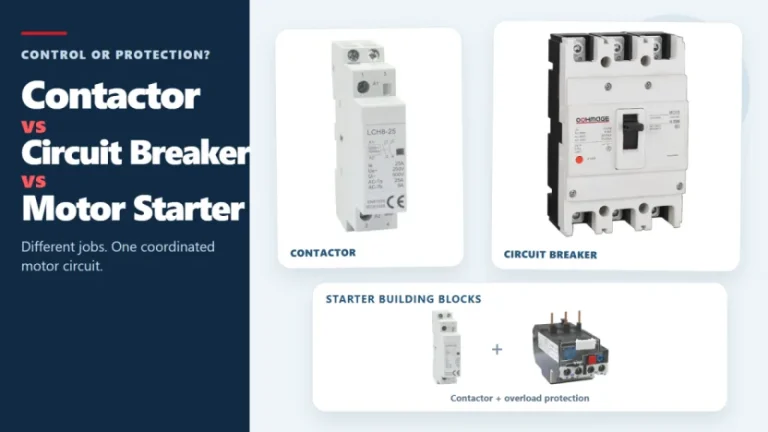
Contactor vs Circuit Breaker vs Motor Starter

Contactor vs Circuit Breaker vs Motor Starter

Figure 1. Contactors, circuit breakers, and motor starters solve different control and protection tasks. These three devices often appear in the same motor-control panel, but they solve different problems. A contactor handles frequent, remote, or automatic switching during normal operation. A circuit breaker interrupts abnormal current within its rated capability. A motor starter normally combines […]
Read More
What Is a Shunt Trip? How It Works in Circuit Breakers and What Buyers Should Specify

What Is a Shunt Trip? How It Works in Circuit Breakers and What Buyers Should Specify

Introduction The concept of remote tripping is simple, but in actual operation, project teams often encounter difficulties in specifying the components. The panel factory may require circuit breakers triggered by fire alarm relays, PLC outputs, building management system instructions, or other coordinated control. At this point, “diversion tripping” is only the first step in the […]
Read More
Types of Circuit Breakers: How MCB, MCCB, RCCB and RCBO Differ

Types of Circuit Breakers: How MCB, MCCB, RCCB and RCBO Differ

The main types of circuit breakers used in low-voltage distribution include miniature circuit breakers (MCBs), molded case circuit breakers (MCCBs) and residual-current devices such as RCCBs and RCBOs. They are not interchangeable. MCBs and MCCBs are selected for overcurrent protection in different circuit roles, an RCCB provides residual-current protection without integral overcurrent protection, and an […]
Read More
+86-18757092555 Phone info@oohmage.com E-mail Chat on WhatsApp WhatsApp