Do you know what is TVS diode? A transient voltage suppression (TVS) diode protects electronics from damaging voltage spikes caused by lightning, electrostatic discharge (ESD), or switching. As a key component in surge protection devices (SPDs) and standalone circuits, TVS diodes are essential for safeguarding modern technology.
A transient voltage suppression (TVS) diode is a semiconductor device designed to protect electronic circuits from sudden voltage spikes, known as transients, by clamping excess voltage and diverting harmful current to ground.
Picture it as a pressure relief valve in a water pipe: when voltage surges beyond safe levels, the TVS diode activates to prevent damage. According to the IEC 61000-4-2, TVS diodes are critical for mitigating transients from ESD, lightning, or switching, making them vital in SPDs and standalone circuit designs.
TVS diodes are used in everything from smartphones to industrial machinery, ensuring reliability in environments prone to electrical disturbances.
How Do TVS Diodes Work?
TVS diodes operate through a process called avalanche breakdown, which allows them to respond to voltage spikes in picoseconds, faster than most other protection devices.
When a transient voltage exceeds the diode’s reverse standoff voltage (the normal operating voltage of the circuit), the diode conducts, clamping the voltage to a safe level (the clamping voltage) and shunting excess current to ground.
Once the transient passes, the diode returns to its non-conductive state, allowing the circuit to function normally.
In surge protection, TVS diodes shine due to their speed and precision. In SPDs, they complement components like metal oxide varistors (MOVs) or gas discharge tubes (GDTs) to handle low-energy transients, such as ESD in consumer electronics.
As standalone components, they protect sensitive integrated circuits (ICs) or signal lines in automotive or telecom systems. Key parameters include:
Reverse Standoff Voltage: The maximum voltage the diode can handle without conducting.
Clamping Voltage: The voltage level at which the diode limits transients.
Peak Pulse Power (PPP): The maximum power the diode can absorb (e.g., 600W, 1500W).
Parasitic Capacitance: Affects signal integrity in high-speed circuits.
Types of TVS Diodes
TVS diodes come in two primary types, each suited for specific circuit requirements and surge protection applications.
Protect DC circuits by clamping voltage spikes in one polarity (positive or negative).
Common in automotive electronics (e.g., protecting ECUs from load dump transients) and consumer devices (e.g., USB ports).
Bidirectional TVS Diodes
Protect AC circuits or bidirectional signals by clamping spikes in both polarities.
Used in telecom data lines, audio interfaces, or industrial sensors.
Type
Circuit Type
Response Time
Applications
Unidirectional
DC
Picoseconds
Automotive, USB, consumer electronics
Bidirectional
AC, bidirectional
Picoseconds
Telecom, audio, industrial sensors
In surge protection devices, unidirectional diodes are common in Type 3 SPDs (point-of-use protection, like power strips), while bidirectional diodes are used in SPDs for data lines or telecom equipment.
Understanding these types helps select the right diode for specific surge protection needs.
TVS Diodes in Surge Protection
TVS diodes play a pivotal role in surge protection, both as standalone components and within SPDs like an outdoor surge protector. Their fast response and precise voltage clamping make them ideal for protecting sensitive electronics from transients caused by lightning, ESD, or switching.
In SPDs
TVS diodes are key components in Type 2 SPDs (sub-panel protection) and Type 3 SPDs (point-of-use, e.g., power strips), per IEC 61643 standards.
They handle low-energy transients, complementing high-energy components like MOVs or GDTs. For example, in a Type 3 SPD, a TVS diode might protect a computer’s USB port from ESD while an MOV handles a lightning surge.
Advantage: Picosecond response time ensures sensitive circuits remain safe.
Standalone Surge Protection
TVS diodes are placed directly on circuit boards to protect ICs, signal lines, or power rails. For instance, a TVS diode on a USB data line prevents ESD damage during plug-in.
Common in automotive electronics (e.g., protecting ADAS from load dump) and telecom (e.g., shielding Ethernet ports).
Advantages of Surge Protection
Speed: Responds faster than MOVs or GDTs, ideal for ESD or fast transients.
Precision: Clamps voltage closer to safe levels, protecting delicate components.
Compact Size: Fits easily in compact devices like smartphones.
Limitations
Lower surge current capacity than GDTs, making them less suited for high-energy lightning strikes alone.
Often paired with other devices in SPDs for comprehensive protection.
By integrating TVS diodes into SPDs or circuits, users can achieve robust surge protection tailored to specific risks.
Applications of TVS Diodes
Scenarios
Applications
Consumer Electronics
Shield USB ports, HDMI interfaces, and smartphone circuits from ESD during plug-in or handling.
Automotive
Protect electronic control units (ECUs), advanced driver-assistance systems (ADAS), and EV charging circuits from load dump or switching transients.
Industrial
Safeguard programmable logic controllers (PLCs), sensors, and motor drives from switching or lightning-induced transients.
Telecom
Defend data lines, antennas, and networking equipment from lightning or ESD.
Surge Protection
TVS diodes in Type 3 SPDs protect residential appliances (e.g., TVs, routers) and industrial equipment (e.g., control panels) from transients.
TVS Diodes vs Other Protection Devices
1. TVS Diode vs Zener Diode:
TVS Diode: Optimized for transient suppression, with faster response and higher power handling (e.g., 1500W PPP). Used in SPDs and circuits for ESD or lightning protection.
Zener Diode: Designed for steady-state voltage regulation, slower and less robust for transients.
2. TVS Diode vs MOV (Metal Oxide Varistor):
TVS Diode: Faster (picoseconds), precise clamping, ideal for low-energy transients in SPDs or IC protection.
MOV: Higher surge capacity (e.g., lightning), but slower and degrades over time.
3. TVS Diode vs GDT (Gas Discharge Tube):
TVS Diode: Faster, lower energy handling, suited for ESD or switching transients.
GDT: Handles high-energy surges (e.g., lightning in Type 1 SPDs), but slower response.
Device
Speed
Surge Capacity
Durability
Surge Protection Use
TVS Diode
Picoseconds
Low to medium
High
Type 3 SPDs, IC protection
Zener Diode
Nanoseconds
Low
Medium
Voltage regulation
MOV
Microseconds
High
Degrades
Type 1/2 SPDs, lightning
GDT
Microseconds
Very high
High
Type 1 SPDs, telecom
In SPDs, TVS diodes are often paired with MOVs or GDTs for layered surge protection, combining speed and capacity.
How to Choose a TVS Diode
Selecting the right TVS diode for surge protection requires understanding key parameters and application needs.
Reverse Standoff Voltage: Must match or exceed the circuit’s normal operating voltage (e.g., 12V for a car battery circuit).
Clamping Voltage: Should be below the equipment’s damage threshold to ensure protection.
Peak Pulse Power (PPP): Indicates surge handling capacity (e.g., 600W for consumer electronics, 1500W for industrial).
Capacitance: Low capacitance (e.g., <1 pF) is critical for high-speed data lines (USB, HDMI) to avoid signal distortion.
Surge Protection Tips:
Use TVS diodes in Type 3 SPDs for point-of-use protection (e.g., power strips, USB hubs).
Pair with MOVs or GDTs in SPDs for high-energy surges, like lightning.
Choose bidirectional diodes for telecom or AC applications; unidirectional for DC circuits.
Practical Advice:
Verify compliance with standards like IEC 61000-4-2 (ESD) or IEC 61000-4-5 (surge).
Select package types (e.g., SMA, SMB) based on board space constraints.
For high-speed circuits, prioritize low-capacitance diodes to maintain signal integrity.
Choosing Reliable Protection Devices from OOHMAGE
TVS diodes are fast, precise protectors against voltage spikes, playing a critical role in surge protection devices and standalone circuits.
For reliable and comprehensive electrical protection solutions, partnering with a trusted supplier like OOHMAGE ensures quality, performance, and safety. OOHMAGE specializes not only in SPDs but also in a wide range of electrical protective devices tailored to residential, industrial, automotive, and telecommunications applications.
Our commitment to innovation, rigorous testing standards, and adherence to international certifications makes us an ideal choice for businesses seeking robust, dependable electrical equipment.
By selecting OOHMAGE, you are investing in proven solutions designed to protect critical electronics and ensure operational stability in even the most challenging environments.
FAQ
What does a TVS diode do in surge protection?
A TVS diode clamps voltage spikes in picoseconds, protecting circuits in SPDs or standalone applications from ESD, lightning, or switching transients.
How is a TVS diode different from a Zener diode?
A TVS diode is faster and handles higher power for transient suppression, while a Zener diode is designed for steady-state voltage regulation.
Can TVS diodes be used in SPDs for home electronics?
Yes, TVS diodes are common in Type 3 SPDs (e.g., power strips), protecting devices like TVs or computers from low-energy transients.
What happens if a TVS diode fails?
TVS diodes typically fail short (safe mode) or open (no protection), depending on the surge severity and diode design.
Can a TVS diode alone protect against lightning strikes?
Typically, no. TVS diodes are best for lower-energy transients like ESD or switching surges. For high-energy lightning protection, they’re usually paired with MOVs or GDTs in a layered SPD approach.
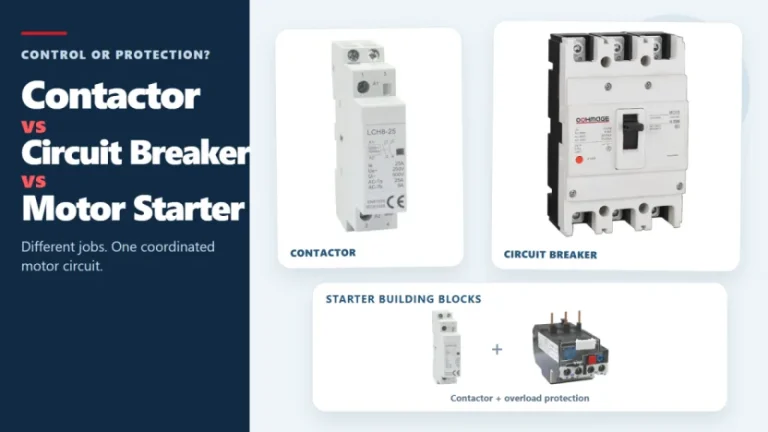
Figure 1. Contactors, circuit breakers, and motor starters solve different control and protection tasks. These three devices often appear in the same motor-control panel, but they solve different problems. A contactor handles frequent, remote, or automatic switching during normal operation. A circuit breaker interrupts abnormal current within its rated capability. A motor starter normally combines […]
The main types of circuit breakers used in low-voltage distribution include miniature circuit breakers (MCBs), molded case circuit breakers (MCCBs) and residual-current devices such as RCCBs and RCBOs. They are not interchangeable. MCBs and MCCBs are selected for overcurrent protection in different circuit roles, an RCCB provides residual-current protection without integral overcurrent protection, and an […]
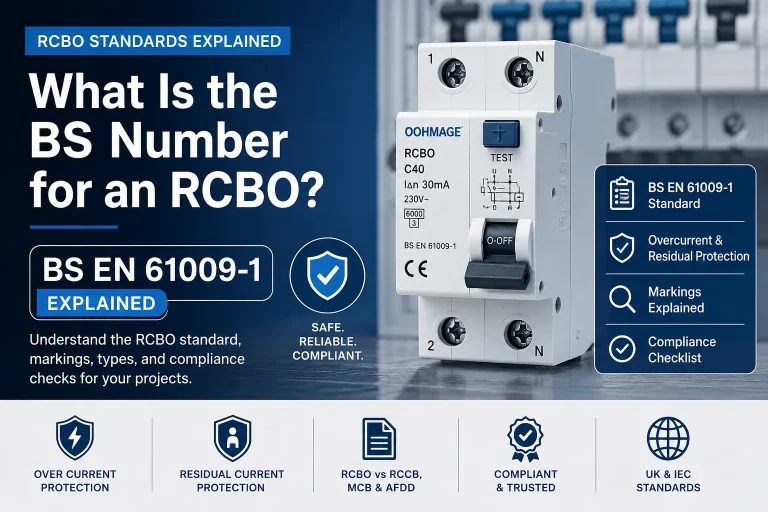
Introduction If you are searching for the RCBO BS number, the answer most commonly required in UK and IEC-based electrical procurement is BS EN 61009-1. This is the principal product standard associated with residual current circuit breakers with overcurrent protection used in residential, commercial, and similar installations. However, merely the BS number is not sufficient […]