Grounding in Surge Protection: Practices and Compliance
Published: Author: Conor
Grounding ensures effective surge protection, ensuring that surge protection devices (SPDs) safely divert excess voltage to prevent equipment damage and fire hazards. According to the IEEE, over 20% of surge-related failures result from improper grounding, highlighting the need for proper installation. I will introduce some grounding principles and compliance requirements in the following content, empowering you to protect electrical systems effectively.
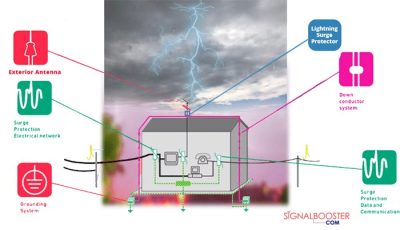
Grounding in surge protection involves connecting an SPD to the earth via a grounding electrode system to safely dissipate excess voltage from power surges, such as those caused by lightning or utility faults.
Without proper grounding, SPDs cannot function effectively, leaving equipment vulnerable to damage and increasing the risk of electrical shocks.
Key Components of Grounding
Grounding Electrode System: Includes grounding rods, plates, or buried conductors that connect to the earth.
Grounding Conductors: Copper or aluminum wires that link the SPD to the electrode system.
Bonding: Ensures all metallic parts (e.g., panels, enclosures) are electrically connected to prevent voltage differences.
Grounding ensures that surges are diverted away from sensitive electronics, making it a critical safety and performance feature for any SPD installation.
Surge Protection Devices and Grounding Requirements
Surge protection devices vary by application, and each type has specific grounding requirements to ensure optimal performance.
SPD Types
Type 1 SPDs: Installed at the service entrance to protect against external surges (e.g., lightning). Require low-impedance grounding (<5 Ohms, per IEEE C62.41).
Type 2 SPDs: Installed at distribution panels for internal surge protection. Need grounding conductors sized per NEC Table 250.66.
Type 3 SPDs: Point-of-use devices (e.g., power strips) for individual equipment. Rely on the existing outlet grounding.
Grounding Specifics
Impedance: Type 1 SPDs need a low-impedance path to handle high-energy surges, typically achieved with dedicated grounding rods.
Conductor Sizing: NEC requires grounding conductors to match the SPD’s current rating (e.g., 6 AWG copper for most Type 2 SPDs).
Bonding: All SPDs must be bonded to the electrical system’s ground bus or neutral to ensure equipotentiality.
Practices for Grounding Surge Protectors
Proper grounding requires adherence to best practices tailored to the application, whether residential, commercial, or industrial.
Without grounding, SPDs cannot redirect excess voltage, rendering them ineffective against surges. This leaves electronics vulnerable and may void SPD warranties.
Solutions for Ungrounded Systems
Retrofit with GFCI Outlets: For Type 3 SPDs, install ground-fault circuit interrupter (GFCI) outlets to provide limited surge protection, though not a full substitute for grounding.
Install a Grounding Electrode System: Hire a licensed electrician to add grounding rods and rewire outlets, ensuring NEC compliance.
Use Isolation Transformers: For sensitive equipment, isolation transformers can provide surge protection without relying on grounding.
Compliance with Standards and Regulations
Grounding for SPDs must comply with national and international standards to ensure safety and performance.
Article 250: Governs grounding and bonding requirements, including electrode systems (250.50) and conductor sizing (250.66).
Article 285: Specifies SPD installation and grounding.
2. IEEE:
C62.41: Defines surge environments and grounding requirements.
C62.45: Outlines testing protocols for SPD grounding.
3. UL 1449: Certifies SPD safety, requiring proper grounding for compliance.
Practical Implications
Verify that grounding systems meet NEC 250.50 (e.g., 8 ft grounding rod buried below the frost line).
Use UL-listed SPDs to ensure compliance with safety standards.
Consult local codes, as some jurisdictions impose stricter requirements.
Common Mistakes and How to Avoid Them
Improper grounding can compromise SPD performance and safety. Here are common mistakes and solutions:
Mistakes
Solutions
Using Water Pipes as Grounding Points: Violates NEC 250.52 and may introduce hazardous voltage.
Install dedicated grounding rods or plates, per NEC.
Long or Looped Conductors: Increases impedance, reducing surge diversion efficiency.
Keep conductors <20 ft and avoid bends or loops.
Neglecting Ground Testing: Fails to identify high-resistance grounds (>5 Ohms).
Test ground resistance annually with a clamp-on tester (e.g., Fluke 1630-2).
Testing and Maintenance of Grounding Systems
Regular testing and maintenance ensure that grounding systems remain effective over time.
Testing Methods
Fall-of-Potential Test: Measures ground resistance using a three-point tester, ideal for new installations.
Continuity Testing: Verifies bonding integrity with a multimeter, ensuring no loose connections.
Maintenance Tips
Inspect connections annually for corrosion, especially in humid climates.
Re-test grounding after electrical upgrades or lightning events.
Document test results to track system performance.
Recommended Tools
Clamp-on ground testers (e.g., Fluke 1630-2) for quick, non-invasive testing.
Multimeters for continuity checks.
Final Thoughts
Proper grounding is essential for surge protection devices to safeguard equipment and ensure safety. By following best practices, complying with NEC and IEEE standards, and addressing challenges like ungrounded systems, every project can achieve reliable surge protection.
OOHMAGE: Protect Your Project Safety
OOHMAGE is your trusted partner in electrical protection, specializing in high-performance surge protection devices (SPDs) and grounding components. With a focus on safety, compliance, and reliability, OOHMAGE delivers solutions that safeguard residential, commercial, and industrial electrical systems against surges and faults.
Why Choose OOHMAGE?
✅ Reliable Quality: All products are manufactured to meet international standards, ensuring dependable protection and long-term durability.
✅ Technical Support: Our team provides expert guidance on product selection and compliance with local and international codes.
✅ Proven Track Record: Trusted by contractors, engineers, and facility managers across the globe for protecting critical infrastructure and sensitive electronics.
FAQs
Why does a surge protector need grounding?
A surge protector, like an outdoor surge protector, needs grounding to divert excess voltage safely to the earth, preventing damage to connected devices. Without grounding, surges may pass through electronics, causing failures.
Can I use a surge protector on an ungrounded outlet?
Surge protectors are less effective on ungrounded outlets, as they lack a path to divert surges. Consider retrofitting with GFCI outlets or installing a grounding system.
How to test a grounding system for surge protection?
Use a clamp-on ground tester to measure resistance (<5 Ohms is ideal) or a multimeter for continuity. Test annually or after electrical changes.
What is the NEC requirement for SPD grounding?
NEC Article 250 requires a grounding electrode system (e.g., 8 ft rod) and proper conductor sizing (per Table 250.66) for SPDs, ensuring low-impedance paths.
What happens if a surge protector is not grounded properly?
If a surge protector is not grounded properly, it cannot safely divert excess voltage to earth. This can result in a surge of energy passing into connected equipment, leading to failures, data loss, or even electrical fires. Improper grounding also risks violating NEC or UL requirements.
Can I install my own grounding rod for surge protection?
Yes, in some residential applications, you can install your own grounding rod, typically an 8-foot copper-clad rod driven into the earth. However, it’s critical to follow NEC Article 250 and ensure it is bonded to the electrical system’s ground bus. Improper installation could create dangerous voltage differences.
Is grounding the same as bonding in surge protection?
No, grounding and bonding are related but distinct. Grounding provides a path to the earth for fault currents or surges. Bonding connects all conductive parts (e.g., metal enclosures, pipes) to ensure there is no voltage difference between them. Both are essential for SPD effectiveness and code compliance.
Figure 1. Three-phase SPD selection starts with system facts, not the largest kA number. A three-phase surge protector should not be selected by the largest kA number on its label. First confirm the system voltage, whether a neutral is present, the earthing arrangement, the installation point, and the required SPD type. Then compare Uc, Up, […]
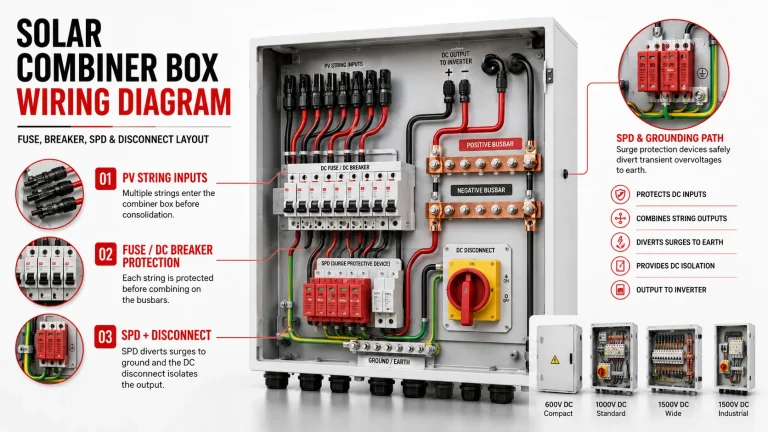
Introduction The wiring diagram of the solar energy combiner box shows how multiple photovoltaic strings enter the combiner box, pass through the string protection device, connect to the positive and negative busbars, ground the surge protection device, and connect to the inverter through the DC circuit breaker. In other words, this diagram not only indicates […]
Sudden power problems do not damage electrical equipment in the same way. Some failures come from long-term voltage instability, while others happen in a split second due to high-energy surges. That’s exactly why a voltage protector and a surge protector serve different purposes—and why using the wrong one can still leave your equipment exposed. In […]