Transient overvoltage is an instant voltage surge that can destroy electronic devices in houses and industries. Knowing its cause, impact, and protection strategies is vital. Join us and learn what transient overvoltage is!
Transient overvoltage is a momentary, high-voltage spike in an electrical system, from microseconds to milliseconds. It is higher than nominal operating levels. Think of it as a sudden increase in water pressure in a pipe, which overwhelms the system.
According to the International Electrotechnical Commission (IEC 61000-4-4), transient surges are as much as thousands of volts and hazardous to sensitive electronics. The phenomenon occurs in all types of devices, from household appliances to industrial equipment, and hence it is crucial to learn about its causes and fixes.
What Causes Transient Overvoltage
External Causes of Transient Overvoltage
Lightning Strikes
Direct lightning strikes or adjacent strikes produce tremendous voltage surges through electromagnetic coupling or ground potential rise.
Even a strike several hundred meters away can induce transients in power lines or communication cables. A single strike can produce surges of more than 100 kV (IEEE C62.41 standards). These are common in regions with high lightning activity, affecting residential houses, telecom towers, and industrial plants.
Power Grid Faults
Utility faults like switching or short circuits produce abrupt voltage surges. For instance, reclosing a miniature circuit breaker upon a fault can cause transients.
They are prevalent in aged grids or overloaded ones, where faults are more frequent. It affects whole blocks of neighborhoods or industrial zones, especially during grid maintenance or shutdowns.
Electromagnetic Interference (EMI)
High-power RF sources (e.g., radar or broadcast towers) or local electrical arcs (e.g., welding) will cause transients on power or signal lines. It is commonly encountered in urban or industrial locations with high EMI source densities.
Internal Causes of Transient Overvoltage
Load Switching
Disconnecting heavy loads such as motors, compressors, or air conditioning units instantly leads to inductive kickback, generating voltage spikes. The transients build up to 2-3 times the system nominal voltage.
It is prevalent in industrial settings with large machinery or commercial buildings with periodic load changes.
Capacitor Bank Switching
On/off switching of capacitor banks in power factor correction systems triggers oscillatory transients, typically in the kHz range. Prevalent in factories or large commercial complexes, optimizing power quality.
Loose connections, damaged insulation, or faulty circuit breakers lead to arcing, producing high-frequency transients. This often occurs in aging electrical systems, from home wiring to industrial panels.
Effects of Transient Overvoltage
Transient overvoltages can wreak havoc on electrical systems, leading to some common impacts. These effects indicate the necessity of strong protection to reduce financial and safety hazards.
Equipment Damage: Spikes burn out circuits, wear down insulation, or destroy devices like computers, TVs, or industrial controllers.
Operational Downtime: Manufacturing and data center industries incur costly downtime.
Safety Risks: While infrequent, excessive surges can initiate fires or result in electrical shock.
Types of Transient Overvoltage
Transient overvoltages are classified into two main types based on their waveform and source:
Type
Description
Duration
Sources
Impulsive Transients
Fast, high-energy spikes
Nanoseconds to microseconds
Lightning, electrostatic discharge
Oscillatory Transients
Ringing waves with decaying amplitude
Microseconds to milliseconds
Capacitor bank switching, load changes
How to Protect Against Transient Overvoltage
Protecting against transient overvoltage is important for the protection of equipment, with surge protection devices (SPDs) being the mainstay of protection. Other electrical measures and non-commercial techniques support SPDs for all-around protection.
Surge Protection Devices (SPDs)
SPDs are the initial line of defense against transient overvoltages, diverting excess voltage to ground before equipment. They’re low-cost and widely used in residential, commercial, and industrial settings.
Per IEC 61643 standards, SPDs are categorized by application:
Type 1 SPDs: Installed at the main electrical panel to handle high-energy surges, including lightning strikes. Ideal for buildings in high-risk areas.
Type 2 SPDs: Placed on sub-panels to protect branch circuits, suitable for offices or residences.
Type 3 SPDs: Point-of-use devices (such as power strips) for sensitive equipment like computers or medical equipment.
Selection Tips:
Choose SPDs by system voltage and surge hazard (such as Type 1 for lightning-prone areas).
Ensure the SPD’s clamping voltage is within equipment tolerances. (Learn more about what is clamping voltage)
Replace SPDs on a regular basis, since they degrade after drawing surges.
Other Electrical Solutions
Beyond SPDs, several devices enhance protection, especially for specific applications:
Devices
Transient Voltage Suppression (TVS) Diodes
Gas Discharge Tubes (GDTs)
Metal Oxide Varistors (MOVs)
Isolation Transformers
Function
Clamp low-energy transients at the circuit level.
Ionize gas to create a low-resistance path for high-energy surges.
Absorb and dissipate transient energy.
Isolate equipment from power line transients and filter noise.
Use Case
Protect sensitive electronics.
Used with SPDs in telecom or utility infrastructure.
Common in consumer surge protectors and industrial systems.
Protect critical systems.
Advantage
Ultra-fast response (picoseconds), ideal for precision equipment.
Handle extreme surge currents, but slower than TVS diodes.
Degrade over time, requiring periodic replacement.
Provide both surge protection and power quality improvement.
Non-Commercial Strategies
In addition to devices, work practices and design practices further augment protection:
Grounding and Bonding: Offer low-impedance paths to ground for safely diverting surges to earth. Periodic inspection prevents corrosion-induced failures.
Circuit Design: Incorporate filters or chokes to suppress transients in sensitive circuits.
Operational Practices: Pull out plug-in equipment from service during a thunderstorm or use automatic disconnect switches on essential equipment.
Practical Tips
Use SPDs at multiple levels (main panel, sub-panel, outlets) to offer layerwise protection.
Mix SPDs with TVS diodes or GDTs in high-risk or sensitive applications.
Maintain grounding systems in position for surge diversion.
Transient overvoltages pose unique challenges in changing environments. Adaptation protection (e.g., Type 3 SPDs in homes, isolation transformers in data centers) offers the best protection.
Different applications:
Residential: Endanger domestic appliances, home automation systems, and chargers.
Industrial: Prevent automation systems, motors, and PLCs.
Automotive: Affect electric vehicles (EVs) while charging or switching.
Data Centers: Place servers, networking hardware, and uptime in jeopardy.
Final Thoughts
Transient overvoltage, a sudden voltage spike due to lightning or switching, jeopardizes equipment and operations. Transient overvoltage lasts but microseconds, but its impact on electrical systems can be long-term and costly.
From lightning discharges to load switching, external and internal conditions alike can induce damaging voltage spikes that threaten equipment, interfere with operations, and cause safety hazards.
By selecting the appropriate combination of surge protection device, circuit-level protection, and grounding procedures, these risks can be easily contained.
OOHMAGE Surge Protection Solutions
For reliable protection against transient overvoltage, OOHMAGE Surge Protection Devices (SPDs) offer a proven, standards-compliant solution trusted across residential, commercial, and industrial environments.
Built to meet international standards, OOHMAGE SPDs suppress dangerous voltage spikes caused by lightning, load switching, or power grid faults. With a complete range, we deliver layered defense tailored to each application.
What is the difference between a transient overvoltage and a power surge?
A power surge is a broader term for any voltage increase, while transient overvoltage refers to short, high-energy spikes (per IEC definitions).
Can transient overvoltage cause fires?
Rarely, but extremely bad surges could warm up wires or equipment enough to create a fire hazard.
How do TVS diodes compare to SPDs for protection?
TVS diodes protect sensitive circuits with fast clamping, while SPDs deal with larger surges at the system level.
Are surge protectors enough to prevent transient overvoltage damage?
Simple surge protectors are useful, but multiple protection (SPDs, grounding, TVS diodes) is optimum for comprehensive protection.
How long does a transient overvoltage last?
Transient overvoltages last for a few nanoseconds up to milliseconds, depending on the reason. Impulsive transients last short, and oscillatory may last longer but fall off rapidly.
What are the signs that a transient overvoltage has occurred?
Typical indications include charred circuit boards, isolated device malfunctioning, frequent resetting of electronic equipment, or char marks, if visible, occurring close to an outlet. They can indicate surge exposure.
Do solar panel systems face transient overvoltage issues?
Yes. Solar panels and inverters can be prone to surges, particularly caused by close-proximity lightning discharges. Use of DC-side SPDs and grounding solutions is advisable.
Figure 1. Contactors, circuit breakers, and motor starters solve different control and protection tasks. These three devices often appear in the same motor-control panel, but they solve different problems. A contactor handles frequent, remote, or automatic switching during normal operation. A circuit breaker interrupts abnormal current within its rated capability. A motor starter normally combines […]
The main types of circuit breakers used in low-voltage distribution include miniature circuit breakers (MCBs), molded case circuit breakers (MCCBs) and residual-current devices such as RCCBs and RCBOs. They are not interchangeable. MCBs and MCCBs are selected for overcurrent protection in different circuit roles, an RCCB provides residual-current protection without integral overcurrent protection, and an […]
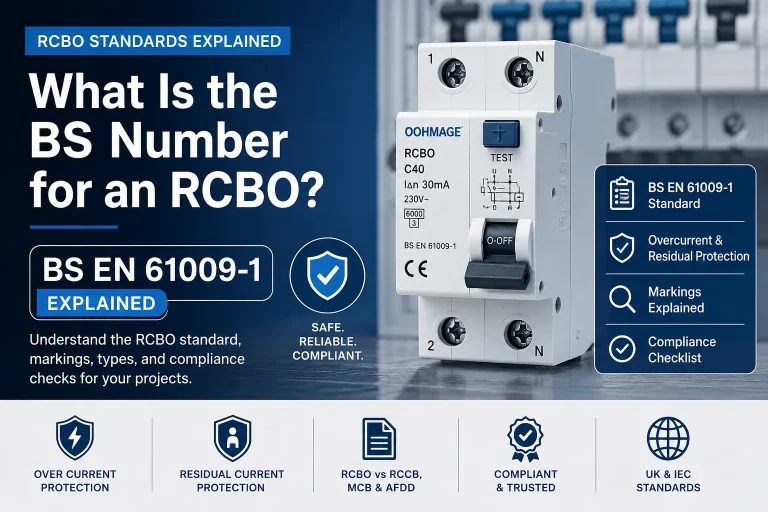
Introduction If you are searching for the RCBO BS number, the answer most commonly required in UK and IEC-based electrical procurement is BS EN 61009-1. This is the principal product standard associated with residual current circuit breakers with overcurrent protection used in residential, commercial, and similar installations. However, merely the BS number is not sufficient […]