3 Phase MCCB: Ratings, Sizes, kA Capacity, and Selection Basics
Published: Author: Joanna
Introduction
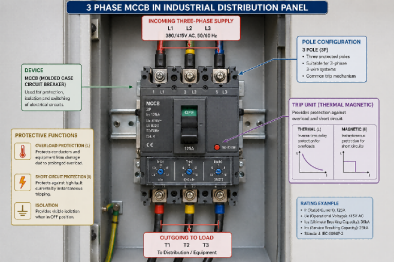
Three-phase molded case circuit breaker (MCCB) is a protective device designed to safeguard three-phase electrical systems from overload and short-circuit faults. When selecting a three-phase MCCB solution, engineers and procurement personnel must consider far more than just the rated current. Factors such as system voltage, pole configuration, fault current level, interrupting capacity, load characteristics, and project documentation all influence whether the circuit breaker is suitable for a particular application.
Three-phase power systems are widely used in industrial plants, commercial facilities, infrastructure projects, renewable energy installations, and modern distribution networks. Choosing the appropriate molded case circuit breaker (MCCB) helps enhance system reliability, reduce downtime, and ensure safe operation of the system under both normal and fault conditions.
This guide explains the working principle of three-phase molded-case circuit breakers (MCCB), common application scenarios, rated parameters and the impact of breaking capacity (kA) on selection, as well as the information that buyers should verify before placing an order.
What Is a 3 Phase MCCB?
Three-phase MCCB is a plastic-case circuit breaker specifically designed to protect three-phase circuits. Its main function is to cut off the power supply in case of overcurrent, overload or short circuit faults.
Unlike the protection devices used in single-phase systems, three-phase molded-case circuit breakers (MCCB) are specifically designed to simultaneously monitor and cut off multiple wires. This makes them suitable for protecting feeder lines, motors, mechanical equipment, switch cabinets, and distribution systems that operate on three-phase power.
Compared with a standard MCB, an MCCB breaker typically offers:
Higher current ratings
Greater short-circuit interruption capability
Adjustable trip settings on selected models
Larger frame sizes for industrial applications
Enhanced protection flexibility
The practical fungsi MCCB 3 phase is to prevent damage to cables, equipment, and distribution infrastructure by isolating faulted circuits before excessive thermal or mechanical stress occurs.
For three-phase projects where trip adjustment is part of the selection requirement, the OMM6RT dual-adjustable MCCB series can be compared with the required current range, pole count and breaking capacity.
Although the term “MCCB circuit breaker” is often used in a general sense, buyers should be aware that there are significant differences in terms of rated current, pole configuration, trip technology and breaking capacity among MCCBs. The correct choice requires an examination of project requirements rather than simply making a selection based on physical size.
Where Are 3 Phase MCCBs Used?
Three-phase molded-case circuit breakers (MCCB) are widely used in various commercial and industrial electrical systems.
Application
Typical Concern
Selection Focus
Industrial control panels
Motor starting currents
Current rating and trip characteristics
Commercial buildings
Distribution protection
Coordination and fault level
Manufacturing machinery
Equipment protection
Load profile and reliability
Renewable energy systems
Variable operating conditions
Voltage compatibility
EV charging infrastructure
High continuous loads
Current rating and future expansion
Distribution boards
Feeder protection
Pole count and breaking capacity
In industrial settings, molded-case circuit breakers (MCCBs) are commonly used as incoming line protection devices or feeder circuit breakers; in commercial buildings, they are employed to protect the distribution circuits that supply power to HVAC systems, elevators, lighting systems, and critical infrastructure.
Renewable energy installations and EV charging projects increasingly require carefully specified industrial MCCB solutions due to changing load patterns and fault-current considerations.
Regardless of application, a properly selected 3 phase breaker should be capable of handling both the expected operating current and the prospective fault current present at the installation location.
3 Phase MCCB Ampere Ratings and Common Sizes
One of the most common questions raised by buyers concerns the rated current. However, if a molded-case circuit breaker (MCCB) is selected solely based on its rated current, it may result in insufficient or excessive protection capacity.
The rated current value represents the continuous current that the circuit breaker is designed to handle under specific operating conditions. Common searches in the market often focus on specific rated values such as 50A or 100A, but these figures are not universal recommended standards.
Common Buyer Searches
Search Demand Example
What the Buyer Is Usually Checking
What Must Be Verified
MCCB 3 phase 50 ampere
Small feeder or equipment protection
Load current, cable size, fault level
MCCB 3 phase 100 ampere
Larger feeder applications
System design and derating
MCCB 3 phase 4 pole
Neutral switching requirement
Wiring design and project specification
When reviewing a tabel ukuran MCCB 3 phase, buyers should verify:
Actual load current
Maximum demand
Ambient temperature
Installation environment
Cable capacity
Diversity factors
Future expansion plans
For instance, the system drawings might suggest the use of a three-phase molded-case circuit breaker (MCCB) with a rated current of 50 amperes. However, a detailed engineering assessment might reveal that the future load growth will require different rated parameters.
Similarly, if a three-phase 100-amp molded-case circuit breaker (MCCB) is specified without assessing the fault current level, it may result in insufficient protection performance.
When choosing circuit breakers, a common mistake often occurs – selecting them solely based on the rated current. To correctly select a three-phase molded-case circuit breaker (MCCB), one must also consider the rated voltage, pole configuration, trip unit characteristics, and breaking capacity.
Important: Never select an MCCB based on ampere rating alone. Engineering verification should always confirm the complete protection requirement.
3 Pole vs 4 Pole MCCB for Three-Phase Systems
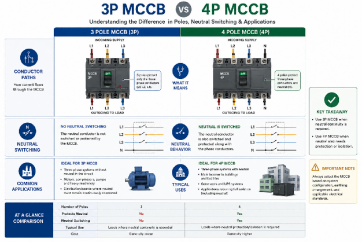
Three-phase MCCBs are commonly available in both 3-pole (3P) and 4-pole (4P) configurations.
A 3 pole MCCB protects and disconnects the three phase conductors. This configuration is frequently used in standard three-phase distribution systems where neutral switching is not required.
A 4 pole MCCB includes an additional pole designed to switch the neutral conductor alongside the phase conductors.
Practical Comparison
Feature
3 Pole MCCB
4 Pole MCCB
Protected Conductors
Three phases
Three phases + neutral
Neutral Isolation
No
Yes
Space Requirement
Smaller
Larger
Typical Applications
Standard distribution systems
Systems requiring neutral switching
The choice between a 3 pole MCCB and 4 pole MCCB depends on project specifications, electrical design philosophy, and local requirements.
For certain commercial buildings, critical infrastructure systems, or those that incorporate neutral line isolation as part of the protection strategy, a three-phase four-pole molded case circuit breaker (MCCB) may be specified.
Due to the varying wiring practices in different regions and projects, the buyer should always follow the project documentation and electrical engineering standards, rather than relying on general assumptions.
Breaking Capacity and kA Rating for 3 Phase MCCBs
The interrupting capacity is one of the most important but often misunderstood specification parameters of molded case circuit breakers (MCCB).
The interrupting capacity of MCCB refers to the maximum fault current that the circuit breaker can safely interrupt under the specified test conditions. This value is usually expressed in kiloamperes (kA).
If the interrupting capacity of the circuit breaker is insufficient, even if its rated current seems appropriate, it may not be able to safely remove the fault.
Key MCCB Ratings
Term
Meaning
Why It Matters
Rated Current
Continuous current rating
Prevents overload mismatch
Breaking Capacity (kA)
Fault interruption capability
Prevents underspecified protection
Icu
Ultimate breaking capacity
Indicates maximum interruption capability
Ics
Service breaking capacity
Indicates reusable operational performance
The MCCB kA rating should always be compared with the calculated prospective fault current at the installation location.
For example:
Low fault-level installations may require lower kA ratings.
Industrial facilities near transformers often require significantly higher ratings.
Large distribution systems may demand advanced coordination studies.
OOHMAGE’s product range includes MCCBs with breaking capacities up to 100kA, depending on the selected product series and configuration.
How to Select a 3 Phase MCCB for a Project
Selecting an MCCB involves evaluating the complete electrical system rather than focusing on a single specification.
Practical Selection Checklist
Before requesting quotations, verify:
Load type
Rated current
Operating voltage
AC or DC requirement
Number of poles
Expected fault current
Required breaking capacity
Trip unit type
Cable sizing
Panel design
Installation environment
Datasheet and certification requirements
Recommended Selection Process
Confirm system voltage.
Calculate expected load current.
Review future load expansion requirements.
Determine pole configuration.
Calculate prospective fault current.
Select appropriate breaking capacity.
Review trip characteristics.
Check installation conditions.
Verify project documentation requirements.
Complete engineering approval process.
Determining the appropriate specification for a molded-case circuit breaker (MCCB) requires an analysis specific to the particular system; there is no universal formula that applies to all installation scenarios.
The most reliable approach is to comprehensively consider load calculation, fault level analysis, manufacturer technical data, and engineering review results before finalizing the selection.
Price, Brand, and Supplier Considerations
When many buyers start the sourcing process, they usually first compare the suppliers and prices. While price is indeed important, it should not be the primary criterion for selection.
The cost of an MCCB can vary based on:
Current rating
Pole count
Breaking capacity
Trip unit technology
Accessories
Certification requirements
Quantity ordered
Project specifications
For this reason, two breakers with similar ampere ratings may have significantly different prices.
When evaluating an MCCB supplier or MCCB manufacturer, buyers should review:
Technical support capability
Product documentation
Available ratings
Lead times
Quality control processes
OEM/ODM support options
The objective should be obtaining the correct protection solution rather than simply selecting the lowest-priced device.
Documentation to Check Before Buying a 3 Phase MCCB
Technical documentation plays a critical role in product selection and project approval.
A complete MCCB datasheet should clearly identify:
Model designation
Rated current
Rated voltage
Pole configuration
Breaking capacity
Trip unit information
Applicable standards
Available accessories
Installation instructions
Buyers should also request relevant documentation supporting project requirements.
Documentation Checklist
Product datasheet
Technical catalogue
Standard compliance information
Test documentation (where applicable)
Accessory compatibility details
Installation instructions
Dimensional drawings
The acceptance requirements vary across different industries and markets. Therefore, it is essential to confirm the local project requirements before making the purchase.
How OOHMAGE Supports 3 Phase MCCB Selection
OOHMAGE provides molded case circuit breaker solutions for industrial and commercial electrical applications.
Based on currently available product information, OOHMAGE supports:
Current ratings from 10A to 2000A
Breaking capacities up to 100kA
Compatibility with 230V, 400V, and 690V AC systems
Industrial and commercial applications
OEM and ODM support services
To help identify a suitable solution, project teams should provide:
System voltage
Required current rating
Pole configuration
Fault current information
Documentation requirements
For additional information, buyers can review the OOHMAGE molded case circuit breaker product range before requesting technical assistance.
Final Selection Checklist
Before purchasing a 3 phase MCCB, confirm the following:
Verify the three-phase system voltage.
Calculate or confirm the load current.
Select an appropriate current rating.
Confirm whether 3P or 4P protection is required.
Verify required kA breaking capacity.
Review trip unit specifications.
Confirm accessory requirements.
Review datasheets and certificates.
Check installation conditions.
Confirm local project requirements.
Following this checklist helps to reduce specification errors and supports a more efficient procurement process.
FAQ
What is a 3 phase MCCB?
A 3 phase MCCB is a molded case circuit breaker designed to protect three-phase electrical systems against overloads and short circuits. It can disconnect multiple conductors simultaneously and is widely used in industrial and commercial power distribution systems.
What is the function of a 3 phase MCCB?
The main function of the three-phase molded-case circuit breaker (MCCB) is to protect the circuit and the connected equipment from overload and short-circuit faults, thereby preventing equipment damage, cable overheating, and system shutdown.
How do I choose the ampere rating of a 3 phase MCCB?
The ampere rating should be selected based on actual load current, cable capacity, operating conditions, and future expansion requirements. Avoid selecting a breaker solely because it matches a common rating such as 50A or 100A.
What is the difference between 3 pole and 4 pole MCCB?
The three-pole plastic housing circuit breaker (MCCB) only cuts off the three-phase conductors, while the four-pole MCCB includes an additional neutral pole. The specific choice depends on the project specifications and system design requirements.
What does kA rating mean in a 3 phase MCCB?
The kA rating indicates the maximum fault current the breaker can safely interrupt. This value must be greater than the prospective fault current available at the installation location.
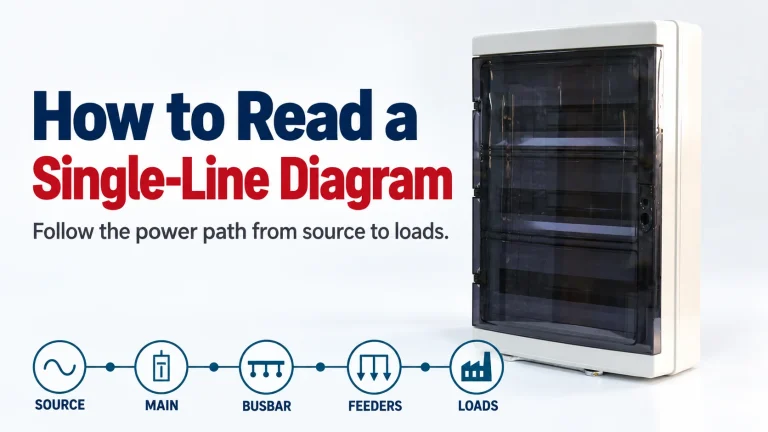
A single-line diagram can look simple and still be difficult to read. One line may represent a multiphase circuit, a small symbol may stand for a major protective device, and a short label may carry the information that determines what equipment belongs downstream. The most reliable way to read a single-line diagram is to follow […]
Figure 1. Three-phase SPD selection starts with system facts, not the largest kA number. A three-phase surge protector should not be selected by the largest kA number on its label. First confirm the system voltage, whether a neutral is present, the earthing arrangement, the installation point, and the required SPD type. Then compare Uc, Up, […]
An AC-only miniature circuit-breaker,you cannot treat it as a DC circuit by default.Confirm before using: If the manufacturer explicitly rates the selected model for the required DC voltage, pole arrangement, polarity where applicable, fault current, and breaking capacity.Some breakers carry both AC and DC ratings, but these alone cannot reflect the actual situation. If the […]