Isolator switches are vital devices in electrical engineering that disconnect circuits for maintenance, repair, or emergency use safely. Their uses extend from domestic wiring to commercial structures, industrial machinery, and renewable energy systems, driven by the need for secure power isolation.
This handbook provides a detailed overview of isolator switches, addressing their operating concepts, AC and DC types, technical specifications, standardization by legislation, engineering applications, and selection principles, rendering it an extensive guidebook for engineers, electricians, and plant operators.
What Is an Isolator Switch?
An isolator switch is a manual operating electromechanical device intended to open electrical circuits by physical separation among conductive items such that there is no flow of current under off-load conditions.
Compared to circuit breakers like miniature circuit breaker, where faults are broken automatically, isolators provide a visible break—noticed gaps in between contacts (3–5 mm)—for de-energization assurance.
They employ mechanisms such as rotary handles, toggle levers, or sliding blades, with contact materials such as silver-plated copper for conductivity and durability. Rated capacities range from 10A to over 1000A, depending on application and design.
Isolator Switch Types: AC vs. DC Isolator Switches
Isolator switches come in alternating current (AC) or direct current (DC) types with individual electrical and mechanical specifications. You can read our blog: DC vs AC Isolator Switches to know more about the topic.
AC Isolator Switch
Voltage/Current Ratings: 230V to 690V AC, 16A to 630A, some heavy-duty models up to 1250A.
Applications: Subpanels in the home (e.g., 230V, 40A), HVAC systems (e.g., 400V, 100A), and industrial motor starters (e.g., 690V, 400A).
Features: Operates at 50Hz or 60Hz, leveraging AC’s zero-crossing to extinguish arcs naturally within 10–20 ms. Contacts experience minimal wear, with a mean lifetime of 15,000 cycles.
Voltage/Current Ratings: 12V to 1500V DC, 10A to 800A, with high-voltage devices up to 2000V for high-voltage DC grids.
Applications: Solar photovoltaic arrays (e.g., 1000V, 32A), battery energy storage (e.g., 48V, 200A), and DC traction systems (e.g., 750V, 600A).
Features: Accommodate prolonged DC flow, requiring arc suppression by magnetic blowouts or ceramic quenching chambers to extinguish arcs in less than 5 ms. Erosion of contact is higher, reducing lifespan to 10,000–12,000 cycles with no maintenance.
Aspects
AC Isolator Switch
DC Isolator Switch
Voltage/Current Ratings
230V to 690V AC
16A to 630A
Some heavy-duty models up to 1250A
12V to 1500V DC
10A to 800A
High-voltage devices up to 2000V for high-voltage DC grids
Applications
Subpanels in the home
HVAC systems
Industrial motor starters
Solar photovoltaic arrays
Battery energy storage
DC traction systems
Features
Operates at 50Hz or 60Hz, leveraging AC’s zero-crossing to extinguish arcs naturally within 10–20 ms
Require arc suppression by magnetic blowouts or ceramic quenching chambers to extinguish arcs in less than 5 ms
How Isolator Switches Work
Isolator switches interrupt current physically, splitting contacts, with varying procedures for AC and DC:
AC Operation: Contacts are opened within a zero-crossing period, minimizing arcing to 0.01–0.02 seconds. Electromagnetic forces provide aid to separation, with contact gaps built at 4–8 mm according to IEC standards.
DC Operation: Continuous current generates stabilized arcs (up to 1000°C), opposed by arc chutes splitting the arc into divisions and magnetic fields deflecting away from contacts, leading to extinction in 3–5 ms.
Safety Features: Locking handles (e.g., to take 6 mm padlocks) ensure compliance with lockout-tagout (LOTO) practices, while IP66 or IP67-rated enclosures provide dust ingress protection (0.05 mm) and water jet protection (12.5 L/min). Insulation resistance is greater than 100 MΩ at 500V DC.
Unlike circuit breakers, isolators lack thermal or magnetic tripping but operate only off-load to prioritize safety over protection.
Applications of Isolator Switches
Isolator switches are employed in several industries:
Residential: Isolate circuits for rewiring (e.g., 230V, 32A, lighting), with single-pole units widely used in consumer units supplying 2–3 kW loads.
Renewable Energy: Isolate solar PV strings (e.g., 1000V DC, 32A, 8 kW per string) or battery banks (e.g., 48V DC, 200A, 10 kWh), critical for installer safety and system life.
Their role ensures compliance with occupational safety codes to prevent electrical accidents that account for 8% of industrial mishaps annually.
Isolator Switch Technical Standards
Isolator switches meet stringent specifications. The following are some key standards:
IEC 60947-3: Specifies performance for AC low-voltage switchgear—up to 1000V, up to 1500V DC, breaking capacity of 10 times rated current (for instance, 320A for a unit of 32A), mechanical life of 10,000 cycles, electrical life 1,500–2,000 operations.
UL 508: Industrial control standard in North America, with 2.5kV dielectric withstand for 60 seconds and 5kA–10kA short-circuit withstand.
AS/NZS 3947: Australasian standard, mandating thermal stability (-5°C to 40°C, derating 1% per °C above 25°C) and IP ratings (e.g., IP66 for 100 kPa water pressure).
Additional tests include vibration resistance (5–150 Hz, 2g), humidity tolerance (95% RH at 40°C), and breakdown of insulation at 3kV, for dependability in any condition.
Selecting the Right Isolator Switch
How to choose a systematic evaluation? Follow these steps to choose.
Identify Circuit Type: AC for grid-connected systems (50/60Hz), DC for solar/battery installations (constant polarity).
Assess Voltage/Current Requirements: E.g., 230V AC/40A for household, 1500V DC/50A for big PV arrays.
Select Pole Configuration: 1P for single-phase (e.g., 230V lighting), 2P for DC solar (positive/negative), 4P for three-phase AC with neutral (e.g., 400V motors).
Consider Environmental Factors: IP67 for coastal areas (salt spray), -25°C to 70°C for extreme environments, UV resistance for outdoor DC units (10-year degradation limit).
Typically, using isolator switches can lead to some misconceptions.
Undersizing: A 16A isolator on a 25A circuit overheats, reducing lifespan by 50% (e.g., 5,000 cycles).
DC Misapplication: AC isolators used on DC loads are burned down in 100 operations by arcs (e.g., 50V/cm length of arc).
Adequate deployment and maintenance ensure the switch’s longevity.
Installation: Mount on a 35 mm DIN rail or on the wall with M6 screws, wire with cables of size corresponding to load (e.g., 6mm² for 40A, 16mm² for 100A), and secure terminals to 2.5 Nm. Verify isolation with a multimeter (<0.5V between contacts).
Maintenance: Inspect every year for pitting (contact resistance >0.1 Ω signifies wear), lubricate rotary units with dielectric grease (0.5 g), and blow out IP66/IP67 units with compressed air (5 bar) to remove dust (<0.1 mm particles). Replace units at 10,000 cycles or when insulation is below 50 MΩ.
LOTO Safety Protocols: Lock with a 6 mm padlock, attach a tag (e.g., “Do Not Operate”), and check with a non-contact voltage tester (50V–1000V sensitivity).
Isolator Switches vs. Disconnect vs. Circuit Breakers
Isolators: Manual, off-load, $20–$100, 10–15 kg weight, focus on isolation (e.g., 32A at 230V AC).
Circuit Breakers: Automatic, on-load, $50–$200, 0.5–2 kg, protect against overloads/short-circuits (e.g., 25A at 230V AC, 6kA breaking). Read more in our blog: Circuit Breaker vs. Isolator.
Disconnect Switches: Manual, off-load, $30–$150, often fused (e.g., 63A with 10×32 mm fuse), used in high-power distribution (e.g., 1000A at 690V). Read more in our blog: Isolation Switch vs. Disconnect.
Equipment
Features
Isolators
Manual, focus on isolation (e.g., 32A at 230V AC)
Disconnect Switches
Automatic, protect against overloads/short-circuits (e.g., 25A at 230V AC, 6kA breaking)
Circuit Breakers
Manual, often fused (e.g., 63A with 10×32 mm fuse), used in high-power distribution (e.g., 1000A at 690V)
OOHMAGE: The Comprehensive Supplier for Isolator Switches
Consulting qualified professionals when planning an electrical installation can help determine the best devices. Partnering with a reliable supplier can make all the difference.
OOHMAGE stands out as a trusted name in electrical safety equipment, offering a comprehensive range of high-quality isolation switches, disconnect switches, and related components.
How does an isolator switch differ from a circuit breaker?
Unlike automatic fault interrupting of current by circuit breakers, isolator switches are switched manually and used only for de-energizing a circuit. They provide a visible gap between the contacts for verifying isolation, but do not provide overload protection.
How do isolator switches ensure safe operation?
They are designed with features like a readily readable contact gap (typically 3–5 mm) and locking handles to support lockout-tagout (LOTO) regulations. Their heavy-duty construction and compliance with worldwide standards also support secure isolation in hostile environments.
How are isolator switches installed and maintained?
Mounting is generally carried out on DIN rails or on walls with neat cabling (with cables of the appropriate sizes) and with connections properly secured.
Preventive maintenance consists of the yearly examination for wear in contacts, cleaning (with air on IP66/IP67 products), greasing mechanical parts, and good lockout-tagout practices being enforced.
What safety features do isolator switches have?
They have lockable handles for secure isolation, visible contact gaps to confirm de-energization, and are built to pass rigorous electrical and mechanical endurance tests. These aspects guarantee operator safety and compliance with workplace safety protocols.
Figure 1. Contactors, circuit breakers, and motor starters solve different control and protection tasks. These three devices often appear in the same motor-control panel, but they solve different problems. A contactor handles frequent, remote, or automatic switching during normal operation. A circuit breaker interrupts abnormal current within its rated capability. A motor starter normally combines […]
The main types of circuit breakers used in low-voltage distribution include miniature circuit breakers (MCBs), molded case circuit breakers (MCCBs) and residual-current devices such as RCCBs and RCBOs. They are not interchangeable. MCBs and MCCBs are selected for overcurrent protection in different circuit roles, an RCCB provides residual-current protection without integral overcurrent protection, and an […]
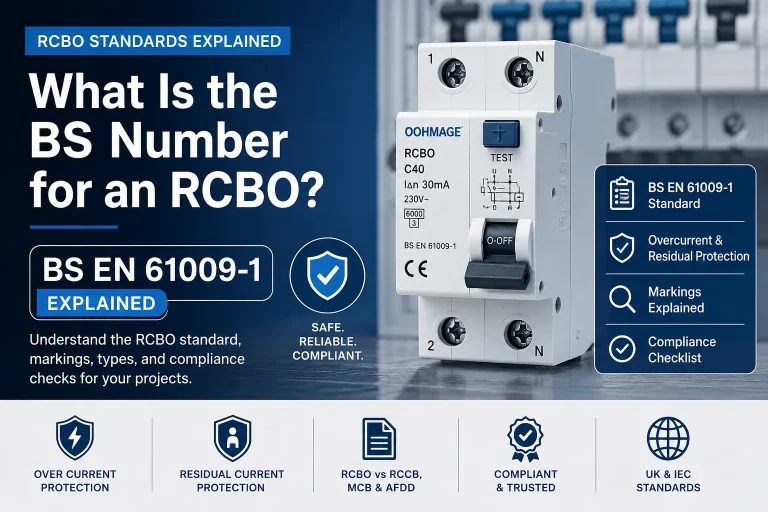
Introduction If you are searching for the RCBO BS number, the answer most commonly required in UK and IEC-based electrical procurement is BS EN 61009-1. This is the principal product standard associated with residual current circuit breakers with overcurrent protection used in residential, commercial, and similar installations. However, merely the BS number is not sufficient […]