Single-Phase vs Three-Phase Power: A Complete Guide for Homes and Businesses
Published: Author: Conor
When it comes to choosing the right electrical system for your home, business, or industrial setup, understanding the difference between single-phase and three-phase power is crucial. Around the world, households generally rely on single-phase systems, while factories and industrial facilities almost always depend on three-phase power for greater efficiency and stability. Each system has its own advantages, applications, and ideal use cases. Whether you’re building a new property, upgrading an existing system, or simply curious about the differences, this guide will walk you through the essentials of both single-phase and three-phase power systems, helping you make an informed decision.
Single-phase power is the most common form of electrical power used in residential homes and small businesses. It consists of two wires: one hot (live) wire and one neutral wire. The electric current flows through the hot wire to the electrical devices and returns via the neutral wire.
How It Works
In a single-phase system, the power supply is delivered to the load in a continuous wave. This means that the voltage rises and falls in a sinusoidal waveform. However, because the power supply in a single-phase system is not constant throughout the cycle, it is best suited for low-demand applications like lighting, small appliances, and residential heating.
Common Applications
Single-phase power is commonly used in the following types of applications:
Residential homes: Powering basic household devices, including lighting, air conditioning units, and kitchen appliances.
Small businesses: When the power demand is relatively low, such as for small offices or retail outlets.
Light commercial equipment: Items like fans, heaters, and small motors often run on single-phase systems.
Advantages of Single-Phase Power
Single-phase power offers several advantages that make it the preferred choice for households and small businesses. It is generally more cost-effective to install and maintain compared to three-phase systems, since the setup is simpler and requires fewer components. This not only reduces initial installation costs but also makes the process faster and easier.
Moreover, single-phase power is perfectly suited for applications with relatively low energy demands, such as residential properties and small-scale commercial facilities, where the need for high power is minimal.
Disadvantages of Single-Phase Power
Despite its advantages, single-phase power also has several limitations. Its power capacity is relatively low, making it unsuitable for heavy machinery or industrial equipment. Voltage in a single-phase system fluctuates throughout the cycle, which can lead to instability in sensitive devices. This makes it inefficient for high-power loads, as using large equipment can result in wear and reduced operational efficiency.
Additionally, single-phase power is not ideal for long-distance transmission, since voltage drops over distance require larger and more expensive cables to minimize losses. For larger-scale operations, these inefficiencies can translate into higher energy consumption and increased operating costs.
Three-phase power, on the other hand, is typically used in commercial, industrial, and large-scale applications. Unlike single-phase systems that use two wires, three-phase systems utilize three live wires, each carrying alternating current that is offset by 120 degrees. This means that power is continuously delivered, resulting in a much more stable and efficient energy flow.
How It Works
In a three-phase system, the three wires (each carrying AC) operate in a rotating sequence. As the current in one wire reaches its peak, the other two wires are at different stages of their cycles, ensuring a continuous flow of power. This constant supply is ideal for heavy equipment that requires large amounts of energy, such as motors, machines, and HVAC systems.
Common Applications
Three-phase power is commonly used in the following types of applications:
Large businesses and factories: For heavy machinery, manufacturing equipment, and other large-scale operations.
Commercial buildings: High-rise buildings, large office spaces, and malls require more power, which is easily supplied by three-phase systems.
Industrial machinery: Motors, pumps, and compressors are often designed for three-phase power.
Residential complexes with high power demand: In regions like Europe, apartment complexes that support centralized elevators, HVAC systems, and other heavy-load devices often adopt three-phase systems to ensure stable and efficient operation.
Advantages of Three-Phase Power
Three-phase systems offer several significant advantages that make them ideal for high-demand applications. They provide more efficient and consistent power delivery, minimizing voltage fluctuations and energy losses. These systems are capable of handling larger electrical loads without placing strain on the network, making them suitable for industrial machinery and commercial facilities.
While the initial installation costs may be higher compared to single-phase systems, three-phase power often proves more cost-effective in the long run for high-demand operations, thanks to reduced energy losses and improved operational efficiency.
Disadvantages of Three-Phase Power
Despite their benefits, three-phase systems also have some drawbacks. The installation process is generally more expensive and complex, requiring additional wiring, equipment, and technical expertise. For small-scale or residential setups, three-phase power is often unnecessary, leading to inefficient use of resources. These systems also require more physical space to accommodate extra wiring and equipment, which may not be feasible in compact environments.
Finally, while three-phase power is generally reliable, larger industrial installations may require more maintenance and monitoring to ensure safe and continuous operation.
Key Differences: Single-Phase vs Three-Phase Power
Power Consistency: Single-phase power can fluctuate throughout the cycle, causing voltage dips or spikes that may affect sensitive devices. Three-phase power, with its overlapping phases, delivers a continuous and balanced flow, ensuring stable electricity for industrial machinery, commercial equipment, and other high-demand applications.
Capacity and Efficiency: Single-phase systems are best for low-demand applications like lighting, small appliances, and residential heating, but they struggle with heavy machinery or large-scale industrial equipment. Three-phase systems handle higher loads more efficiently, making them ideal for factories, large commercial buildings, and energy-intensive operations.
Cost: Installing single-phase power is generally cheaper due to fewer wires and simpler setup. While three-phase systems have higher initial costs from extra wiring andelectrical equipment, they are more cost-effective over time in high-demand settings because they reduce energy losses and improve operational efficiency.
Size and Space: Single-phase setups are compact and suitable for homes or small businesses with limited space. Three-phase systems require more room for additional wiring, larger transformers, and other components, fitting better in commercial and industrial installations.
Use Cases: Single-phase power works well for residential homes, small offices, and light commercial setups with moderate energy needs. Three-phase power is necessary for factories, high-rise buildings, shopping malls, and industrial processes that demand stable, high-capacity electricity.
Feature
Single-Phase Power
Three-Phase Power
Number of Wires
Typically 2 wires: 1 hot, 1 neutral
Typically 4 wires: 3 hot (phases), 1 neutral
Power Consistency
Voltage fluctuates throughout the cycle, less stable
Continuous, balanced power flow, more stable
Capacity and Efficiency
Suitable for low-power applications
Handles high-power loads efficiently
Cost
Lower installation cost, cheaper wiring
Higher installation cost, but cost-effective for high-demand use
Size and Space
Compact setup, requires fewer components
Requires more space for additional wires and equipment
Use Cases
Homes, small businesses, light commercial equipment
Large businesses, factories, commercial buildings, industrial machinery
Converting Between Single-Phase and Three-Phase Power
Sometimes, you may need to convert your electrical system from single-phase to three-phase, or vice versa, due to business expansion, equipment upgrades, or moving to a location with a different power supply. Residential users may upgrade to three-phase to support high-power equipment such as electric vehicles or large air conditioning units. For businesses, adding larger machinery or expanding operations often necessitates a switch to three-phase power.
The cost of conversion varies depending on the scale of the project, complexity of wiring, and any required permits. In general, upgrading to three-phase is more expensive because of the additional wiring and equipment required.
The conversion process typically involves the following steps and should always be performed by a licensed electrician to ensure safety and compliance with local codes:
Single-phase to Three-phase: Upgrade the electrical panel, install a transformer, and run additional wiring.
Three-phase to Single-phase: Downsize or simplify the system by converting to a single-phase supply, which may involve different transformers and rewiring.
Choosing the Right System for Your Electrical Setup
For most homes, single-phase power is sufficient to handle lighting, heating, appliances, and personal devices efficiently. Businesses and industrial facilities with high-demand equipment, such as large HVAC systems or manufacturing machinery, benefit from three-phase power for greater reliability and consistent energy delivery.
Key Factors to Consider:
Power Load: Small homes and offices typically operate well on single-phase power, while industrial equipment and high-demand operations require three-phase systems.
Space: Three-phase systems need more room for wiring, transformers, and other components, whereas single-phase setups are more compact.
Cost: Single-phase power is cheaper to install initially, but three-phase systems can be more cost-effective over time for facilities with high and continuous power demands.
Electrical Safety Tips for Single-Phase and Three-Phase Systems
Safety should always be the top priority when dealing with electricity, whether you are using a single-phase or three-phase system. Single-phase systems generally pose lower risks, but poor wiring or faulty installations can still result in shocks or fire hazards. Three-phase systems, due to higher voltages and larger power loads, can be more dangerous if handled improperly, potentially leading to equipment failure, electrical fires, or serious injuries.
To ensure safe operation, always hire a licensed electrician for installation or upgrades. Professionals can verify that your system meets local codes and is set up correctly. Additionally, make sure your electrical system is designed to handle the intended load, as overloading can cause overheating, short circuits, and other hazards. Regular maintenance and inspections are essential for both single-phase and three-phase setups. Routinely check wiring, connections, and equipment to prevent potential issues before they escalate.
Conclusion
Choosing between single-phase and three-phase power depends on your power needs, the size of your property or business, and your budget. Single-phase systems are ideal for residential use and small businesses, offering simplicity and affordability. Three-phase systems, on the other hand, are more efficient and necessary for larger-scale commercial and industrial applications where power demand is higher.
Want to know more detailed electrical standards and calculation methods, please read our blog:
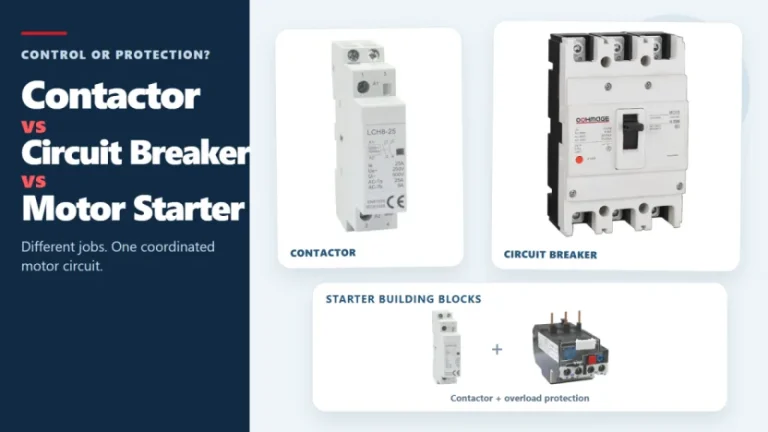
Figure 1. Contactors, circuit breakers, and motor starters solve different control and protection tasks. These three devices often appear in the same motor-control panel, but they solve different problems. A contactor handles frequent, remote, or automatic switching during normal operation. A circuit breaker interrupts abnormal current within its rated capability. A motor starter normally combines […]
Introduction The concept of remote tripping is simple, but in actual operation, project teams often encounter difficulties in specifying the components. The panel factory may require circuit breakers triggered by fire alarm relays, PLC outputs, building management system instructions, or other coordinated control. At this point, “diversion tripping” is only the first step in the […]
The main types of circuit breakers used in low-voltage distribution include miniature circuit breakers (MCBs), molded case circuit breakers (MCCBs) and residual-current devices such as RCCBs and RCBOs. They are not interchangeable. MCBs and MCCBs are selected for overcurrent protection in different circuit roles, an RCCB provides residual-current protection without integral overcurrent protection, and an […]