Single-Phase vs Three-Phase Power: Applications, Details & Selection
Published: Author: Conor
Electric power systems form the core of modern life, providing power to homes, businesses, and industries. Single-phase vs three-phase power are the two broad arrangements that are available for various uses, from powering small home appliances to powering high industrial machines.
Both the choice and efficiency rely on choosing the right system. The following content explores more on single-phase and three-phase power, their technical specifications, mode of operation, and selection criteria.
What Are Single-Phase and Three-Phase Power?
Single-Phase Power
Single-phase power has one live wire and a neutral, delivering alternating current (AC) through a single sinusoidal waveform. It operates on standard voltages of 120V in the US or 230V in Europe and Asia, at a frequency of either 50Hz or 60Hz.
The current varies, approaching zero twice in a cycle (every 10 ms at 50Hz), resulting in a pulsating supply of power. This type of setup is common for loads of up to 10–15 kilowatts (kW).
Three-Phase Power
Three-phase power uses three live wires, each has AC displaced by 120° in phase, and so offers a constant supply of power. Typical voltages are 208V to 480V in the US and 400V to 690V in Europe, at either 50Hz or 60Hz. Overlapping waveforms give a constant supply of power, with no less than 86.6% of maximum power at any time. The system supports large-capacity loads, typically in excess of 50kW.
Single-phase and three-phase power differ significantly in their electrical properties:
1. Voltage and Current: Single-phase typically delivers 230V at 40A (9.2kW with a power factor of 1), while three-phase provides 400V at 100A per phase (69kW total).
2. Power Formulas: Single-phase power is calculated as P = V × I × PF, where PF is the power factor (e.g., 0.9 for typical loads).
Three-phase power uses P = √3 × V × I × PF, yielding 1.732 times more power per unit of current due to phase multiplication.
3. Efficiency: Three-phase systems reduce line losses by 25–30% compared to single-phase, as current is distributed across three conductors, lowering resistive heating (I²R losses).
4. Wiring: Single-phase requires two wires (live and neutral), while three-phase uses three or four wires (three live, optional neutral for unbalanced loads).
5. Load Capacity: Single-phase supports up to 15kW with standard 63A breakers, whereas three-phase handles 50kW–500kW or more with 250A+ breakers.
Single-Phase vs Three-Phase Power: How They Work
Single-phase power delivers energy in a single AC cycle, powering loads intermittently as the voltage peaks and drops. This suits resistive devices like heaters (2kW) or lighting (500W), where power fluctuations are tolerable.
In contrast, three-phase power synchronizes three AC cycles, each offset by 120°, providing a steady output. This stability is critical for inductive loads such as motors (10kW), where consistent torque reduces vibration and wear.
The 120° phase separation in three-phase systems minimizes torque ripple to 5%, compared to 50% in single-phase motors, enhancing mechanical efficiency.
Three-phase maintains an average power delivery of 86.6% of its peak, versus 50% for single-phase, due to its continuous waveform overlap.
Applications of Single-Phase and Three-Phase Power
Three-phase systems dominate where power demand exceeds 15kW, while single-phase suffices for lighter loads.
Single-Phase Applications
Residential: Powers lighting circuits (500W), small appliances (1–3kW like refrigerators), and domestic electric vehicle chargers (7kW at 32A).
Small Commercial: Supports office equipment (2kW total) and retail HVAC units (5kW), typically under 10kW total demand.
Three-Phase Applications
Industrial: Drives large motors (10–100kW), manufacturing lines (200kVA), and CNC machines requiring stable power.
Commercial: Supplies data centers (50kVA), large HVAC systems (20kW), and escalators in shopping centers.
Renewable Energy: Supports solar inverters (>10kW output) and high-power EV charging stations (50kW–150kW).
Difference Between Three-Phase and Single-Phase Power Supply
Single-Phase Power
Advantages: Requires simpler wiring (2-core cable, 2.5mm² for 32A), lower installation costs ($50–$200 for a distribution panel), and is universally available in residential grids.
Disadvantages: Limited to 10–15kW, with higher voltage drops (e.g., 5% over 100m at 40A), reducing efficiency for long runs.
Three-Phase Power
Advantages: Offers 90% efficiency (vs. 75% for single-phase), supports loads above 50kW, and reduces conductor size by 25% (e.g., 10mm² vs. 16mm² for 100A), lowering material costs.
Disadvantages: Requires complex wiring (4-core cable, 16mm² per phase), higher installation costs ($500–$2000), and balanced loads to avoid neutral overload.
Regulatory and Safety Standards on Electrical Systems
IEC 60364: Governs low-voltage installations globally, specifying 230V single-phase and 400V three-phase at 50Hz, with a maximum breaker size of 125A for single-phase.
NEC (NFPA 70): US standard, sets 120V/208V for single-phase and 480V for three-phase at 60Hz, requiring grounding conductors (e.g., 8 AWG for 40A).
BS 7671: UK wiring regulations mandate 230V/400V, with residual current devices (RCDs) tripping at 30mA for safety.
Safety considerations include three-phase load balancing to prevent neutral currents (e.g., a 10% imbalance on a 100A system generates 50A neutral flow) and single-phase overload protection (e.g., 80A continuous load risks breaker trips).
Single-Phase vs Three-Phase Power: How to Choose?
Selecting a power system involves a structured approach:
Assess Load Demand: Less than 10kW (e.g., 2kW lighting) suits single-phase; above 20kW (e.g., 50kW motor) requires three-phase.
Evaluate Equipment: Resistive loads (e.g., heaters) work with single-phase; inductive loads (e.g., pumps) benefit from three-phase stability.
Check Infrastructure: Verify existing supply—single-phase homes typically have 63A–100A fuses; three-phase may need utility upgrades.
Consider Cost: Single-phase panels cost $50–$200 with minimal wiring; three-phase setups range from $500–$2000, offset by 20% energy savings for high loads.
Common Mistakes to Avoid
Undersizing single-phase for motors (e.g., 5kW at 230V trips a 32A breaker due to 22A continuous draw).
Ignoring three-phase balancing (e.g., 20A imbalance on a 63A system risks overheating).
Implementing Single-Phase and Three-Phase Systems
Single-Phase: Uses a 2-wire setup (live, neutral, 2.5mm² cable for 32A), 32A–100A breaker, and a distribution panel. Installation takes 2–4 hours by an electrician.
Three-Phase: Requires a 4-wire setup (3 live, neutral, 16mm² per phase for 100A), 63A–250A breaker, and a panel. Installation spans 6–12 hours, plus utility upgrades.
Wrap Up
This guide has outlined the distinctions between single-phase and three-phase power, from their technical foundations to practical applications and selection processes.
Single-phase suits small-scale needs with simplicity, while three-phase excels in high-power, efficient operations. Apply these insights to choose the optimal power supply for your requirements.
OOHMAGE: The Comprehensive Supplier for Electrical Equipment
Consulting qualified professionals when planning an electrical installation can help determine the best devices. Partnering with a reliable supplier can make all the difference.
OOHMAGE stands out as a trusted name in electrical safety equipment, offering a comprehensive range of high-quality isolation switches, disconnect switches, and related components.
What’s the difference between single-phase and three-phase power?
Single-phase uses one waveform for intermittent power (230V, <15kW), while three-phase uses three offset waveforms for continuous power (400V, >50kW).
Can single-phase be used for industrial equipment?
Yes, for loads under 5kW (e.g., small pumps), but three-phase is required for larger equipment (e.g., 10kW motors) due to efficiency and stability.
How to check for a three-phase supply?
Check your electrical panel—single-phase has one main breaker (63A–100A), while three-phase has three or four wires and higher ratings (e.g., 200A).
Which power system is more efficient?
Three-phase systems are generally 15–25% more energy-efficient than single-phase systems for equivalent loads, thanks to reduced line losses and consistent voltage delivery. This is especially beneficial for motors and other inductive loads.
How to check if a house has a three-phase supply?
Inspect the main distribution panel, and look for the following features:
Single-phase: 1 live wire + 1 neutral (2 wires total), usually one main breaker.
Three-phase: 3 live wires + optional neutral (3 or 4 wires), multiple breakers or one large 3-pole breaker.
You can also consult your utility bill or call your electricity provider.
Is three-phase power available in residential areas?
Rarely, unless the home is near an industrial or commercial zone. Some newer or high-load homes (e.g., those with solar arrays or EV fast chargers) may have three-phase, but most residential properties use single-phase by default.
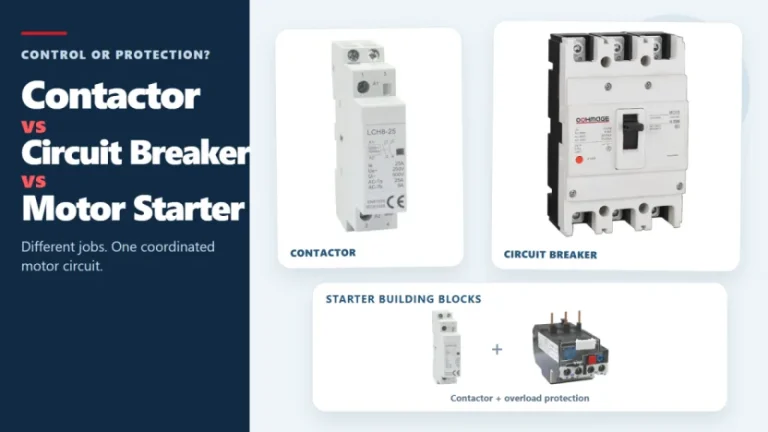
Figure 1. Contactors, circuit breakers, and motor starters solve different control and protection tasks. These three devices often appear in the same motor-control panel, but they solve different problems. A contactor handles frequent, remote, or automatic switching during normal operation. A circuit breaker interrupts abnormal current within its rated capability. A motor starter normally combines […]
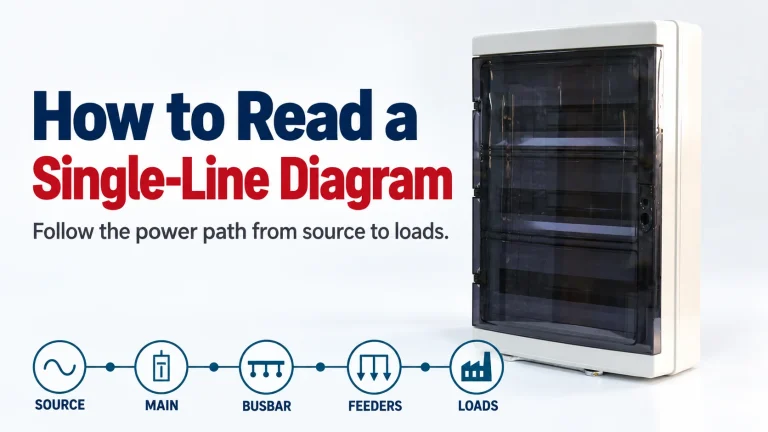
A single-line diagram can look simple and still be difficult to read. One line may represent a multiphase circuit, a small symbol may stand for a major protective device, and a short label may carry the information that determines what equipment belongs downstream. The most reliable way to read a single-line diagram is to follow […]
Figure 1. Three-phase SPD selection starts with system facts, not the largest kA number. A three-phase surge protector should not be selected by the largest kA number on its label. First confirm the system voltage, whether a neutral is present, the earthing arrangement, the installation point, and the required SPD type. Then compare Uc, Up, […]