An RCBO combines residual-current and overcurrent protection in one device. Type AC, Type A, Type F and Type B describe the residual-current waveforms the device is designed to detect; they do not describe arc-fault detection. Standard RCBOs do not detect arc faults—an AFDD function is required for that purpose.
Quick answer: Choose an RCBO by the expected residual-current waveform, rated current, breaking capacity, trip curve, number of poles, rated residual operating current and the rules that apply to the installation. Type F and Type B have additional requirements under IEC 62423. Confirm the selected model’s datasheet and certification before ordering.
What Are Arc Faults and Residual Currents?
Arc faults
An arc fault is an unintended electrical discharge that can generate intense local heat. Damaged insulation, loose connections and deteriorated conductors are possible causes. Some arc faults may not draw enough current to operate a conventional overcurrent protective device. Arc-fault detection is therefore a separate function covered by the AFDD product standard.
Residual current and earth leakage
Residual current, often described as earth leakage, is current flowing through an unintended path. It is not the same as a short circuit. A rated residual operating current such as 30 mA is a device selection value used for particular protective purposes; it is not a universal threshold below which current is safe. Selection and verification must follow the applicable installation standard.
What Protection Does an RCBO Provide?
An RCBO combines two protective functions:
residual-current protection, which detects an imbalance between conductors; and
overcurrent protection against overload and short-circuit conditions.
RCBOs are commonly applied at individual-circuit level so that a fault can be isolated without disconnecting every circuit protected by a shared upstream RCD. The appropriate arrangement depends on the distribution design, coordination study and local installation rules.
RCBO Types by Residual-Current Waveform
The classifications below describe residual-current response. They do not state the MCB-style overcurrent trip curve, and they do not prove that a particular classification is available in the OOHMAGE catalogue. Confirm the exact model marking, datasheet and certification before selection.
Type AC RCBO
Type AC responds to sinusoidal alternating residual current. Its suitability must be checked against the connected equipment and the rules that apply to the installation.
Type A RCBO
Type A responds to sinusoidal alternating and pulsating direct residual currents. The connected equipment manufacturer’s instructions and local installation rules determine whether this response is appropriate.
Type F RCBO
Type F includes Type A response plus specified composite residual currents associated with certain single-phase frequency converters. Verify the product declaration against IEC 62423 and the actual load; do not infer suitability from a generic application label.
Type B RCBO
Type B covers specified alternating, pulsating direct and smooth direct residual currents, including the additional response defined by IEC 62423. Use it only where the system design, equipment instructions and applicable rules require that response.
Selective or time-delayed devices
Selective or time-delayed operation is a coordination characteristic, not another residual-current waveform family. Upstream and downstream devices must be coordinated using the applicable design rules and manufacturer data.
RCBO type comparison
Classification
Residual-current response described on this page
Inherent arc-fault detection?
Selection boundary
Type AC
Sinusoidal AC residual current
No
Verify suitability against the connected equipment and local rules.
Type A
Sinusoidal AC and pulsating DC residual current
No
Check the load manufacturer’s instructions and installation rules.
Type F
Type A response plus specified composite residual currents associated with certain single-phase frequency converters
No
Confirm the product declaration against IEC 62423 and the load.
Type B
Specified AC, pulsating DC and smooth DC residual currents
No
Use only where the system design, equipment instructions and local rules require it.
Selective/time-delayed
A coordination characteristic, not another waveform family
No
Coordinate upstream and downstream devices using the applicable design rules.
Do RCBO Types Provide Arc-Fault Detection?
Standard RCBOs do not provide AFDD functionality. IEC 62606 covers AFDDs, which may be standalone, integrated with another protective device, or assembled with a declared protective device. If a product combines functions, verify both its RCBO and AFDD declarations; do not infer arc-fault detection from a Type A, Type F or Type B marking.
An RCBO and an AFDD therefore address different fault conditions. A project may require one function, the other or a declared combination, depending on the circuit design and applicable rules.
How to Select an RCBO
Before requesting a model or quotation, verify:
the expected residual-current waveform from the connected equipment;
rated current and overcurrent trip curve;
rated residual operating current;
breaking capacity at the installation point;
pole arrangement and neutral-switching requirements;
equipment manufacturer instructions and the local installation standard; and
model-level datasheet, standard declaration and certification evidence.
For EV charging, PV, VFD and other power-electronic loads, follow the equipment manufacturer’s residual-current requirements and the applicable local installation standard. Depending on the system architecture, a particular RCBO type or additional DC residual-current detection may be specified. Do not select a device solely from a generic application label.
Need a Model-Level Check?
Compare the OOHMAGE RCBO series and send the circuit schedule, rated current, trip curve, breaking capacity, pole arrangement, residual-current sensitivity and applicable standard with your enquiry. OOHMAGE can confirm catalogued options; final device selection and installation remain the responsibility of the qualified designer or installer.
The B and C markings shown on some product pages are overcurrent trip curves. They must not be read as Type B or Type C residual-current waveform classifications.
What’s the difference between an RCBO and an AFDD?
An RCBO provides residual-current and overcurrent protection. An AFDD is designed to detect specified arc-fault conditions. Standard RCBO Type AC, A, F or B classifications do not add AFDD functionality. For a combined product, verify the separate RCBO and AFDD declarations.
Can an RCBO be added to an older installation?
Only after a qualified assessment. The installer should verify the earthing arrangement, shared neutrals, existing leakage, conductor condition, enclosure compatibility, fault level and the rules that apply to the installation. Do not assume universal backward compatibility from the RCBO label alone.
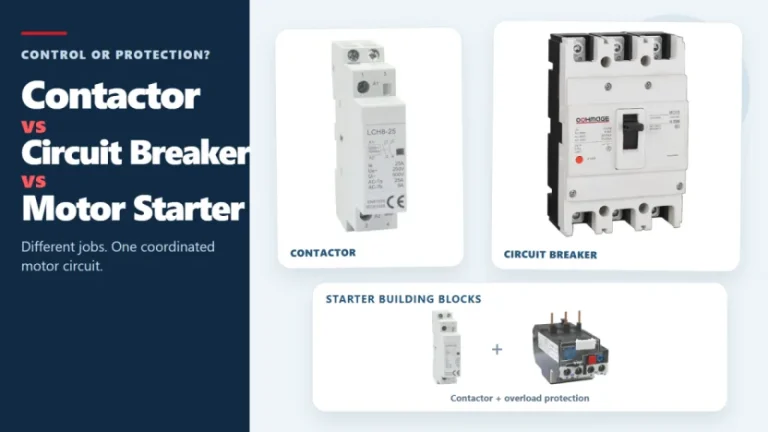
Figure 1. Contactors, circuit breakers, and motor starters solve different control and protection tasks. These three devices often appear in the same motor-control panel, but they solve different problems. A contactor handles frequent, remote, or automatic switching during normal operation. A circuit breaker interrupts abnormal current within its rated capability. A motor starter normally combines […]
Introduction The concept of remote tripping is simple, but in actual operation, project teams often encounter difficulties in specifying the components. The panel factory may require circuit breakers triggered by fire alarm relays, PLC outputs, building management system instructions, or other coordinated control. At this point, “diversion tripping” is only the first step in the […]
The main types of circuit breakers used in low-voltage distribution include miniature circuit breakers (MCBs), molded case circuit breakers (MCCBs) and residual-current devices such as RCCBs and RCBOs. They are not interchangeable. MCBs and MCCBs are selected for overcurrent protection in different circuit roles, an RCCB provides residual-current protection without integral overcurrent protection, and an […]