What Is an Electrical Substation: A Beginner’s Guide
Published: Author: Conor
Electricity doesn’t simply travel directly from a power plant to your home or office. It passes through several key points in the transmission and distribution system along the way. The electrical substation is one of the most important — an equipment that changes voltage levels, directs power where it’s needed, and assists in protecting the grid from faults.
If you are a student learning the basics of power engineering, a new entrant into an industry going into a utility company, or a purchaser ordering equipment for an upcoming project, understanding substations is critical. This blog will guide you through what is an electrical substation, how it works, its basic functions, and the equipment that keeps it working.
What Is a Substation?
An electrical substation is a critical power network facility that transforms voltage levels and regulates the flow of electricity from generation to consumption points.
Visualize it as an electric power control center. On the generation side, power is typically generated at relatively low voltages (commonly 11–33 kV) and must be “stepped up” — sometimes to hundreds of kilovolts — for efficient long-distance transmission. Before being delivered to final customers, the voltage must be “stepped down” to lower, safer levels. Substations allow these transformations with specialized hardware in the form of power transformers, switchgear, and control equipment.
Substations also enable maintenance and repair by isolating components of the network, help maintain system stability, and avoid overloads or faults.
How Does an Electricity Substation Work?
The working principle of a substation revolves around three main processes:
Voltage Transformation– Using transformers, substations increase voltage for transmission (step-up) or decrease voltage for distribution to homes and industries (step-down).
Switching and Routing– Switchgear and busbars control the path of electrical flow, allowing operators to route electricity through different circuits or isolate parts of the system.
Protection and Monitoring– Protection relays detect faults such as short circuits or overloads and send a signal to circuit breakers, which then disconnect the affected section to prevent damage.
For example, in a transmission-to-distribution substation:
Electricity arrives at high voltage(e.g., 132 kV).
Transformers reduce it to a medium voltage(e.g., 33 kV) for regional distribution.
Circuit breakers and isolators ensure safety during maintenance or emergencies.
Power is routed to multiple feeders serving different neighborhoods or industrial zones.
Key Functions of a Substation
An electrical substation performs several interconnected functions that keep the power system safe, reliable, and efficient. These go beyond simply transforming voltage — substations are operational hubs for control, protection, and system optimization.
Voltage Conversions
The most fundamental role of a substation is to change voltage levels to suit different stages of the power supply chain.
Step-up conversion: Raises voltage from generation levels (e.g., 11–33 kV) to transmission levels (e.g., 132–400 kV) to minimize losses during long-distance transmission.
Step-down conversion: Reduces high transmission voltages to medium or low voltages for safe distribution to homes, businesses, and factories.
Switching Operations
Substations allow operators to switch circuits on or off, either to reroute power or to isolate sections for maintenance. This switching capability is vital during planned works or emergencies to keep as much of the grid operational as possible.
Protection
Advanced protection schemes detect faults — such as short circuits, overloads, or earth faults — within milliseconds.
Circuit breakers quickly interrupt faulty circuits to protect equipment.
Relays identify the fault location and trigger the necessary isolation. These systems prevent damage to critical infrastructure and reduce downtime.
Load Management and Balancing
Substations help control how electricity is distributed between different lines and areas. By balancing loads, they prevent any single part of the network from being overloaded, improving the stability and lifespan of equipment.
Power Quality and Grid Stability
Some substations are equipped with devices like capacitor banks, reactors, or Static VAR Compensators (SVCs) to control reactive power, stabilize voltage, and maintain the quality of electricity supplied to customers.
System Monitoring and Control
Modern substations often incorporate SCADA systems that provide real-time monitoring of voltages, currents, and equipment health. Operators can adjust configurations remotely, diagnose issues, and coordinate with other substations in the network.
Main Components of an Electrical Substation
A substation is made up of several specialized components, each with a specific role in transforming, controlling, and protecting electricity. Understanding these parts helps in selecting, operating, and maintaining the right equipment for your needs.
Power Transformers
Transformers are the workhorses of voltage conversion.
Step-up transformers are used at generation stations to increase voltage for transmission.
Step-down transformers are used at distribution substations to reduce voltage for local use. Key selection factors include voltage rating, capacity (KVA/MVA), cooling type (oil-immersed or dry), and efficiency class.
Circuit Breakers
Act like heavy-duty switches that automatically disconnect circuits during abnormal conditions.
Can be air-insulated, oil-insulated, vacuum, or SF₆ gas-insulated depending on voltage and environmental factors.
Must operate reliably even under high fault currents.
Switchgear Assemblies
Enclosures housing circuit breakers, isolators, relays, and measuring instruments.
High-voltage switchgear is typically outdoors or in gas-insulated enclosures.
Low-voltage switchgear is often indoors for building or industrial distribution.
Busbars
Thick conductive bars (copper or aluminum) that carry large currents within the substation.
Enable flexible connections between incoming and outgoing circuits.
Can be configured in single bus, double bus, or ring bus layouts for redundancy.
Isolators (Disconnect Switches)
Provide a visible break in the circuit for maintenance purposes.
Unlike circuit breakers, isolators are operated only when the circuit is de-energized.
Essential for worker safety during service.
Protection Relays
Electronic or electromechanical devices that monitor electrical parameters and detect faults.
Overcurrent relays trigger when currents exceed safe limits.
Differential relays detect imbalances between circuit inputs and outputs.
Ensure accurate measurements without exposing equipment or operators to high voltages.
Control Panels and SCADA Systems
Centralized panels display system data, allow manual control, and interface with SCADA for remote operation.
Modern panels include alarms, digital readouts, and networked controls.
Auxiliary Systems
Earthing systems for safety.
Battery banks for power controls and protection during outages.
Fire detection and suppression systems for equipment safety.
Types of Electrical Substations
Electrical substations can be classified in several ways:
By Voltage Level
High-voltage substations– Interface between generation plants and transmission lines (e.g., 400 kV, 220 kV).
Medium-voltage substations– Step down power from transmission to distribution levels (e.g., 33 kV, 11 kV).
Low-voltage substations– Supplied directly to end users at safe voltages.
By Function
Transmission substations– Connect and control high-voltage transmission lines.
Distribution substations– Reduce voltage for local distribution networks.
Collector substations– Aggregate power from multiple generation sources, such as wind farms.
Converter substations– Convert AC to DC or vice versa for HVDC systems.
By Construction
Outdoor (AIS)– Traditional, with equipment exposed and air-insulated.
Indoor/Gas-insulated (GIS)– Compact and enclosed, suitable for urban or space-constrained sites.
Mobile substations– Mounted on trailers for temporary or emergency use.
Substation Safety and Maintenance
Substations operate at high voltages, so safety protocols are critical:
Grounding and Earthing
A well-designed earthing system ensures fault currents are safely dissipated into the ground, reducing the risk of electric shock.
Arc Flash and Fire Safety
Protective relays, fire suppression systems, and arc-resistant switchgear reduce hazards.
PPE and Training
Personnel must use insulated gloves, helmets, and other PPE, and undergo regular safety training.
Routine Maintenance
Includes:
Visual inspections
Infrared thermography for hot spots
Transformer oil analysis
Breaker timing tests
Regular maintenance extends equipment life and prevents unexpected failures.
Final Thoughts
Electrical substations are the nerve centers of our power system. Without them, it would be impossible to efficiently and safely deliver electricity from generation plants to end users.
For industry professionals and project managers, knowing how substations function is not only valuable for design and operation — it’s also essential for selecting the right electrical equipment. Whether you need transformers, switchgear, protection devices, or SCADA solutions, choosing quality components ensures long-term reliability and safety.
OOHMAGE is a trusted name in the electrical component industry, known for producing high-quality isolator switches, RCBOs, surge protection devices, and more. With a strong emphasis on safety, durability, and performance, OOHMAGE products are widely relied upon across residential, commercial, and industrial applications.
If you’re looking for dependable, high-performance substation equipment, contact our team today or browse our complete product catalog.
FAQs
What are the main differences between AIS and GIS substations?
An AIS (Air-Insulated Substation) uses air as the primary insulation medium between energized components. It typically requires more space, has lower installation costs, and is easier to maintain in the field. A GIS (Gas-Insulated Substation) uses SF₆ gas for insulation, resulting in a much more compact design. GIS is ideal for urban or space-limited sites but comes with a higher upfront cost and specialized maintenance requirements.
Which substation components require the most frequent maintenance?
High-wear and safety-critical components such as circuit breakers, protection relays, and disconnect switches require the most frequent inspection and servicing. Regular transformer oil analysis is also important for detecting insulation degradation early. Preventive maintenance of these elements reduces the risk of failures and extends the life of the entire installation.
How do I choose the right transformer for a substation?
Selecting the right transformer depends on several factors:
Voltage ratio– Must match the input and output requirements of your system.
Load capacity– Measured in KVA or MVA, based on expected demand.
Cooling method– Oil-immersed transformers are common for high capacity; dry-type transformers are better for indoor or fire-sensitive environments.
Installation environment– Consider temperature, humidity, and space constraints. Consulting with an experienced equipment supplier ensures compliance with local grid standards and operational efficiency.
What role does SCADA play in modern substations?
SCADA (Supervisory Control and Data Acquisition) systems enable operators to monitor, control, and analyze substation operations remotely. They improve fault detection, allow faster response times, and support predictive maintenance strategies. SCADA also helps integrate substations into wider smart grid systems, enabling real-time data sharing and automated decision-making for improved reliability.
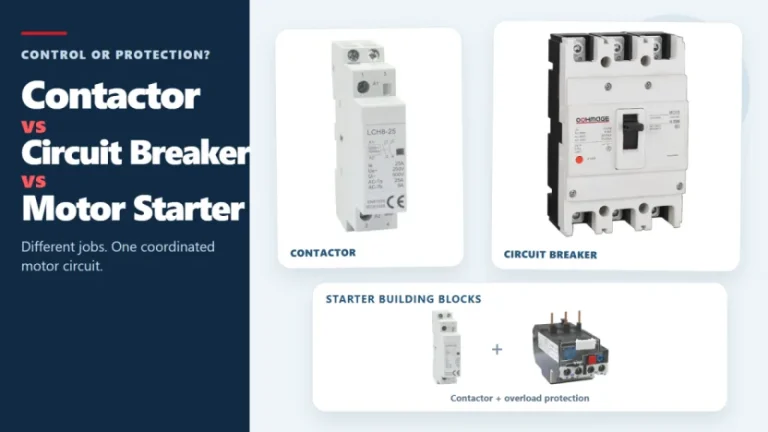
Figure 1. Contactors, circuit breakers, and motor starters solve different control and protection tasks. These three devices often appear in the same motor-control panel, but they solve different problems. A contactor handles frequent, remote, or automatic switching during normal operation. A circuit breaker interrupts abnormal current within its rated capability. A motor starter normally combines […]
The main types of circuit breakers used in low-voltage distribution include miniature circuit breakers (MCBs), molded case circuit breakers (MCCBs) and residual-current devices such as RCCBs and RCBOs. They are not interchangeable. MCBs and MCCBs are selected for overcurrent protection in different circuit roles, an RCCB provides residual-current protection without integral overcurrent protection, and an […]
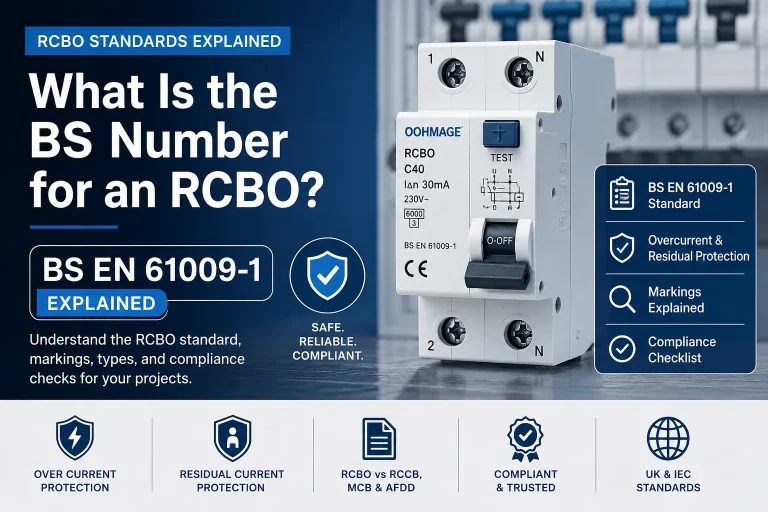
Introduction If you are searching for the RCBO BS number, the answer most commonly required in UK and IEC-based electrical procurement is BS EN 61009-1. This is the principal product standard associated with residual current circuit breakers with overcurrent protection used in residential, commercial, and similar installations. However, merely the BS number is not sufficient […]