Push Button Switches vs Toggle Switches: Differences, Applications, and Selection Guide
Published: Author: Conor
Do you want to choose the perfect switch for your project? Picking the right one can feel tricky, but don’t worry! When you understand how push button switches and toggle switches work, their differences, and where to use each type, you can make the best choice for your project.
In this guide, you will learn the differences, functions, and applications of push button switches and toggle switches. You will also learn how to select the right one for safety and convenience, so you can operate electrical devices easily and efficiently every time.
A push button Switch is a control device used to open or close an electrical circuit. Pressing the button connects the circuit and allows current to flow, while releasing it breaks the circuit and stops the flow.
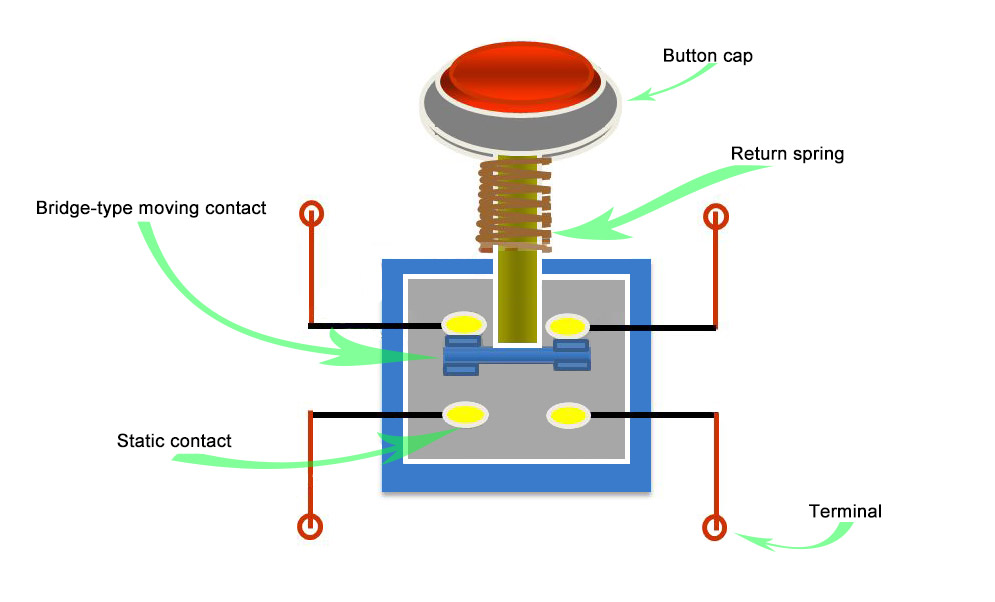
The push button switch consists of a button cap, a return spring, a bridge-type moving contact, a static contact, a pillar connecting rod, and a protective shell.
Working of a Push Button Switch
Step 1) Press the Push Button Cap: Pressing the button cap starts the process of connecting the electrical contacts.
Step 2) Pillar Connecting Rod Moves: The pillar connecting rod pushes the moving contact.
Step 3) Moving Contact Touches Static Contact: When the moving contact touches the static contact, the circuit closes and electricity flows.
Step 4) Spring Returns the Button: Releasing the button allows the spring to push it back, separating the contacts and stopping the electricity.
Step 5) Shell Protects All Parts: The shell keeps all components safe and securely in place.
Push button Switches are typically made from plastic, metal, or stainless steel. Industrial push button switches are often dustproof and waterproof (IP65 or higher). They are also available in different colors, such as red for stop, green for start, and yellow for warning.
Specification
Details
Rated Voltage
12V, 24V, 110V, or 220V AC/DC
Rated Current
1A to 10A
Contact Type
Normally Open (NO) or Normally Closed (NC)
Mechanical Life
1 to 5 million operations
Mounting Size
16mm, 19mm, 22mm, or 25mm
Protection Level
IP65 or higher (dustproof and waterproof)
What Is a Toggle Switch?
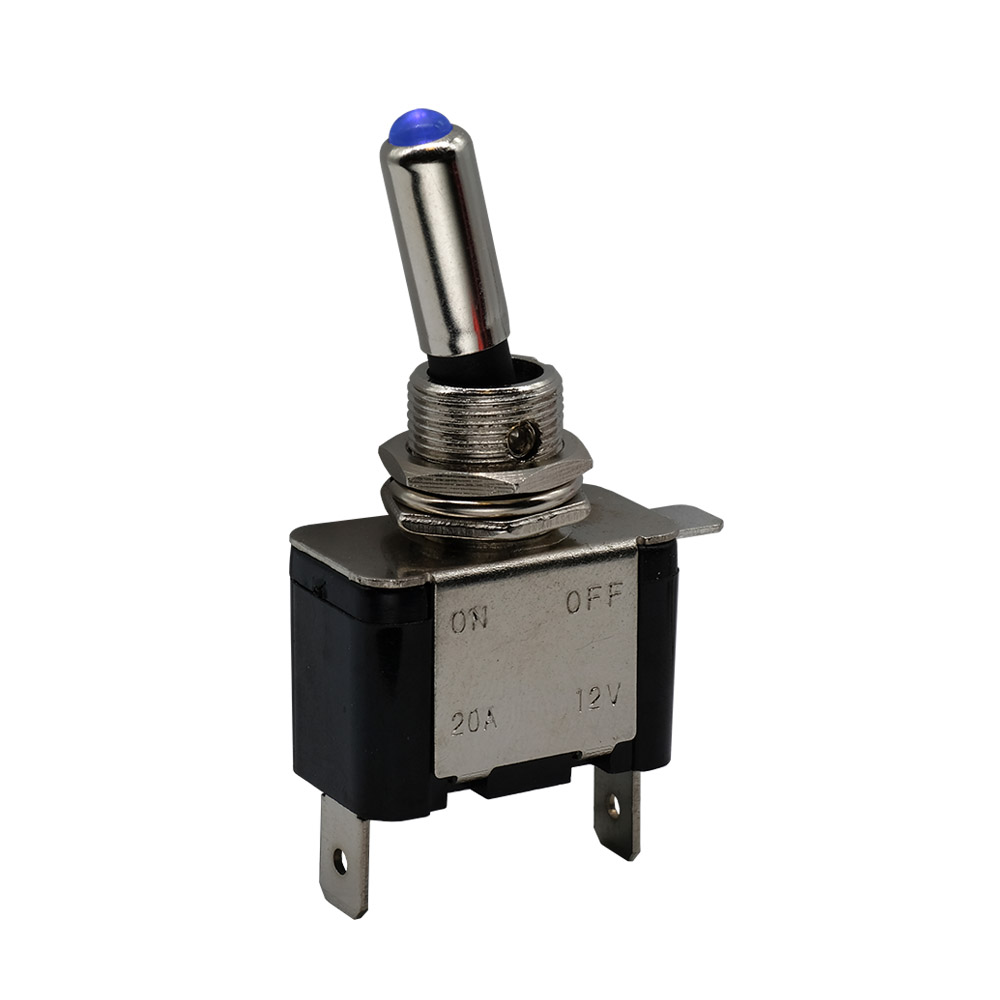
A toggle switch is a control device that opens or closes an electrical circuit using a lever or handle. Flipping the lever connects the circuit to allow electricity to flow or breaks the circuit to stop it.
Toggle switches are commonly used in automotive dashboards, lighting systems, power tools, and industrial equipment. They typically consist of a lever, spring, O-ring, plunger, moving armature, case, and base.
Working of a Toggle Switch
Step 1) Flip the Lever: Flipping or pushing the lever initiates the internal movement of the switch.
Step 2) Plunger Moves: The plunger moves along with the lever. It guides the lever and ensures it moves within the correct range.
Step 3) Contacts Touch: The moving part inside, called the armature, touches the terminals. This closes the circuit and allows electricity to flow.
Step 4) Spring Helps the Lever: The spring holds the lever in place and can return it to its original position if necessary.
Step 5) Case and Base Protect Parts: The case and base hold all components together. They protect the internal parts from dust, damage, and other external elements.
Toggle switches are typically made from plastic or metal. Some are designed for industrial or outdoor use. They come in various colors and shapes depending on the application.
Specification
Details
Voltage
12V, 24V, 110V, 220V AC/DC
Current
1A to 20A
Contact Type
Normally Open (NO) or Normally Closed (NC)
Mechanical Life
1 to 10 million operations
Mounting Size
Varies by design
Protection
Some types are IP65 or higher
Applications of Push Button Switches
Push button switches are widely used to control electrical devices. Examples include:
Factory Plants: Emergency stop buttons are used to shut down machines immediately for safety.
Industrial Machines and Control Panels: Push button switches can be used to turn devices on or off, trigger signals, or control simple functions efficiently.
Elevators and Access Systems: Push button switches can be used to trigger signals or control access systems safely.
Electronic Devices and Control Systems: These switches provide reliable user input for activating circuits or signaling operations.
Applications of Toggle Switches
Toggle switches are commonly used in both everyday life and industrial environments. Examples include:
Aircraft Cockpits: Toggle switches control various systems to ensure safety.
Vehicle Dashboards: They manage functions such as headlights, wipers, and other electrical systems.
Lighting in Homes and Offices: Toggle switches are used to turn lights on and off efficiently.
Key Differences Between Push Button Switches and Toggle Switches
As you have learned about the working and applications of a push button and toggle switches. Now you will learn the key difference between a push button and a toggle switch.
Feature
Push button Switch
Toggle Switch
Operation
Press only
Flip lever
Function
Momentary / Maintained
Maintained
Durability
Frequent cycles
Strong / Mechanical
Visual Feedback
LED / Color
Lever position
Application
Panels / Machines
Power / Lights
Rated Voltage
12V–220V AC/DC
12V–220V AC/DC
Rated Current
1A–10A
1A–20A
Contact Type
NO / NC
NO / NC
Mechanical Life
1–5 million
1–10 million
Protection
IP65 / Dustproof
IP65 / Dustproof
Mounting Size
16–25 mm
Varies by type
Material
Plastic / Metal
Plastic / Metal
How to Choose Between a Push Button Switches and a Toggle Switch
Now that you understand the differences between push button switches and toggle switches, here is how to choose the right one for your application:
i) Procedure: First of all, you consider how the switch will work. Do you need a momentary push button or a permanent lever?
ii) Environment: Next, you consider where you will be using it. Check whether there will be dust, water, vibration, or high temperatures.
iii) Current and voltage: Then you check that the switch can safely handle the required current and voltage.
iv) Safety and visual indicators: After that, you consider whether you want an LED or a color indicator to make the switch’s status clear.
v) Design and ease of use: At last, you consider how the switch is designed and whether it is easy to use.
Conclusion
In short, push button switches and toggle switches help you control power easily. Push button switches are ideal for quick or emergency operations, while toggle switches are better suited for circuits that require constant control.
When choosing between them, consider your application needs, current capacity, and safety standards. At Oohmage, we offer you high-quality push button switches that are sturdy, reliable, and ready for your projects. Our products are designed for safety and are easy to use. They are perfect for your industrial applications and everyday projects.
FAQs
How do I choose between a push button and a toggle switch for my project?
If you need a switch for momentary control (such as a start, reset, or emergency stop), choose a push button switch. If your application requires a maintained position (like an on/off light or power control), a toggle switch is more suitable. Also, consider your environment, current and voltage rating, and safety requirements before making a decision.
Can push button switches be used for heavy-duty applications?
Yes, industrial-grade push button switches are designed to handle higher currents and voltages. They can also be dustproof and waterproof (IP65 or higher) for harsh environments.
Can I replace my old toggle switch with a push button switch?
In some cases, yes — but it depends on the wiring and the type of circuit. Push button switches are usually momentary, while toggle switches maintain their state. Make sure the replacement fits your device’s electrical and functional requirements.
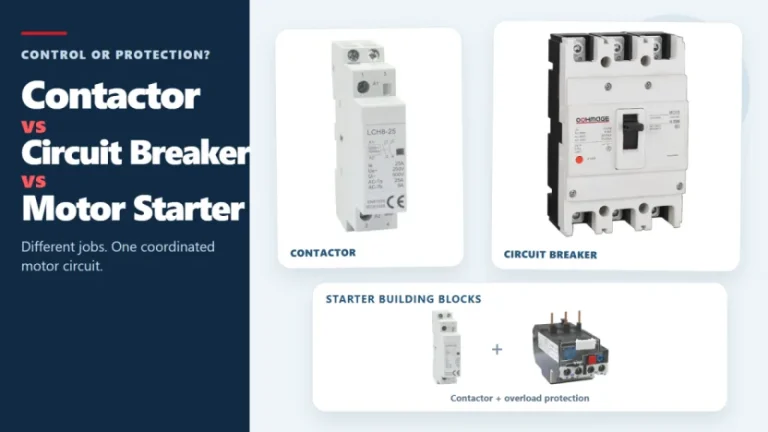
Figure 1. Contactors, circuit breakers, and motor starters solve different control and protection tasks. These three devices often appear in the same motor-control panel, but they solve different problems. A contactor handles frequent, remote, or automatic switching during normal operation. A circuit breaker interrupts abnormal current within its rated capability. A motor starter normally combines […]
The main types of circuit breakers used in low-voltage distribution include miniature circuit breakers (MCBs), molded case circuit breakers (MCCBs) and residual-current devices such as RCCBs and RCBOs. They are not interchangeable. MCBs and MCCBs are selected for overcurrent protection in different circuit roles, an RCCB provides residual-current protection without integral overcurrent protection, and an […]
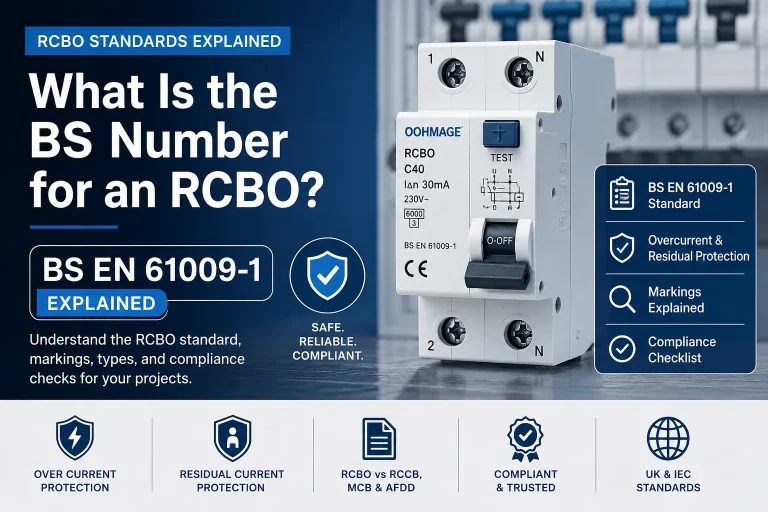
Introduction If you are searching for the RCBO BS number, the answer most commonly required in UK and IEC-based electrical procurement is BS EN 61009-1. This is the principal product standard associated with residual current circuit breakers with overcurrent protection used in residential, commercial, and similar installations. However, merely the BS number is not sufficient […]