Isolation Switch vs. Disconnect: Are They the Same?
Published: Author: Conor
In electrical installations, safety and functionality are literally dependent on electric control devices. Though used synonymously in many cases, the terms refer to different devices with varied purposes and features. Grasping these differences is crucial in the selection of appropriate devices for your electrical installation.
The following article explains what isolation and disconnect switches are, their functions, types, and the difference between them to help you make informed decisions for your system’s safety and efficiency.
What Are Isolating Switches?
An isolating switch is a device that serves to disconnect a circuit or a piece of equipment from its power supply for safe maintenance or servicing.
Most isolating switches are not designed to interrupt current flow. They can be operated only when the circuit is already de-energized. They are typically operated manually to ensure a deliberate disconnection.
Primary Functions of Isolating Switches
Safety: Isolating switches provide a visual break in the circuit for complete disconnection from the power supply.
Maintenance: The switch isolates the equipment for routine maintenance or repair without the threat of accidental re-energization.
Emergency Shutoff: Under critical conditions, an isolating switch will enable operators to cut the power in an efficient and safe way.
What Are Disconnect Switches?
An electrical disconnect switch is an electrical device for disconnecting or isolating a circuit but also allows the breaking of current under specified conditions. These are commonly installed in systems to provide operational and safety functions.
Some disconnect switches can break current flow safely, while others need first to have the circuit de-energized.
Primary Functions of Disconnect Switches
Load-Break Capability: A disconnect switch can interrupt the current flow through a circuit safely, allowing use both in isolation and in operational switching.
Overload Protection: Fusible disconnects among other types of disconnect switches offer protection against overcurrent.
System Control: Disconnect switches will enable the safe operation and control of various electrical circuit systems.
Isolating Switches vs. Disconnect Switches
Whereas there are some similarities between isolating switches and disconnect switches, the differences between the two greatly outnumber the similarities.
Load-Breaking Capability
Isolating Switches: Ordinarily, isolating switches are not designed to interrupt current flow. They shall only be operated after a circuit has been de-energized.
Disconnect Switches: Disconnect switches, especially load-break types, are designed to safely interrupt current flow under load conditions.
Applications
Isolating Switches: Primarily used for maintenance and safety isolation in already de-energized circuits.
Disconnect Switches: Suitable for both operational switching and safety isolation, often found in industrial and commercial power systems.
Design and Standards
Isolating Switches: Designed with a visible break to confirm the circuit is completely disconnected. They adhere to safety standards focused on maintenance.
Disconnect Switches: Meet stricter operational standards to handle load-breaking requirements and may include features like arc suppression.
Isolation Switch and Disconnect Switch Types
Both isolation and disconnect switches come in various types, tailored for specific applications and requirements.
Isolation Switches
1. Manual vs. Automatic
The manual isolation switches are operated by hand for controlled isolation, while the automatic ones are used in systems requiring automatic disconnection during emergencies.
2. Single-Pole vs. Multi-Pole
Single-Pole: Isolates a single circuit or phase.
Multi-Pole: Simultaneously isolates multiple phases, commonly used in three-phase systems.
Disconnect Switches
Fusible vs. Non-Fusible:
Fusible: Incorporates fuses for additional overcurrent protection.
Non-Fusible: Lacks integrated fuses, designed solely for disconnection.
Load-Break vs. Non-Load-Break:
Load-Break: Able to interrupt the flow of the current when under load.
Non-Load-Break: Should be operated only when the circuit is de-energized.
Comparison
Feature
Isolation Switch
Disconnect Switch
Operation Mode
Manual or Automatic
Manual or Automatic
Current Flow Handling
No load-breaking capability
Load-breaking capability (in some types)
Circuit Phases
Single-pole or Multi-pole
Single-pole or Multi-pole
Are Isolation Switches and Disconnect Switches Interchangeable?
Even though an isolation switch and a disconnect switch look similar in many aspects, they are not always interchangeable because they serve different purposes and also have different capabilities.
Safety vs. Operation: Isolation switches are for safety during maintenance, while disconnect switches serve the dual purpose of safety and operation.
Load-Breaking Capability: A disconnect switch that also has load-breaking capability can handle live circuits, making them more versatile in certain applications.
Code Compliance: Electrical codes and standards often specify which type of switch to use based on the application. Making use of a wrong type could be considered a safety violation.
In real-life applications, an isolation switch cannot replace a load-break disconnect switch in applications requiring operational switching under load. Similarly, a disconnect switch may not provide the visible isolation needed for maintenance tasks.
Final Thoughts
Isolation switches and disconnect switches are related but distinct devices serving important functions in electrical systems. Knowledge of their differences and the correct type for the application enhances the safety, regulatory compliance, and performance of a system.
When planning electric equipment, one should consult reliable electric equipment suppliers while referring to the local codes and standards for selecting and using such devices correctly.
OOHMAGE: Your Trusted Partner in Electrical Safety Equipment
Consulting qualified professionals when planning an electrical installation can help determine the best devices. Partnering with a reliable supplier can make all the difference.
OOHMAGE stands out as a trusted name in electrical safety equipment, offering a comprehensive range of high-quality isolation switches, disconnect switches, and related components.
From isolation switches to each device in a PV combiner box, OOHMAGE provides various types of products to meet the requirements of different projects.
FAQ
What is the primary purpose of an isolation switch?
The main purpose for which an isolation switch is used is to disconnect a circuit from its power source to maintain safety during maintenance or servicing.
Can an isolation switch be used to break current under load?
No, it is not under load conditions that the current is interrupted by an isolation switch; rather, this switch operates when the circuit is de-energized.
What is a fusible disconnect switch?
A fusible disconnect switch integrates fuses that offer additional protection against overcurrent and short circuits.
Are isolation switches required for all electrical systems?
Isolation switches shall be provided in systems where maintenance or servicing is performed – for safety by ensuring a visible point of disconnection.
How do I choose between an isolation switch and a disconnect switch?
Consider the application requirements, such as whether load-breaking capability is needed. Consider the application of an isolation switch for maintenance-focused safety and a disconnect switch for operational and safety requirements.
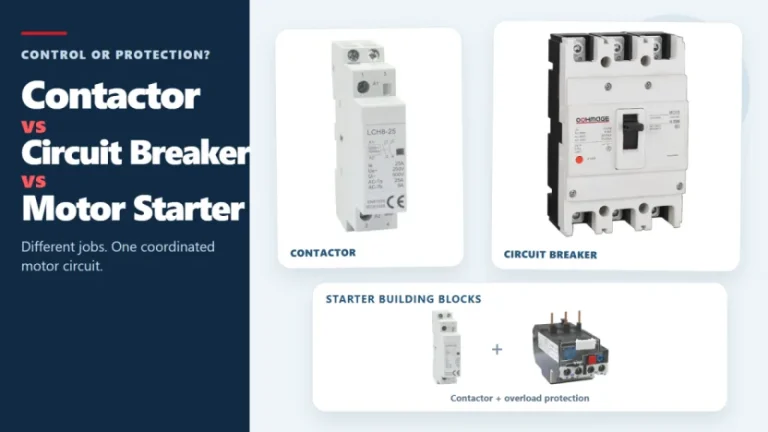
Figure 1. Contactors, circuit breakers, and motor starters solve different control and protection tasks. These three devices often appear in the same motor-control panel, but they solve different problems. A contactor handles frequent, remote, or automatic switching during normal operation. A circuit breaker interrupts abnormal current within its rated capability. A motor starter normally combines […]
The main types of circuit breakers used in low-voltage distribution include miniature circuit breakers (MCBs), molded case circuit breakers (MCCBs) and residual-current devices such as RCCBs and RCBOs. They are not interchangeable. MCBs and MCCBs are selected for overcurrent protection in different circuit roles, an RCCB provides residual-current protection without integral overcurrent protection, and an […]
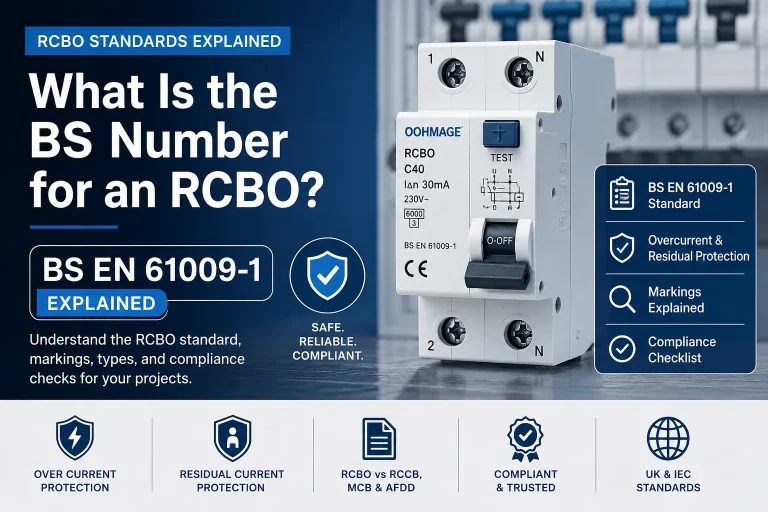
Introduction If you are searching for the RCBO BS number, the answer most commonly required in UK and IEC-based electrical procurement is BS EN 61009-1. This is the principal product standard associated with residual current circuit breakers with overcurrent protection used in residential, commercial, and similar installations. However, merely the BS number is not sufficient […]