Batteries energize devices from tiny sensors to massive electric vehicles. Yet, a fundamental question often arises: Is battery power AC or DC?
Grasp the nature of battery electricity. Leverage its potential in applications like renewable energy, transportation, and portable electronics. But at the beginning, let’s find out the battery power!
What Are AC and DC Power?
Source: https://peguru.com/2011/03/ac-dc-power/
Direct Current (DC)
Direct current (DC) involves electrons flowing in one direction, maintaining a constant voltage polarity.
A 12V DC source, for instance, sustains a steady 12-volt potential from negative to positive terminals, with no reversal. This unwavering output powers sensitive electronics like microchips, where voltage fluctuations could cause malfunctions.
Alternating current (AC) features electrons oscillating back and forth, with voltage reversing direction at 50Hz or 60Hz.
For example, in a 230V AC system, the voltage swings between +230V and -230V every 10 milliseconds (at 50Hz), averaging zero but delivering power through its cycle. AC’s adaptability for voltage transformation and long-distance transmission makes it the cornerstone of electrical grids.
Is Battery Power AC or DC?
Battery power is exclusively DC.
Batteries generate direct current through electrochemical reactions that establish a fixed voltage difference between their anode (negative) and cathode (positive) terminals. In an alkaline battery, zinc at the anode oxidizes, releasing electrons that travel through an external circuit to the manganese dioxide cathode, producing a steady 1.5V DC.
This unidirectional flow continues until the chemical reactants are exhausted. The principle traces back to 1800, when a stack of zinc and copper plates soaked in brine delivered 1.1V DC per cell, cementing batteries as DC sources for over two centuries.
Batteries produce DC through redox reactions, where oxidation at the anode and reduction at the cathode drive electron movement. Explore some common types of batteries and how they work:
Alkaline: Zinc (anode) reacts with manganese dioxide (cathode) via potassium hydroxide electrolyte, yielding 1.5V and 1000–3000mAh. Open-circuit voltage starts at 1.65V, dropping to 1.2V under load.
Lithium-Ion: Lithium ions shuttle between a graphite anode and a metal oxide cathode (e.g., cobalt oxide), producing 3.7V nominal (4.2V fully charged, 3.0V cutoff) and 2000–5000mAh per 18650 cell. High energy density (150–250 Wh/kg) suits portable tech.
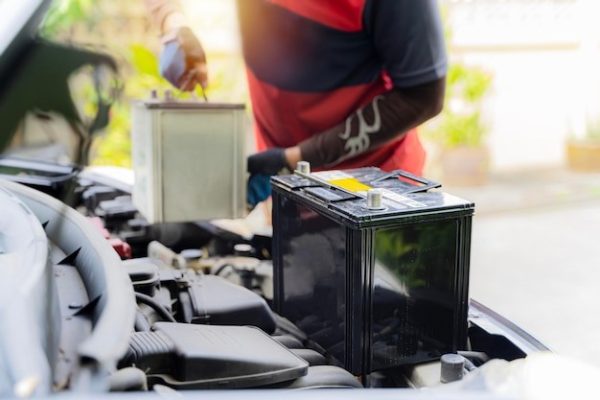
Lead-Acid: Lead (anode) and lead dioxide (cathode) in sulfuric acid generate 2V per cell, totaling 12V for a 6-cell battery. Capacities range from 20Ah (small UPS) to 200Ah (automotive), with a 2.5A trickle charge maintaining 13.8V.
Nickel-Metal Hydride (NiMH): Nickel oxyhydroxide (cathode) and a hydrogen-absorbing alloy (anode) deliver 1.2V, with 800–2500mAh. Self-discharge (20% per month) limits long-term storage.
Current capacity varies widely—100mAh for AA cells powers low-drain devices (e.g., 10mA remote), while 200Ah lead-acid units support 50A discharges (600W at 12V).
Internal resistance (20–200mΩ) impacts efficiency; a 12V battery with 50mΩ loses 0.5V at 10A (5W heat loss), delivering 11.5V. Temperature affects performance—capacity drops 20% at 0°C and doubles degradation above 40°C, shortening lifespan from 500 to 200 cycles.
Battery Type
Anode
Cathode
Electrolyte
Nominal Voltage
Capacity (mAh)
Alkaline
Zinc
Manganese Dioxide
Potassium Hydroxide
1.5V
1000–3000
Lithium-Ion
Graphite
Metal Oxide (e.g., Cobalt Oxide)
Lithium Salts
3.7V (4.2V max, 3.0V min)
2000–5000 (18650 cell)
Lead-Acid
Lead
Lead Dioxide
Sulfuric Acid
2V/cell (12V for 6 cells)
20,000–200,000 (20–200Ah)
Nickel-Metal Hydride (NiMH)
Hydrogen-Absorbing Alloy
Nickel Oxyhydroxide
Not specified
1.2V
800–2500
Why Batteries Produce DC and Not AC
Batteries generate DC because their chemical reactions create a stable, fixed polarity.
In a lead-acid cell, lead oxidizes to lead sulfate at the anode, and lead dioxide reduces at the cathode, maintaining a constant 2V per cell across a 12V battery.
This static process contrasts with AC generators, where rotating coils in magnetic fields alternate polarity 50–60 times per second, producing a 230V sine wave.
Also, batteries lack moving parts or oscillation mechanisms—attempting AC would require reversing chemical reactions. Even experimental designs (e.g., piezoelectric cells) produce pulsed DC, not true AC.
How to Convert Battery Power from DC to AC?
https://www.youtube.com/watch?v=ln9VZIL8rVs
A battery powers AC devices through inverters. These devices transform a steady voltage into an oscillating waveform. Using pulse-width modulation (PWM), inverters switch transistors at 20–50kHz to approximate a sine wave.
A 12V DC battery inverted to 230V AC at 50Hz delivers 100W with an 8.3A draw (100W ÷ 12V), plus a 10% loss (0.83A), totaling 9.13A input. Efficiency ranges from 85% (low-cost models) to 95% (high-end units), with losses as heat (e.g., 15W at 85% for 100W).
Solar Systems: 48V DC banks convert to 230V AC, powering homes with 5kW inverters (104A input at 48V).
Electric Vehicles: 400V DC packs drive AC motors via 90% efficient inverters, delivering 75kW (187A at 400V).
Portable Power: 5V DC USB outputs invert to 120V AC, running 50W appliances (10A at 5V).
Applications of Battery Power
Battery DC power supports an array of applications, leveraging its stability and portability:
1. Portable Devices: Smartphones (3.7V, 3000mAh, 11Wh) run for 10–20 hours, laptops (19V, 4Ah, 76Wh) power 6–8 hours, and flashlights (3V, 1Ah, 3Wh) last 50 hours at 20mA. Low-voltage DC suits compact electronics, with 5V USB charging delivering 10W (2A).
2. Automotive: Car batteries (12V, 50Ah, 600Wh) crank starters at 200A for 5 seconds (1kW burst), while EV packs (400V, 100kWh) sustain 300kW peaks for 300-mile ranges, recharging at 50kW (125A at 400V). Hybrid systems use 48V DC for auxiliaries (e.g., 1kW pumps).
3. Renewable Energy: Solar storage (48V, 200Ah, 9.6kWh) powers off-grid homes, discharging 2kW (42A) for 4.8 hours. Wind systems pair 24V batteries (100Ah, 2.4kWh) with turbines, supporting 500W loads (21A) overnight.
4. Industrial: Forklifts (24V, 300Ah, 7.2kWh) lift 2 tons for 8 hours at 900W (37.5A), while UPS backups (120V DC, 50Ah, 6kWh) bridge 10-minute outages at 3kW (25A). Telecom towers use 48V DC banks (400Ah, 19.2kWh) for 48-hour resilience (400W constant).
DC’s direct compatibility with electronics eliminates conversion losses, while its storage capacity enables off-grid and mobile solutions.
Extra Information: Battery Standards and Safety
Battery power complies with strict standards. By following these standards, batteries work well in various applications.
IEC 62133: Ensures portable battery safety, capping short-circuit currents (e.g., 10A for 3.7V lithium-ion) and requiring 500-cycle durability at 80% capacity.
UL 2054: Mandates household battery protections, like overcharge cutoffs at 4.2V for lithium and 14.4V for lead-acid, with thermal fuses at 85°C.
ANSI C18: Defines alkaline specs (e.g., 1.5V, 1000mAh, 500mA peak discharge), ensuring 90% capacity after 12 months at 20°C.
Safety features include polarity diodes (0.7V drop, 5mA leakage), thermal limits (60°C max, capacity halves at 80°C), and pressure vents (150 psi in lead-acid, 200 psi in lithium). A 12V battery at 70°C loses 30% capacity over 6 months, versus 5% at 25°C.
Final Thoughts
Batteries deliver DC power, driven by electrochemical reactions that produce a steady, unidirectional current from 1.5V to 400V. The DC output of batteries meets diverse needs, with inverters enabling AC compatibility.
For a stable and safe power supply, various electrical equipment is necessary in the electric system. OOHMAGE stands out as a trusted name in electrical safety equipment, offering a comprehensive range of high-quality isolation switches, disconnect switches, and related components.
Yes, all batteries produce DC, from 1.5V alkaline cells to 400V EV packs, due to their fixed chemical polarity.
How do batteries power AC devices?
Batteries supply DC to inverters, converting it to AC (e.g., 12V DC to 230V AC) with 85–95% efficiency for appliances.
What’s the difference between battery DC and grid AC?
Battery DC is steady and unidirectional (e.g., 12V constant), while grid AC oscillates (e.g., 230V, 50Hz) for efficient long-distance delivery.
Can a battery ever output AC directly?
No, batteries cannot output AC directly. Their internal electrochemical processes create a constant polarity, making only DC output possible. To obtain AC from a battery, an inverter is required.
Why don’t batteries recharge with AC?
Batteries require DC to recharge because the charging process depends on reversing the original electrochemical reaction. AC would constantly switch polarity, disrupting the chemical flow and preventing effective charging.
Why is battery voltage always so specific?
Battery voltages reflect the specific electrochemical reaction used. For example, alkaline cells use zinc and manganese dioxide to yield ~1.5V, while lithium-ion cells produce ~3.7V due to their material properties.
Can you use a battery without an inverter for AC devices?
Only if the device is designed for DC or includes its own built-in inverter. Most household AC appliances require external inverters to function on battery power.
Figure 1. Contactors, circuit breakers, and motor starters solve different control and protection tasks. These three devices often appear in the same motor-control panel, but they solve different problems. A contactor handles frequent, remote, or automatic switching during normal operation. A circuit breaker interrupts abnormal current within its rated capability. A motor starter normally combines […]
The main types of circuit breakers used in low-voltage distribution include miniature circuit breakers (MCBs), molded case circuit breakers (MCCBs) and residual-current devices such as RCCBs and RCBOs. They are not interchangeable. MCBs and MCCBs are selected for overcurrent protection in different circuit roles, an RCCB provides residual-current protection without integral overcurrent protection, and an […]
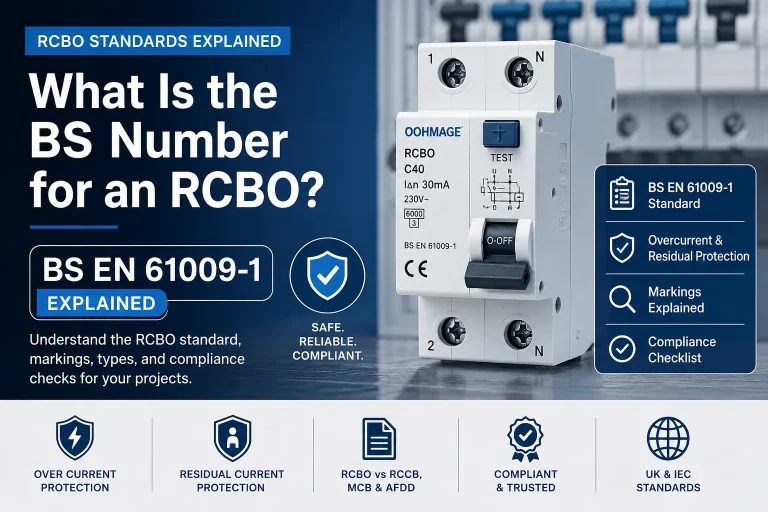
Introduction If you are searching for the RCBO BS number, the answer most commonly required in UK and IEC-based electrical procurement is BS EN 61009-1. This is the principal product standard associated with residual current circuit breakers with overcurrent protection used in residential, commercial, and similar installations. However, merely the BS number is not sufficient […]