How Does an RCBO Work? Inside the Dual-Function Circuit Breaker
Published: Author: Joanna
Introduction
Modern electrical safety focuses on protecting human life and critical infrastructure simultaneously. Historically, distribution boards required multiple separate devices to achieve comprehensive protection. For example, engineers installed separate overload breakers and leakage detectors to secure a single circuit. This guide provides an objective technical teardown of a single dual-function device.
What Is a RCBO?
An RCBO serves as an advanced integrated safety device for modern power systems. It combines overload, short-circuit, and earth leakage protection into one compact unit. It distinguishes its all-in-one capability directly from traditional separate protective components. This single device acts as the absolute cornerstone of modern electrical panel design.
oohmage manufactures these precision units to streamline installation for global B2B clients. The consolidated design reduces wiring complexity inside crowded distribution boards. Facility managers utilize this technology to ensure robust compliance with strict international safety codes. This hardware minimizes installation time while maximizing long-term operational reliability.
The Anatomy of a RCBO with Overcurrent Protection
The Thermal-Magnetic Module
The Thermal-Magnetic Module The thermal-magnetic module handles overcurrent protection within the device. First, it utilizes a precision bimetallic strip to detect gradual electrical overloads. Additionally, it contains a heavy electromagnetic coil to identify sudden power surges. These two parts work together to monitor the normal current flow constantly.
The Residual Current Module
The residual current module manages the detection of dangerous electrical leakage. It relies on a highly sensitive Core Balance Current Transformer internally. This transformer connects to a precision sensing relay responsible for triggering the mechanism. The precision relay acts exactly like a mechanical brain for the leakage sensor.
The Arc Extinguishing Chamber
The arc extinguishing chamber manages the energy created during a fault interruption. An internal arc chute dissipates the intense heat and plasma safely. This specific component prevents the main electrical copper contacts from melting together completely. Safely clearing the arc prevents severe electrical fires inside the distribution panel.
How an RCBO Circuit Breaker Detects Faults
Overload Detection (The Thermal Response)
A sustained electrical current exceeding the rated limit generates excess physical heat. This steady heat slowly warms the internal bimetallic strip over time. The two different metals expand at different rates, causing the strip to bend. This physical bending eventually triggers the mechanical latch mechanism to stop the power.
Short Circuit Detection (The Magnetic Response)
A massive surge of fault current enters the rcbo circuit breaker instantly. This rapid surge creates an incredibly strong electromagnetic field inside the coil. The intense magnetic force pulls the internal trip lever immediately. This instantaneous reaction clears severe short circuits before connected wires catch fire.
Earth Leakage Detection (The Differential Response)
The internal transformer continuously monitors the current vector sum passing through the wires. The current on the live and neutral wires must remain perfectly balanced. A tiny leakage to the earth disrupts this perfect mathematical balance immediately. The transformer triggers the sensing relay the exact millisecond this differential occurs.
The Tripping Mechanism: Milliseconds to Safety
The internal device utilizes a highly complex mechanical synchronization system. Any of the three distinct detection methods feed directly into a single unified trip linkage. This linkage unlatches a heavy compressed spring to separate the internal copper contacts. Strict precision engineering ensures these contacts separate rapidly enough to prevent electrocution.
RCBO vs. MCB and RCCB Combinations
Operational Efficiency
An RCBO protects a single dedicated circuit with total operational independence. A traditional setup often uses one shared RCCB to protect a group of standard MCBs. The dual-function device clears localized faults without disrupting adjacent power lines. This independence maintains operational efficiency across the wider electrical network.
Diagnostic Simplicity
The dual unit immediately isolates the exact problematic circuit during an emergency. Maintenance teams know exactly which machine or wire caused the trip event. A shared RCCB setup requires tedious trial-and-error troubleshooting to locate the specific fault. This rapid diagnostic simplicity reduces expensive facility downtime significantly.
Real-World Applications for Dual-Function Breakers
Medical and Healthcare Facilities
Hospitals require stable power to keep critical life-support systems running. Preventing nuisance tripping remains a necessity in these specialized medical environments. A localized fault in a waiting room must not disconnect power to essential operating theaters. Dual-function breakers isolate minor issues while keeping critical infrastructure fully active.
Industrial Control Panels
Manufacturing facilities utilize highly sensitive and expensive automation machinery daily. Localized power anomalies pose a severe threat to these complex robotic systems. Engineers install dual-function units to protect individual control panels securely. This targeted protection prevents a single motor failure from shutting down the assembly line.
High-End Residential Developments
Developments Modern homes feature complex electronics and heavy electrical loads across multiple rooms. Dual-function units provide homeowners with maximum safety and operational convenience. They eliminate the risk of whole-house blackouts caused by a single faulty appliance. Electricians deploy them to secure delicate smart-home integration networks safely.
Key Procurement Factors for Panel Builders
Selecting the Right Breaking Capacity
Engineers evaluate the breaking capacity to match the installation environment. The kA rating dictates the maximum fault current the device can interrupt safely. Therefore, buyers assess the maximum prospective fault current of the specific installation site. Selecting the correct kA rating ensures safe electrical interruption capabilities.
The chosen capacity complies with local electrical safety regulations. Standard residential applications typically require a solid 6kA breaking capacity. Conversely, heavy industrial networks require a 10kA rating to handle massive prospective fault currents.olid 6kA breaking capacity. Heavy industrial networks require a much higher 10kA rating to handle massive prospective fault currents.
Understanding Tripping Characteristics
Procurement teams select specific tripping curves based on the connected load profile. Installers also choose the correct leakage detection type for the specific environment. For instance, Type B curves handle standard resistive lighting and heating loads. Type C curves manage inductive motor loads with high inrush currents.
Furthermore, Type A leakage detection handles pulsating DC faults from modern electronic devices. Matching these technical characteristics correctly prevents nuisance tripping during normal operations.
Final Thoughts
Integrating three distinct protection mechanisms into a single DIN-rail module offers technical superiority. This consolidated approach maximizes panel space and drastically improves overall network reliability. Electrical engineers should standardize on dual-function breakers to future-proof their distribution networks. EPCs and distributors should consult the oohmage technical team for OEM supply and custom configurations.
FAQs
How do I test if my RCBO is working correctly?
Users press the dedicated test button located on the front panel monthly. This action simulates a minor internal earth leak to verify the mechanical tripping function. It ensures the internal springs and contacts move freely without sticking.
What causes an RCBO to trip immediately upon resetting?
Immediate tripping indicates a persistent hard fault still exists on the connected circuit. It signals a dead short circuit, an active earth leak, or a severely overloaded wire. Technicians locate and repair the physical fault before restoring power safely.
Does an RCBO protect against voltage surges?
No, it strictly handles overcurrent, short circuits, and earth leakage faults. Facilities must install separate Surge Protection Devices to defend against lightning strikes. These separate devices protect sensitive electronics from massive grid voltage spikes.
Related Product Selection
For model-level comparison, review the OMR8 RCBO series and OMB8 RCBO series. Use the product-page parameters to narrow the selection before sending circuit details.
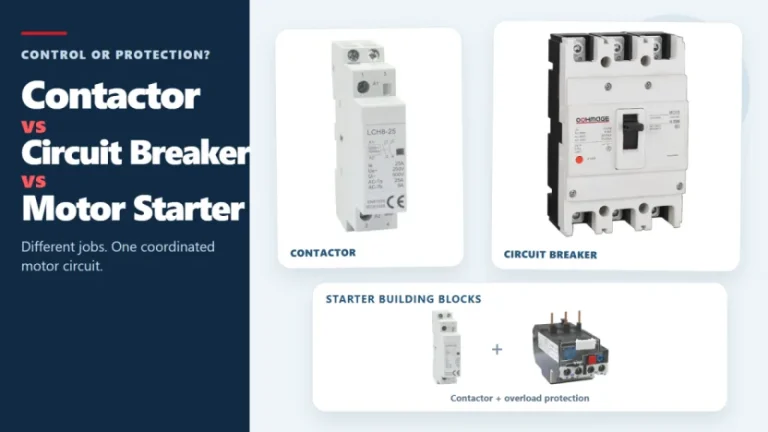
Figure 1. Contactors, circuit breakers, and motor starters solve different control and protection tasks. These three devices often appear in the same motor-control panel, but they solve different problems. A contactor handles frequent, remote, or automatic switching during normal operation. A circuit breaker interrupts abnormal current within its rated capability. A motor starter normally combines […]
Introduction The concept of remote tripping is simple, but in actual operation, project teams often encounter difficulties in specifying the components. The panel factory may require circuit breakers triggered by fire alarm relays, PLC outputs, building management system instructions, or other coordinated control. At this point, “diversion tripping” is only the first step in the […]
The main types of circuit breakers used in low-voltage distribution include miniature circuit breakers (MCBs), molded case circuit breakers (MCCBs) and residual-current devices such as RCCBs and RCBOs. They are not interchangeable. MCBs and MCCBs are selected for overcurrent protection in different circuit roles, an RCCB provides residual-current protection without integral overcurrent protection, and an […]