Individual Circuit Protection: Why RCBOs Are the Gold Standard for Modern Homes
Published: Author: Joanna
Introduction
Modern electrical infrastructure faces demands simply did not exist a generation ago. Smart home systems, EV chargers, solar inverters, and entire arrays of sensitive electronics now share the same distribution boards that once powered little more than lights and sockets. This escalating complexity has exposed the fundamental limitations of legacy protection strategies — and created an urgent need for smarter, more targeted solutions.
Enter the RCBO. As a comprehensive, single-module safety device, it delivers a level of circuit-specific protection that older systems simply cannot match. Property developers, panel builders, and procurement professionals across the globe are increasingly specifying it as a non-negotiable component in modern consumer units.
This guide examines exactly how an RCBO works, why it outperforms conventional arrangements, and what B2B buyers must consider when sourcing these devices at scale. Whether you manage procurement for a national housing developer or design bespoke industrial panels, the information here will sharpen your decision-making from the outset.
What Is an RCBO?
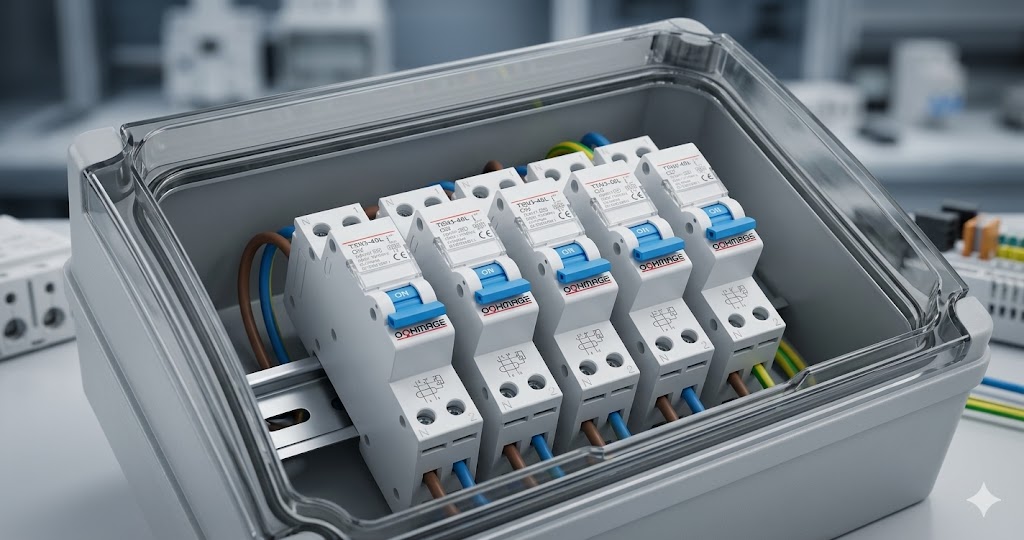
An RCBO — short for Residual Current Circuit Breaker with Overcurrent protection — is a dual-function protective device that consolidates two critical safety components into one compact module. Specifically, it merges the roles of a Miniature Circuit Breaker (MCB) and a Residual Current Circuit Breaker (RCCB), eliminating the need to install both as separate units.
This single-module design delivers comprehensive protection on three distinct fronts: overload currents, short circuits, and earth leakage faults. In practical terms, an RCBO monitors every millisecond of a circuit’s operation, ready to disconnect the instant any dangerous condition arises.
For modern consumer units handling diverse, mixed-load environments, no other individual device offers this breadth of protection. Engineers and developers who specify an RCBO from the outset build safety directly into the architectural fabric of a project — rather than retrofitting it as an afterthought.
The Mechanics of a Residual Current Circuit Breaker with Overcurrent Protection
Understanding how the Residual Current Circuit Breaker with Overcurrent protection operates internally is essential for anyone specifying or procuring these devices. Three interdependent detection systems work in concert to guarantee complete fault coverage at all times.
Overload and Short Circuit Detection
The thermal-magnetic mechanism forms the first line of defence. A bimetallic strip responds to sustained overload currents: as excessive current flows, the strip heats gradually and bends until it activates the trip mechanism. This thermal response is deliberately time-delayed, allowing brief inrush spikes — such as a motor starting — to pass without unnecessary disconnection.
For more severe short-circuit events, a magnetic coil takes over instantly. An intense fault current generates a powerful magnetic field that actuates the trip linkage in fractions of a second. This dual thermal-magnetic architecture means the RCBO handles both slow-building overloads and instantaneous fault events with equal precision.
Earth Fault Detection
At the heart of the earth fault detection system sits a Core Balance Current Transformer (CBCT). This component continuously monitors the balance between current flowing outward through the live conductor and current returning through the neutral. Under normal operating conditions, these values are equal and the net difference reads zero.
The moment a leakage path to earth develops — through a damaged appliance, degraded insulation, or direct human contact — the CBCT detects even the smallest imbalance. Most RCBO devices trip at a residual current as low as 30mA, a sensitivity threshold specifically calibrated to protect human life.
The Combined Tripping Action
Both detection systems feed into a single, unified mechanical trip linkage. Regardless of whether the fault is thermal, magnetic, or residual current in nature, the response is identical: decisive disconnection in milliseconds. This integrated architecture ensures there are no gaps in protection, no matter the fault type or origin.
Why the RCBO Circuit Breaker Is Replacing Legacy Systems
The RCBO circuit breaker is rapidly displacing older protection arrangements, and the reasons are both technical and commercial. Each advantage directly addresses a documented limitation of conventional split-load systems.
True Individual Circuit Protection
Traditional split-load consumer units group multiple circuits under a single shared RCCB. When one circuit develops an earth fault, the entire RCCB trips — cutting power to every circuit under its umbrella. A faulty outdoor socket, therefore, can plunge the entire kitchen, server room, or critical office into darkness simultaneously.
The RCBO eliminates this vulnerability entirely. Each circuit carries its own independent earth fault and overcurrent protection. A fault on the garden lighting circuit trips only that circuit — every other circuit in the building continues to operate without interruption. For facility managers and property operators, this directly translates into reduced downtime and fewer emergency call-outs.
Eliminating Nuisance Tripping
Modern electronics are not entirely passive loads. LED drivers, variable frequency drives, switch-mode power supplies, and Class I appliances all generate small but measurable amounts of continuous leakage current. In aggregate, these natural leakage currents accumulate across a shared RCCB and can trigger nuisance trips — even when no genuine fault exists.
By assigning a dedicated RCBO to each circuit, that cumulative effect disappears. The leakage current from any single circuit remains well below the 30mA trip threshold, so genuine faults still trigger immediate disconnection while normal operation proceeds uninterrupted. The result is a dramatically more stable and reliable electrical environment throughout the building.
Space-Saving Advantages
Combining two protective devices into a single DIN-rail module produces a noticeably reduced panel footprint. For panel builders working within tight enclosure dimensions — a frequent challenge in residential refurbishments and commercial fit-outs — this compactness delivers genuine practical value.
Beyond space, a single module is faster to install, easier to label, and simpler to maintain than a combination of discrete MCBs and RCCBs. Over the full lifecycle of a distribution board, these marginal time savings compound into meaningful reductions in both labour cost and maintenance complexity.
Real-World Applications in Residential and Commercial Builds
The RCBO’s versatility makes it the preferred protection device across a broad spectrum of applications. Key deployment environments where its specification is most critical include:
Kitchens and bathrooms — where moisture and proximity to water create the highest statistical risk of electrocution
Home offices and IT equipment circuits — where power continuity and sensitive electronics demand fully isolated, independent protection
EV charging points — where sustained high-draw currents and DC leakage components require dedicated, correctly typed protection
HVAC and heat pump circuits — where inrush currents and continuous operation necessitate a robust thermal-magnetic response
Outdoor and garden circuits — where weather exposure increases both leakage risk and the potential for nuisance tripping under shared protection
High-Risk Wet Environments
Kitchens and bathrooms present the highest probability of electrocution due to the coexistence of water and live electrical circuits. Wiring regulations in most jurisdictions now mandate earth fault protection for circuits serving these zones, and an RCBO delivers precisely that — combined with overcurrent protection in a single, compact unit.
The 30mA earth leakage threshold ensures that even a brief accidental contact with a live conductor, while standing on a wet surface, triggers disconnection before the current can cause cardiac arrest. No other individual device provides this combination of safeguards so efficiently.
IT Equipment and Home Offices
Protecting workstations, servers, and networking equipment requires a nuanced approach to circuit design. An RCBO fully isolates the IT circuit from faults originating elsewhere in the building, ensuring that a tripped bathroom circuit never interrupts a critical financial process or cloud backup operation.
Equally, sensitive power supplies in computing equipment frequently generate pulsating DC leakage. For these installations, a Type A RCBO — designed to detect both standard AC and pulsating DC residual currents — is the correct specification to ensure comprehensive coverage.
EV Charging and HVAC Systems
Electric vehicle chargers and heat pumps draw substantial, continuous currents over extended periods. These loads demand dedicated circuits with robust overload protection, and the RCBO’s thermal-magnetic mechanism is purpose-built to handle precisely this demanding load profile.
Furthermore, many EV chargers produce smooth DC components within their leakage current. For these installations, a Type B RCBO — sensitive to AC, pulsating DC, and smooth DC fault currents alike — should be specified to guarantee complete protection throughout the entire charge cycle.
Key Factors When Procuring RCBOs for Large-Scale Projects
Sourcing the correct RCBO for each application is not a single binary decision — it is a matrix of interconnected considerations. Procurement managers and electrical engineers should evaluate each project using the following structured process:
Define the load type first. Resistive loads — such as heating elements and incandescent lighting — suit a Type B tripping curve. Inductive loads with high inrush currents, including motors and commercial LED drivers, require the higher magnetic threshold of a Type C RCBO.
Select the correct leakage sensitivity. Standard 30mA devices provide life protection. Where additional fire protection is required on long cable runs, a 300mA RCBO at the sub-circuit head may also be appropriate.
Identify the leakage current type. Choose Type AC for pure sinusoidal AC faults; Type A for installations with modern electronics generating pulsating DC; and Type B for EV charging points or equipment with active rectifier stages.
Verify current rating and breaking capacity. Match the continuous current rating precisely to the design load, and confirm the short-circuit breaking capacity meets the prospective fault current at the point of installation.
Confirm standards compliance. Specify only devices certified to IEC 61009-1, the international benchmark for RCBOs, and verify CE marking for European markets — or the relevant regional certification for other territories.
Tripping Curves (Type B and C)
Selecting the wrong tripping curve is one of the most common — and costly — procurement errors in large-scale projects. A Type B RCBO trips magnetically at 3–5 times its rated current, making it ideal for pure resistive loads in domestic and light commercial installations. A Type C device trips at 5–10 times rated current, providing the tolerance that inductive commercial loads consistently demand.
Mismatching the curve causes either nuisance tripping under normal motor start-up conditions or, conversely, inadequate protection for lighter residential loads. Always confirm the load profile before specifying a single unit.
Leakage Sensitivity and Type (AC, A, B)
The 30mA sensitivity threshold is non-negotiable for any circuit presenting a direct risk to human life. This figure is grounded in established physiological research: currents above 30mA can cause ventricular fibrillation, while disconnection at or below this level maintains a sufficient safety margin.
Beyond sensitivity, the leakage type matters enormously in contemporary installations. Type A RCBOs cover the vast majority of modern residential and commercial applications, including appliances with switch-mode power supplies. Type B devices extend this coverage to smooth DC components, making them essential wherever three-phase rectifiers or EV chargers are present.
International Standards and Compliance
For property developers operating across multiple markets — or EPCs managing international procurement pipelines — adherence to IEC 61009-1 is the absolute baseline standard. Devices built to this specification undergo rigorous testing for dielectric strength, mechanical endurance, and trip accuracy under temperature extremes.
Procuring non-certified devices to reduce unit cost is a false economy. A single regulatory penalty, insurance claim, or product recall will far exceed any short-term saving achieved at procurement. Insist on full certification documentation before approving any supplier for a large-scale project.
Final Thoughts
The RCBO has earned its status as the gold standard for modern electrical protection — not through marketing, but through measurable, repeatable technical superiority. Its ability to simultaneously guard against overloads, short circuits, and earth leakage faults within a single DIN-rail module makes it the definitive choice for any project where safety, reliability, and operational continuity are non-negotiable.
For electrical wholesalers, developers, and panel builders, the procurement decision extends well beyond price per unit. Tripping curve accuracy, leakage type compatibility, and rigorous standards compliance all determine whether a board performs dependably in the field — or fails at the worst possible moment.
At Oohmage, our engineering team works directly with procurement managers, EPCs, and panel builders to specify, source, and supply certified RCBO solutions at scale. Whether the requirement is bulk OEM manufacturing, custom distribution panel design, or full technical compliance review, we support the complete project lifecycle from initial specification to final commissioning.
Contact the Oohmage engineering team today to discuss your RCBO requirements and discover how our premium low-voltage protection portfolio can elevate the safety and performance of your next project.
FAQs
What is the difference between an RCBO and an RCCB?
An RCCB detects only earth leakage faults; it offers no protection whatsoever against overloads or short circuits. An RCBO integrates both functions — combining the earth fault sensitivity of an RCCB with the overcurrent protection of an MCB. For complete, single-device circuit protection, the RCBO is always the superior and more code-compliant choice.
Why are RCBOs considered better for modern consumer units?
Modern consumer units serve a diverse mix of sensitive electronics, high-inrush inductive loads, and continuous-draw appliances. A traditional split-load board with shared RCCBs cannot prevent a single earth fault from disrupting multiple unrelated circuits simultaneously. An RCBO board assigns fully independent protection to each individual circuit, preserving supply continuity across the building while ensuring every circuit meets current safety standards.
Can I replace my existing MCBs with RCBOs directly?
In most cases, yes — provided the DIN-rail mounting pitch and module width are compatible with the existing enclosure. However, always verify the available busbar connection method and confirm that the replacement RCBO’s rated current and tripping curve are appropriate for the specific circuit load profile. Consulting a qualified electrical engineer before undertaking any distribution board upgrade remains strongly advisable.
Figure 1. Contactors, circuit breakers, and motor starters solve different control and protection tasks. These three devices often appear in the same motor-control panel, but they solve different problems. A contactor handles frequent, remote, or automatic switching during normal operation. A circuit breaker interrupts abnormal current within its rated capability. A motor starter normally combines […]
Introduction The concept of remote tripping is simple, but in actual operation, project teams often encounter difficulties in specifying the components. The panel factory may require circuit breakers triggered by fire alarm relays, PLC outputs, building management system instructions, or other coordinated control. At this point, “diversion tripping” is only the first step in the […]
The main types of circuit breakers used in low-voltage distribution include miniature circuit breakers (MCBs), molded case circuit breakers (MCCBs) and residual-current devices such as RCCBs and RCBOs. They are not interchangeable. MCBs and MCCBs are selected for overcurrent protection in different circuit roles, an RCCB provides residual-current protection without integral overcurrent protection, and an […]