RCD is the broad device family; RCCB is one type of RCD. An RCCB provides residual-current protection without integral overcurrent protection. An RCBO combines residual-current and overcurrent protection, while an MCB provides overcurrent protection but not residual-current protection.
So “RCCB vs RCD” is not a choice between two separate product families. The practical design question is whether a circuit needs an RCCB coordinated with a separate overcurrent protective device, or an RCBO that combines both functions. The answer depends on the circuit, fault conditions, installation rules and the published data for the exact model.
RCD, RCCB, RCBO and MCB at a glance
Term
What it means
Residual-current protection
Integral overload and short-circuit protection
RCD
The broad family of residual current devices
Yes
Depends on the device type
RCCB
RCD without integral overcurrent protection
Yes
No
RCBO
RCD with integral overcurrent protection
Yes
Yes
MCB
Miniature circuit breaker for overcurrent protection
No
Yes
An RCCB must be coordinated with suitable overcurrent protection. None of these family names alone proves that a device is suitable for a particular circuit; the exact ratings, coordination and destination-market requirements still have to be checked.
What is an RCD?
An RCD is a mechanical switching device, or an association of devices, intended to open its contacts when residual current reaches a specified value under specified conditions. It monitors the balance of current in the conductors passing through its sensing arrangement.
Under normal conditions, current flowing out through the active conductor or conductors is balanced by the returning current. If current follows an unintended path, an imbalance can occur. When the selected RCD’s operating conditions are reached, the device can initiate disconnection.
RCD is a family term rather than one construction. The family includes RCCBs, RCBOs and other residual-current device arrangements. An instruction that only says “install an RCD” is incomplete until the required device type, ratings and coordination are known.
What is an RCCB?
An RCCB is a residual current operated circuit-breaker without integral overcurrent protection. It provides the residual-current function but does not include the overload and short-circuit protection supplied by an MCB or the overcurrent section of an RCBO.
IEC 61008-1:2024 gives general requirements and tests for RCCBs for household and similar uses within its stated scope. A standard reference does not prove that every product model conforms; confirm the declaration, certificate and technical documents for the selected series and destination market.
An RCCB should not be described as a device that “does not protect against shock.” Residual-current protection is its defining function. Its key limitation is different: it has no integral overcurrent protection, so the circuit needs correctly coordinated protection against overload and short-circuit current.
RCCB vs RCD: the real difference
RCD is the umbrella term for devices that respond to residual current.
RCCB is one type of RCD without integral overcurrent protection.
RCBO is another type of RCD with integral overcurrent protection.
“Which is better, RCD or RCCB?” is therefore the wrong selection question. A more useful question is which RCD arrangement and exact device ratings satisfy the circuit’s residual-current, overcurrent, coordination and installation requirements.
RCCB vs RCBO
An RCCB provides residual-current protection and works with separate overcurrent protection. An RCBO combines residual-current, overload and short-circuit protection in one device.
An RCCB arrangement may be considered where one residual-current device is coordinated with separate protective devices for multiple circuits. An RCBO may be considered where individual circuits require both functions in one device. These are design choices, not universal advantages.
An RCCB and an MCB perform different functions. An RCCB responds to residual current under its specified operating conditions. An MCB responds to overload and short-circuit current according to its published characteristics.
Using one does not automatically replace the other. Where an RCCB is selected, suitable overcurrent protection remains necessary. An MCB does not add residual-current protection. The devices must be coordinated as part of the complete circuit design.
Which RCCB ratings need to be checked?
Rated current
The rated current shown on an RCCB is not an adjustable overload-protection setting. It must be coordinated with the separate overcurrent protective device, conductors, load and installation conditions.
Rated residual operating current
The IΔn value indicates the rated residual operating current. The required value depends on the protective purpose, circuit, installation rules and coordination. No single sensitivity value is universally safer for every residential, commercial or industrial circuit.
Poles, neutral, voltage and frequency
Confirm the number of poles, which conductors are switched, the neutral arrangement, wiring diagram, rated voltage and frequency of the exact model. A product intended for one supply arrangement must not be assumed suitable for another.
Residual-current type
Type AC, Type A, Type F, Type B and other classifications address different residual-current waveforms and application conditions. They are not interchangeable. Selection must consider the connected equipment, possible DC components, installation rules and the scope published for the device.
Short-circuit coordination and selectivity
Because an RCCB has no integral overcurrent protection, check its conditional short-circuit performance and coordination with the associated protective device. Where several residual-current devices are used, the design may also need time or current selectivity based on the installation and published characteristics.
RCD Types AC, A, F and B
These type classifications describe residual-current waveforms for which a device is designed to respond:
Type AC addresses sinusoidal alternating residual current within its defined scope.
Type A also addresses pulsating direct residual current within its defined scope.
Type F adds characteristics intended for certain circuits with frequency components and single-phase converters, subject to the applicable requirements.
Type B addresses additional residual-current waveforms, including smooth direct residual current within its defined scope.
These summaries are not an application table. Electronic loads, variable-speed drives, photovoltaic equipment, battery systems and EV charging can introduce different residual-current characteristics. Use the equipment manufacturer’s instructions, applicable installation standard and exact RCD data rather than assigning one type from the application name alone.
How to choose between an RCCB and an RCBO
Define the circuit and supply: voltage, frequency, phases, neutral arrangement, earthing system, load and conductors.
Identify the residual-current function: protective purpose, IΔn, type and any time characteristics.
Choose the architecture: compare an RCCB plus separate breakers with individual RCBOs, including selectivity and the effect of a trip on other circuits.
Confirm destination-market documents: verify the documents for the selected series and order rather than assuming category-wide coverage.
Installation and testing boundaries
Residual-current devices are part of an electrical protection system, not standalone guarantees of safety. Correct earthing, conductor sizing, isolation, overcurrent protection, surge protection where required, equipment selection and inspection all remain necessary.
Installation, replacement and electrical testing should be completed by qualified personnel. The test button checks an internal test function under the conditions described by the manufacturer; it does not replace the verification tests required for the installation.
Testing intervals should follow the manufacturer instructions and applicable local requirements. If an RCCB trips repeatedly, fails a test or shows damage, investigate the circuit and device rather than bypassing or repeatedly resetting it.
Frequently asked questions
Is an RCCB an RCD?
Yes. An RCCB is a type of RCD without integral overcurrent protection.
Is an RCD always an RCCB?
No. RCD is the broader family term. An RCBO is also an RCD, but it includes integral overcurrent protection.
Does an RCCB protect against overload or short circuit?
No. It must be coordinated with suitable overload and short-circuit protection.
Is a higher IΔn value always better?
No. The required residual operating current depends on the protective purpose, circuit, selectivity and applicable installation rules. Do not choose a larger or smaller value without the system context.
Can the test button prove that the whole installation is safe?
No. It checks the device’s internal test function. It does not verify earthing, conductor condition, overcurrent coordination or every required installation test.
Compare OOHMAGE RCCB and RCBO series
Review the OOHMAGE RCCB series for residual-current protection without integral overcurrent protection, or the OOHMAGE RCBO series when the project requires both functions in one device. The OOHMAGE MCB range provides overcurrent protection options for appropriate circuit designs.
These sources define general terminology and standard scope. They do not prove that every OOHMAGE model conforms to every listed standard; the technical documents for the exact product remain authoritative.
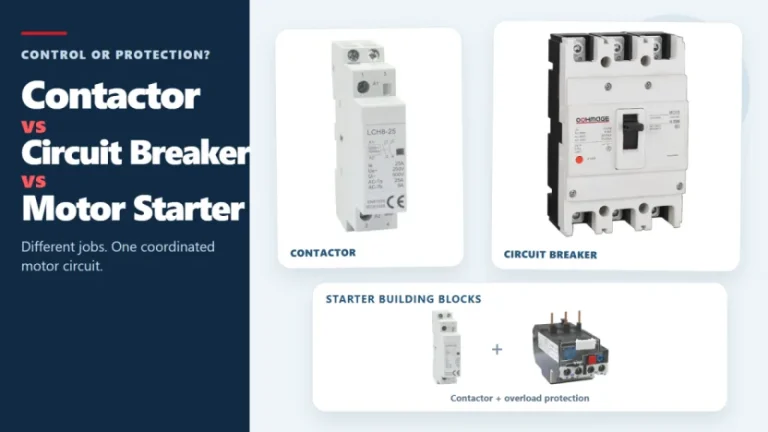
Figure 1. Contactors, circuit breakers, and motor starters solve different control and protection tasks. These three devices often appear in the same motor-control panel, but they solve different problems. A contactor handles frequent, remote, or automatic switching during normal operation. A circuit breaker interrupts abnormal current within its rated capability. A motor starter normally combines […]
A single-line diagram can look simple and still be difficult to read. One line may represent a multiphase circuit, a small symbol may stand for a major protective device, and a short label may carry the information that determines what equipment belongs downstream. The most reliable way to read a single-line diagram is to follow […]
Figure 1. Three-phase SPD selection starts with system facts, not the largest kA number. A three-phase surge protector should not be selected by the largest kA number on its label. First confirm the system voltage, whether a neutral is present, the earthing arrangement, the installation point, and the required SPD type. Then compare Uc, Up, […]