Can MCCBs Be Reconditioned? What’s Possible, What’s Not, and When Replacement Is Safer
Published: Author: Conor
Yes—molded case circuit breakers can be reconditioned, but only within strict limits. Most MCCBs are not designed for deep overhaul, and in many cases, replacement is the safer choice. Reconditioning only makes sense when the breaker’s condition, history, and application risk are clearly understood.
Your MCCB failed. Or maybe it’s starting to show signs of wear. Someone suggests reconditioning it instead of replacing it. It sounds cheaper—but is it actually safe?
We’ve seen facilities save thousands through smart, limited reconditioning. We’ve also seen serious failures caused by reconditioning breakers that should have been scrapped.
This guide explains what “reconditioned” really means for MCCBs, when it may be acceptable, when it’s risky, and how to decide whether reconditioning or replacement makes more sense.
Can MCCBs Be Reconditioned?
Yes, MCCBs can be reconditioned within strict limits, but most are not designed for deep overhaul or remanufacturing like larger circuit breakers.
The Short, Practical Answer (Yes, But With Strict Limits)
MCCBs are sealed or semi-sealed units. The manufacturer designed them for limited field serviceability.
You can replace accessories. You can clean contacts in some models. You can adjust trip settings on electronic units. But you can’t replace the arc chute. You can’t rebuild the operating mechanism. You can’t replace internal springs and linkages.
This isn’t like reconditioning an air circuit breaker where you can disassemble everything, replace worn parts, and essentially build a new breaker from components.
MCCBs are more “replace when worn” than “rebuild when worn.”
Here’s what manufacturers typically allow:
Cleaning accessible contacts
Replacing terminal lugs and hardware
Replacing trip units on modular designs
Basic mechanical maintenance on accessible parts
Testing and verification
Here’s what they don’t allow:
Opening sealed compartments
Replacing arc chutes or chambers
Rebuilding internal mechanisms
Modifying original design
Using non-OEM internal parts
The keyword is “accessible.” If you need special tools to get to it, or if opening it voids the UL listing, you probably shouldn’t be doing it.
What “Reconditioned” Means for MCCBs?
“Reconditioned” for MCCBs typically means cleaning, testing, verifying proper operation, and replacing accessible worn components to restore the breaker to acceptable operating condition.
The term gets misused a lot.
Recondition vs Repair vs Refurbish vs Rebuild: Key Differences
Repair means fixing a specific known problem. Your breaker won’t close? You repair the latch mechanism. Simple. Targeted.
Recondition means restoring to serviceable condition through cleaning, inspection, and limited component replacement. You’re bringing it back to acceptable standards. If a seller cannot clearly describe what was cleaned, replaced, and tested, assume no meaningful reconditioning was done.
Refurbish often means cosmetic restoration plus basic reconditioning. Clean the case. Replace labels. Make it look good. Maybe replace some parts.
Rebuild means complete disassembly and replacement of all worn parts. This works for ACBs. It doesn’t work for most MCCBs because you can’t access internal components without destroying the breaker.
The distinctions matter because sellers use these terms interchangeably. “Refurbished” might just mean “we cleaned it and tested it.” Or it might mean “we replaced every serviceable part.”
You need to know exactly what was done.
A Practical “Reconditioning Levels” Framework
Level 1 – Basic Service: Visual inspection, cleaning, mechanical operation check, basic electrical testing. No parts replaced. You’re verifying it still works.
Level 3 – Moderate Reconditioning: Everything from Level 2 plus replacing modular components (trip units, accessories), addressing minor mechanical issues, detailed testing including primary injection.
Level 4 – Deep Reconditioning: Only possible on certain MCCB designs. Requires manufacturer authorization or specialized certification. May involve partial disassembly of serviceable sections.
Most MCCBs shouldn’t go beyond Level 2 or 3. If you need Level 4, seriously consider replacement instead. If a provider cannot clearly state which reconditioning level was performed, assume Level 1 and price the risk accordingly.
MCCB vs ACB: Why Reconditioning Rules Don’t Translate
MCCBs and air circuit breakers have fundamentally different construction, making reconditioning practices for ACBs inappropriate for MCCBs.
This causes massive confusion.
Design and Serviceability: What MCCB Construction Allows (or Doesn’t)
Air circuit breakers are designed for field service. They’re modular. You can disassemble them completely. Every major component is replaceable.
MCCBs are designed for installation and replacement. They’re sealed or semi-sealed units. Limited field serviceability.
Why the difference? Economics and application.
ACBs handle higher currents and voltages. They’re expensive. They’re critical. Designing them for serviceability makes economic sense.
MCCBs are mass-produced commodity items. Designing them for complete field serviceability would increase cost without corresponding benefit for most applications.
Your 100-amp MCCB costs $150. Designing it like a miniature ACB would make it cost $500. Nobody wants that.
When People Say “Reconditioned Breakers,” What They Often Mean
Often, “reconditioned MCCB” means:
Pulled from a decommissioned facility
Cleaned and tested
Maybe some basic parts replaced
Sold as “reconditioned” or “refurbished”
Sometimes it means genuine reconditioning by qualified technicians using proper procedures and equipment.
Sometimes it means “we pulled it from a panel, wiped it off, and tested that it closes.”
You need to know which one you’re getting.
When Reconditioning Might Be Acceptable (Decision Conditions)
Reconditioning might be acceptable when the breaker is in excellent physical condition, has no history of severe faults, and doesn’t protect critical circuits. Notice the word “might.” This isn’t a blanket endorsement.
Breaker Condition: What Must Be True Before You Even Consider It
Your breaker must show:
No visible damage to the case or terminals
No signs of overheating (discoloration, melted plastic)
No contact erosion or pitting (if visible)
Smooth mechanical operation
All labels and ratings clearly legible
No modifications or repairs visible
If you see any of these red flags, reconditioning is off the table.
Event History: Why Past Faults Matter More Than Age
A 5-year-old breaker that’s interrupted three short circuits is worse than a 15-year-old breaker that’s only been manually operated. Every fault interruption stresses your breaker. The contacts erode. The arc chute degrades. The mechanism absorbs mechanical shock.
If your breaker has:
Never interrupted a fault
Only been manually operated for maintenance
Operated in a clean, controlled environment
No unusual loading conditions
Then reconditioning might be viable.
If your breaker has:
Interrupted multiple faults
Experienced any short circuits
Unknown operating history
Operated in harsh conditions
Skip reconditioning. Replace it.
Application Criticality: Where the Risk Tolerance Is Low
These applications demand new breakers with full manufacturer warranties.
In field investigations and failure reviews we’ve been involved in, we’ve seen both sides of this decision.
A manufacturing facility in Michigan reconditioned main distribution breakers to save money. They cleaned them, tested them, reinstalled them. Everything looked good.
Six months later, one breaker failed to trip during a ground fault. The fault propagated upstream, taking down an entire production line. The investigation revealed internal contact degradation that wasn’t visible during reconditioning. The downtime cost them $85,000. A new breaker would have cost $800.
Decision takeaway:
Reconditioning only works when the breaker has a clean history, no fault interruptions, and protects non-critical circuits. If any of those conditions are uncertain, replacement is the safer option.
When Reconditioning Is Not Recommended (Stop Rules)
You should not recondition MCCBs showing heat damage, mechanical problems, unknown service history, or any signs of internal deterioration. Some situations are automatic “no-go.”
Clear “No-Go” Signs: Heat Damage, Mechanical Issues, or Unknown Events
Heat damage shows as:
Discolored terminals or case
Melted plastic anywhere
Burned smell
Warped components
Heat damage indicates the breaker operated beyond its thermal capacity. Internal components are compromised even if you can’t see them.
Mechanical issues include:
Sticky or binding operation
Loose handle
Cracked case
Missing or damaged parts
Excessive force required to operate
These indicate internal mechanism problems you can’t see or fix.
Unknown history is automatic disqualification. You don’t know what happened to this breaker. You don’t know how many faults it interrupted. You don’t know its operating environment.
If you’re debating whether one of these signs “really matters,” that debate alone is your answer. These breakers should not return to service.
“Looks Fine” Isn’t a Pass: Hidden Failure Modes to Consider
The most dangerous breakers are the ones that look fine externally but are degraded internally. Contact erosion happens inside where you can’t see it. Arc chute damage isn’t visible without disassembly. Internal springs lose tension without external indication.
During commissioning and verification work we’ve reviewed, a hospital in Florida bought “reconditioned” breakers for a renovation project. The breakers looked perfect. They tested fine with basic testing. During commissioning, one breaker failed primary injection testing. It wouldn’t trip at 300% of rated current. The trip mechanism had failed internally.
They pulled all the “reconditioned” breakers and tested them. Four out of twelve failed. They replaced all of them with new breakers. The cost of the replacement breakers? $6,000. The cost if one had failed after the hospital was operational? Potentially millions, plus liability for any patient harm.
If you remember one thing:
External appearance tells you almost nothing about an MCCB’s ability to trip safely under fault conditions.
What Verification Should Follow Any Reconditioning Work?
Any reconditioned MCCB must undergo comprehensive electrical testing including insulation resistance, contact resistance, and trip verification before returning to service. Verification isn’t optional. It’s mandatory.
The Minimum Verification Goals (Conceptual, Not a Step-by-Step Procedure)
If the breaker can’t pass all these tests, it shouldn’t return to service.
Acceptance Criteria and Documentation: What Should Be Recorded
You need documented proof of:
What work was performed
What parts were replaced (if any)
Test results with measured values
Comparison to manufacturer specifications
Technician qualifications
Date of work
Serial number or unique identifier
Without documentation, you have no proof the work was done correctly. You have no legal protection if something goes wrong.
In maintenance audits we’ve reviewed, an industrial facility in Ohio reconditioned several breakers in-house. Their maintenance team did good work. But they didn’t document it properly. When OSHA investigated after an electrical incident (unrelated to the reconditioned breakers), they cited the facility for inadequate MCCB maintenance documentation. The citation cost them $25,000 in fines plus legal fees. Proper documentation would have cost nothing.
OEM vs Third-Party Reconditioning: What B2B Buyers Should Evaluate
OEM reconditioning provides traceability and warranty support, while third-party reconditioning offers cost savings but requires careful vetting of capabilities and quality systems. Both have advantages. Both have risks.
Support, Traceability, and Liability: Why Source Matters
OEM reconditioning gives you:
Factory-trained technicians
Genuine parts
Proper test equipment
Warranty coverage
Liability protection
Documentation that satisfies inspectors
Third-party reconditioning gives you:
Lower cost (usually 30-50% less)
Faster turnaround sometimes
More flexible on older models
But third-party reconditioning requires due diligence. You need to verify their capabilities, quality systems, and track record.
Questions to Ask Any Reconditioning Provider (Checklist)
Before you send breakers for reconditioning, ask:
About their process:
What specific work do you perform?
What tests do you conduct?
What test equipment do you use?
Do you follow manufacturer procedures?
About their qualifications:
Are your technicians factory-trained?
What certifications do you hold?
How long have you been reconditioning this brand/model?
About quality and documentation:
What documentation do you provide?
What warranty do you offer?
Can you provide customer references?
Do you maintain quality system certification (ISO, etc.)?
About parts and materials:
Do you use OEM parts or aftermarket?
What’s your parts traceability system?
What happens if you can’t restore the breaker?
If they can’t answer these questions satisfactorily, find another provider.
Recondition or Replace? A Practical Cost–Risk Decision Framework
Your decision to recondition or replace should balance direct costs against downtime risk, safety implications, and long-term reliability requirements. This isn’t just about upfront cost.
The Cost Triangle: Downtime, Safety Risk, and Total Cost of Ownership
Direct cost is obvious. New breaker costs more upfront. Reconditioned costs less upfront.
Downtime risk is hidden. New breaker has lower failure probability. Reconditioned has higher failure probability. If that breaker protects critical equipment, what’s a failure worth?
Safety risk is critical. New breaker has full manufacturer certification and warranty. Reconditioned has question marks. What’s the liability if someone gets hurt?
Calculate total cost of ownership:
Purchase price (new or reconditioned)
Installation cost (same either way)
Failure probability × cost of failure
Warranty value
Expected service life
Often, new breakers win this calculation even though they cost more upfront.
A Simple Decision Matrix for Maintenance Teams
Replace with new when:
The breaker protects critical circuits
Service history is unknown
The breaker shows any damage
Age exceeds 15-20 years
Multiple faults have occurred
Application is life safety
Consider reconditioning when:
The breaker is less than 10 years old
Service history is documented
No faults have been interrupted
Application is non-critical
Budget constraints are severe
The breaker is rare or obsolete (and new isn’t available)
Never recondition when:
Heat damage is visible
Mechanical operation is impaired
Unknown history exists
Critical application
Manufacturer explicitly prohibits it
When in doubt, replace. The cost difference isn’t worth the risk.
Closing Ideas
Can MCCBs be reconditioned? Yes—but only within strict limits.
Reconditioning can work for non-critical applications when the breaker has a documented service history, shows no signs of damage, and passes proper verification testing. It does not work for critical circuits, unknown histories, or breakers that have experienced fault events.
In many cases, replacement is the safer and more economical choice once downtime risk and safety exposure are considered.
Before you make a decision, take these next steps:
Classify MCCBs by application criticality.
Treat breakers with unknown history, heat damage, or past fault interruption as replacement-only.
Require clear documentation of work performed, testing completed, and applicable reconditioning level.
When uncertainty exists, replace the breaker.
Electrical protection devices are not the place to gamble. A small upfront saving can lead to disproportionately large consequences when a breaker fails.
If you’re evaluating whether to recondition or replace MCCBs in your facility, the team atOohmage works with maintenance and engineering teams to review breaker condition, application criticality, and replacement options—so decisions are based on risk, not guesswork.
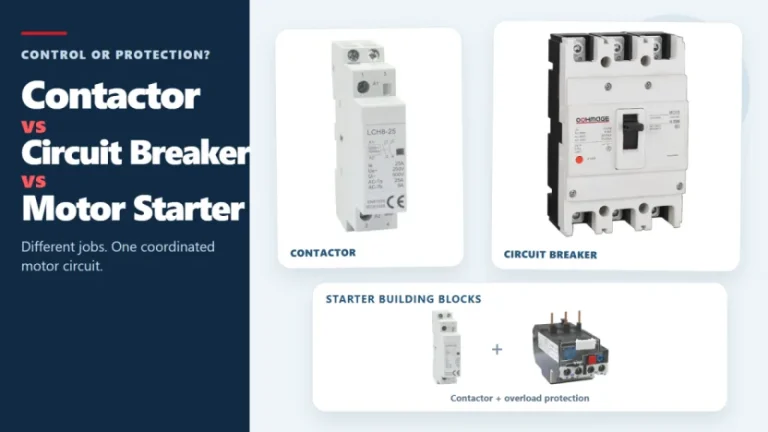
Figure 1. Contactors, circuit breakers, and motor starters solve different control and protection tasks. These three devices often appear in the same motor-control panel, but they solve different problems. A contactor handles frequent, remote, or automatic switching during normal operation. A circuit breaker interrupts abnormal current within its rated capability. A motor starter normally combines […]
Introduction The concept of remote tripping is simple, but in actual operation, project teams often encounter difficulties in specifying the components. The panel factory may require circuit breakers triggered by fire alarm relays, PLC outputs, building management system instructions, or other coordinated control. At this point, “diversion tripping” is only the first step in the […]
The main types of circuit breakers used in low-voltage distribution include miniature circuit breakers (MCBs), molded case circuit breakers (MCCBs) and residual-current devices such as RCCBs and RCBOs. They are not interchangeable. MCBs and MCCBs are selected for overcurrent protection in different circuit roles, an RCCB provides residual-current protection without integral overcurrent protection, and an […]