How Often Should a Molded Case Circuit Breaker Be Exercised? (Standards & Best Practices)?
Published: Author: Conor
Most molded case circuit breakers should be exercised every 1 to 3 years. The right interval depends on two things: how critical the circuit is and how harsh the environment is.
The reason is simple: many MCCBs stay in the ON position for years. Then, during a shutdown or a fault, you find out the handle feels stiff or the mechanism doesn’t move the way it used to.
In this guide, you’ll learn what “exercising” really means (and what it does not mean), how to pick a practical interval for your site, and how to do it safely without creating avoidable downtime.
What Does “Exercising” a Molded Case Circuit Breaker Actually Mean?
Exercising a molded case circuit breaker means manually operating it from ON to OFF and back to ON to keep its internal mechanism free-moving and dependable.
At its core, exercising is about mechanical readiness. You are checking whether the breaker’s moving parts can still travel smoothly and predictably after long periods of inactivity. This is especially important for breakers that protect steady loads and may sit untouched for years.
In real facilities, exercising usually happens during planned shutdowns, annual or multi-year maintenance windows, or as part of an outage checklist when parts of the distribution system are already being isolated.
What exercising does not do is verify electrical protection performance. That distinction matters, and it’s where many maintenance programs get confused.
Exercising vs Electrical Testing: What’s the Difference?
Exercising checks mechanical movement, while electrical testing checks electrical condition and performance.
Electrical testing may include insulation resistance, contact resistance, trip testing, or coordination verification. Those tests can uncover issues like insulation degradation, contact wear, or incorrect trip settings. What they cannot guarantee is that the handle, latch, and spring mechanisms will physically move as intended after years of inactivity.
Exercising fills that gap. It can reveal stiffness, binding, hesitation, or inconsistent handle travel—issues that may never show up in electrical test results.
A simple way to think about it is this:
Electrical testing tells you whether a breaker should work. Exercising tells you whether it can still move when asked to.
Both have a place in a complete maintenance program, but they answer different questions and should not be treated as interchangeable.
What Parts of an MCCB Are Affected During Exercising?
Exercising primarily affects the handle mechanism, internal linkages, springs, pivots, and the trip latch interface.
These components are the most sensitive to long-term inactivity. Dust, humidity, vibration, and aging lubricants can all change how these parts behave over time. During exercising, you are watching and feeling for:
Smooth, consistent handle travel
Normal operating force without hesitation or binding
Positive detent behavior in the ON position
No scraping sounds, grinding feel, or delayed movement
Any abnormal resistance, gritty feel, or hesitation is a signal to stop cycling and move from “exercise” to inspection, testing, or replacement planning.
From a maintenance perspective, this observation step is the real value of exercising. The goal is not just to move the handle—it is to confirm that the breaker still behaves like a healthy, predictable device.
Why Do MCCBs Need to Be Exercised?
MCCBs need exercising because mechanical reliability can degrade over time, even when the breaker has not seen electrical stress and appears to be “working fine.”
Most unexpected breaker problems are not sudden, catastrophic failures. They are gradual reliability losses that go unnoticed until the breaker is finally asked to operate—often during a fault or an urgent isolation. Inactivity allows small mechanical changes to accumulate quietly, without triggering alarms or trips.
That gap between “looks fine” and “behaves reliably” is exactly where exercising adds value.
What Happens When MCCBs Sit Idle for Long Periods?
When MCCBs remain in one position for years, their mechanical components can slowly lose freedom of movement.
Dust and debris can settle around handle mechanisms and external interfaces
Humidity and temperature cycling can promote light corrosion at pivots and contact surfaces
Lubricants age, thicken, or migrate away from critical points
Vibration in industrial environments can subtly change mechanical alignment
None of these conditions necessarily cause a breaker to trip or fail electrically. As a result, the breaker often appears healthy—until someone tries to operate it.
This is why breakers protecting steady, uninterrupted loads are often the ones that surprise facilities during the first real switching operation in years. The device wasn’t electrically stressed. It was mechanically neglected.
Real-World Consequences of Poor MCCB Mechanical Reliability
Poor mechanical reliability rarely stays confined to the breaker itself. It usually spreads into downtime, safety exposure, and operational disruption.
Case example – commercial distribution feeder: A multi-tenant building experienced a downstream fault. The upstream feeder breaker opened, but reclosure was inconsistent and required multiple attempts. Investigation showed the breaker had not been manually operated in over a decade. Mechanical stiffness was present, even though no prior electrical issues had been recorded. The result was extended outage duration and emergency service costs.
Case example – industrial process isolation: During a planned maintenance shutdown, a breaker handle felt unusually stiff during isolation. The team stopped instead of forcing the operation. Follow-up inspection confirmed mechanical degradation near end-of-life. That pause avoided an unplanned failure during production and allowed a controlled replacement.
These examples highlight a common pattern: mechanical unreliability often reveals itself at the worst possible time, and the consequences are usually larger than the breaker itself.
How Often Should an MCCB Be Exercised?
Most MCCBs should be exercised every 1 to 3 years, depending on the consequence of failure, environmental conditions, and how often the breaker is otherwise operated.
There is no single “best” interval that fits every installation. A breaker in a clean, climate-controlled electrical room serving a non-critical load does not face the same risks as a breaker in a humid industrial area feeding a production process. For that reason, the most effective programs assign exercising frequency based on risk tier rather than applying one blanket rule across all breakers.
Is There a Single Recommended Frequency?
No. There is no single recommended frequency because breaker design, service conditions, and operational criticality vary widely.
Industry standards intentionally avoid locking facilities into a fixed interval. Manufacturers also differ in mechanism design and long-term behavior. In practice, most maintenance teams start with a conservative interval, observe results over several cycles, and then adjust.
If repeated exercising reveals stiffness or abnormal feel in certain environments, intervals should be shortened there. If clean, low-risk areas show stable behavior over time, intervals can often be extended without increasing risk.
Typical Exercising Intervals by Application Type
As a practical starting point, many facilities use the following risk-based ranges:
Commercial buildings (general distribution): Every 2–3 years, especially for breakers that rarely see normal switching
Commercial buildings with high occupancy or high consequence: Every 1–2 years, where safe isolation and fast restoration matter
Industrial production and manufacturing:Annually or biennially, depending on dust, humidity, vibration, and downtime cost
Infrastructure or mission-critical systems with redundancy: Typically annually, coordinated with transfer or redundancy testing
OEM equipment and packaged systems: During scheduled shutdowns, recommissioning, or refurbishment cycles
Case example: One industrial site grouped breakers by location—clean electrical rooms versus process-floor panels. Process-floor breakers were exercised annually, while clean-room breakers followed a two-year cycle. After two years, the data supported the split: fewer stiff mechanisms discovered late and fewer unplanned outages.
Environmental and Operational Factors That Affect Exercising Frequency
Exercising frequency should increase when environmental stress is high, normal switching is rare, or the consequence of failure is significant.
Key factors include:
Dust, humidity, corrosive atmospheres, or temperature cycling
Vibration from nearby equipment or structural movement
Breakers that remain continuously ON with no routine operation
Circuits where outages are infrequent but costly when they occur
Operational reality also matters. If a facility only has one safe outage window per year, that window effectively defines the exercising opportunity. A maintenance program that ignores how the site actually operates is unlikely to be followed consistently.
What Do Industry Standards and Manufacturers Recommend?
Industry guidance generally treats MCCB exercising as a reliability best practice, while manufacturer instructions define the safe operating boundaries for each specific device.
In other words, standards focus on what your maintenance program should achieve, while manufacturers focus on what their breaker can safely tolerate.
How Standards and Manufacturers View MCCB Exercising
Standards emphasize outcomes and risk. Manufacturers emphasize device-specific limits.
Industry standards:
Most electrical maintenance standards focus on inspection, testing, and overall electrical safety management rather than prescribing a fixed exercising interval. The intent is to ensure breakers remain reliable and can be safely operated when needed. As a result, standards typically support periodic operation for devices that remain in one position for long periods, but they stop short of mandating “exercise every X months.”
The expectation is usually: have a documented program, justify your intervals, and adjust based on observed condition and risk.
Manufacturers:
Manufacturers take a more device-specific view. Internal mechanism design, materials, trip unit style, enclosure sealing, and lubrication all influence how a breaker behaves over time. For that reason, manufacturer instructions often define:
Whether manual operation under certain conditions is permitted
What is considered normal versus abnormal handle behavior
When operation should stop and inspection or replacement should begin
For general background on what an MCCB is and how it is categorized, see NFPA 70B guidance on electrical equipment maintenance (reference context only, not a fixed interval mandate).
The Practical Field Rule
Here is the rule most maintenance teams rely on in practice:
If a generic maintenance habit conflicts with the manufacturer’s instructions, the manufacturer always wins.
Exercising a breaker in a way that violates manufacturer guidance can introduce risk rather than reduce it. That includes forcing stiff mechanisms, operating outside permitted conditions, or treating exercising as a substitute for inspection, testing, or replacement planning.
A well-run maintenance program uses standards to shape policy and manufacturers to set boundaries—and then adjusts frequency based on real findings in the field.
How to Properly Exercise an MCCB?
Properly exercising a molded case circuit breaker is less about “flipping a handle” and more about planning, observation, and decision-making.
The goal is not speed. The goal is to confirm that the breaker can be operated safely and predictably—and to stop immediately if it cannot.
Should MCCBs Be Exercised Under Load or No Load?
MCCBs should normally be exercised under no-load or reduced-load conditions, unless your procedures and manufacturer guidance explicitly allow under-load operation for that specific circuit.
Operating under load increases contact stress and raises the risk of unintended consequences, especially for sensitive equipment such as drives, control systems, and electronics. Exercising under no-load conditions makes the activity safer, more repeatable, and easier to evaluate.
If load cannot be reduced and interruption is unacceptable, that is a signal to defer exercising until redundancy, bypass capability, or an engineered switching plan is in place.
Basic Steps for Safe MCCB Exercising
Safe exercising follows a deliberate, repeatable sequence designed to minimize surprises and capture useful observations.
Before operating the breaker:
Confirm breaker identification and supplied loads using panel schedules and labeling
Obtain operational approval and notify all affected teams
Verify how downstream equipment will respond to power removal
During exercising:
Reduce or isolate load where feasible using proper shutdown procedures
Move the handle firmly to OFF with steady pressure and confirm full travel
Pause briefly and observe handle position and resistance
Return the handle firmly to ON and confirm a stable ON position
After re-energization:
Observe downstream equipment for alarms, abnormal sounds, or unexpected trips
Confirm the breaker remains stable under normal load
Throughout the process, do not rush. Handle feel, resistance, and response time matter as much as the final ON position.
Why Documentation Matters During Exercising
Documenting exercising results turns a switching action into asset intelligence.
Notes such as “normal operation confirmed,” “increased resistance compared to last cycle,” or “hesitation near OFF position” help maintenance teams trend condition over time. That information supports inspection planning, replacement decisions, and spare inventory management—rather than waiting for a failure to force action.
Common Mistakes to Avoid During Exercising
The most common mistakes involve speed, force, and false confidence.
Avoid:
Rapid or repeated cycling
Forcing a handle that feels abnormal
Exercising during peak production or high-occupancy periods
Treating successful re-energization as proof the breaker is healthy
If the operation does not feel right, stop and escalate. A breaker that turns back on can still be mechanically compromised.
When Exercising Is Not Recommended?
Exercising is not always the right action. In some situations, operating an MCCB can introduce more risk than it removes.
The purpose of exercising is to confirm mechanical readiness—not to gamble with equipment that is already near the end of its reliable service life or feeding loads that cannot tolerate interruption. Knowing when not to exercise is just as important as knowing how to do it.
Aging or High-Cycle MCCBs Near End of Service Life
Aging or high-cycle MCCBs are often better candidates for replacement planning than routine exercising.
Over time, springs lose tension, linkages wear, and internal tolerances change. Exercising can expose those conditions, which is useful, but it can also trigger a failure that cannot be quickly recovered—especially if replacement inventory is not immediately available.
Warning signs that should shift the decision away from exercising include:
A history of nuisance tripping or abnormal operation
Exposure to high fault currents in the past
Visible damage, cracking, or discoloration
Persistent overheating evidence at terminals
A noticeable change in handle feel compared to previous operations
When these indicators are present, the safer choice is usually a controlled replacement, not another operating cycle.
Critical Circuits Where Unplanned Interruption Is Unacceptable
Critical circuits should not be exercised unless redundancy, bypass capability, or an engineered switching plan makes the interruption a controlled event.
In these cases, the risk is not limited to the breaker itself. Even a successful reclosure can trigger downstream issues such as control system faults, process trips, or failed restarts.
Case example – decision failure, not equipment failure: A facility exercised a breaker feeding a critical control segment without verifying standby readiness or restart behavior. The breaker reclosed normally, but the downstream system failed to recover, resulting in a cascade of alarms and an extended outage. The breaker was not the root cause. The decision process was.
For critical loads, the right sequence is often:
Improve system design or redundancy
Establish controlled switching procedures
Then incorporate exercising as part of a broader plan
Until those conditions are met, deferring exercising is the responsible choice.
How to Decide If Your MCCB Needs Exercising Now?
An MCCB is a good candidate for exercising only when the risk of operating it is lower than the risk of leaving it untouched.
The checklist below is not a scoring system. It is a decision filter. If most answers point toward low operational risk and long inactivity, exercising is usually appropriate. If several answers raise concern, exercising should pause in favor of inspection, testing, or replacement planning.
Quick Assessment Checklist for Maintenance Teams
Use the following questions before scheduling an exercising operation:
Has the breaker not been manually operated in the last 1–3 years?
Is the breaker installed in a dusty, humid, corrosive, or vibration-prone environment?
Does the breaker protect a steady load with little or no normal switching?
Is there a planned outage window with stakeholder approval?
Is replacement inventory or contingency available if abnormal behavior is observed?
Have there been no recent warning signs, such as overheating, odor, or repeated nuisance trips?
If most of these conditions are true, exercising is generally a reasonable next step.
If several answers raise concern—especially around condition warnings or lack of contingency—stop here and shift the plan.
Case Example: Using the Checklist in Practice
Before a scheduled shutdown, a distribution center reviewed breakers in a loading-area electrical room. Three feeders had not been manually operated in years and were exposed to dust and vibration. Replacement units were available on site, and the loads could tolerate interruption.
Exercising revealed abnormal stiffness in one breaker. The team replaced it during the same outage. That decision prevented a future unplanned failure during peak operations.
The value was not just the exercising—it was the decision process that made exercising safe.
Exercising vs Inspection vs Replacement: Choosing the Right Action
Different conditions call for different actions:
Choose exercising when the breaker appears healthy but has been idle for long periods
Choose inspection or testing when there are visible signs of stress, thermal evidence, or abnormal history
Choose replacement planning when degradation is confirmed or the consequence of failure is too high to accept uncertainty
This distinction matters. Exercising is a tool for inactivity risk—it is not a fix for aging, damage, or high-consequence uncertainty. For teams building a consistent decision framework across assets, this is where a broader MCCB maintenance approach becomes essential.
Final Thoughts
MCCBs should be exercised on a risk-based schedule that reflects environment, circuit criticality, and how rarely the device is otherwise operated. Breakers that never move can become less predictable over time—and unpredictability is the enemy of safe operations and fast restoration.
Exercising adds value when it is planned, observed, and documented. It becomes risky when it is rushed, forced, or applied to aging devices or critical circuits without redundancy. The goal is not to move every breaker on a calendar—it is to know which actions reduce risk and which ones increase it.
If you’re evaluating whether to exercise, inspect, or replace MCCBs across your facility, Oohmage works with maintenance and engineering teams to review breaker condition, application criticality, and failure risk—so decisions are based on evidence and consequence, not habit or guesswork.
FAQs
Should exercising be logged even if nothing unusual happens?
Yes, because “normal operation confirmed” is valuable trending data for future decisions and warranty, audit, or asset planning.
Can exercising be done on breakers with electronic trip units?
Yes, because exercising targets mechanical movement, but any trip setting changes should follow your engineering change process.
What should a maintenance team do if the handle feels stiff but still operates?
Stop further cycling, document the observation, and escalate for inspection and possible testing or replacement planning.
Is exercising useful if the breaker trips occasionally during normal faults?
Less so, because real trips already create mechanical movement, but scheduled observation and documentation can still reveal deterioration trends.
Should contractors perform exercising during short shutdown windows?
Only if roles, approvals, and contingency plans are clear, because the risk is not just the switching action but the operational consequences after restoration.
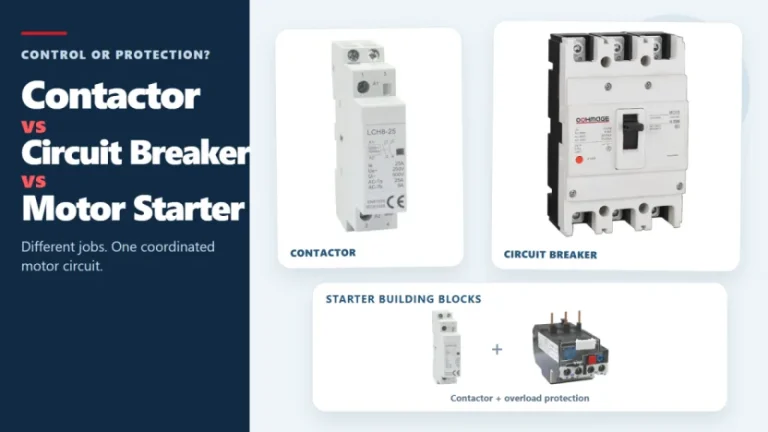
Figure 1. Contactors, circuit breakers, and motor starters solve different control and protection tasks. These three devices often appear in the same motor-control panel, but they solve different problems. A contactor handles frequent, remote, or automatic switching during normal operation. A circuit breaker interrupts abnormal current within its rated capability. A motor starter normally combines […]
Introduction The concept of remote tripping is simple, but in actual operation, project teams often encounter difficulties in specifying the components. The panel factory may require circuit breakers triggered by fire alarm relays, PLC outputs, building management system instructions, or other coordinated control. At this point, “diversion tripping” is only the first step in the […]
The main types of circuit breakers used in low-voltage distribution include miniature circuit breakers (MCBs), molded case circuit breakers (MCCBs) and residual-current devices such as RCCBs and RCBOs. They are not interchangeable. MCBs and MCCBs are selected for overcurrent protection in different circuit roles, an RCCB provides residual-current protection without integral overcurrent protection, and an […]