Understanding Low Voltage Systems: Meaning, Components, and Safety
Published: Author: Conor
Low voltage systems are electrical systems that operate at lower voltage levels than medium voltage or high voltage networks. They are commonly used in homes, commercial buildings, industrial control panels, data centers, communication systems, security systems, and renewable energy installations.
The exact meaning of “low voltage” can vary by standard, country, and application. In many international electrical standards, low voltage can include power distribution up to 1000 V AC or 1500 V DC. In other contexts, especially control, communication, and limited-energy circuits, the term may refer to much lower voltages such as 12 V, 24 V, or 48 V.
This guide explains what low voltage means, common low voltage systems examples, key components, safety considerations, and how low voltage equipment supports reliable power distribution.
A low voltage electrical system is a power, control, or communication system that operates within a voltage range classified as low by the relevant standard or application. For building power distribution, many IEC-based systems classify low voltage as up to 1000 V AC or 1500 V DC. For control, alarm, telecom, and security circuits, low voltage often refers to much lower levels such as 12 V, 24 V, or 48 V.
Because definitions can vary, engineers and installers should always check the applicable local standard, equipment rating, and installation environment before designing a low voltage distribution system. Compared with medium voltage and high voltage systems, low voltage systems are usually easier to distribute close to end users. However, they can still create shock, fire, overheating, and equipment-damage risks if they are not designed, protected, installed, and maintained correctly.
In a building or facility, a low voltage network connects power distribution equipment, protection devices, control circuits, and end-use loads into one coordinated electrical system.
These are common low voltage examples, but the exact classification depends on the standard, country, equipment rating, and application.
Common voltage ratings include:
12 V, 24 V, 48 V: Used in security systems, fire alarms, and telecommunications.
120/240 V (North America): Standard for residential and small commercial settings.
230 V (Europe, Asia): Common for household and commercial applications globally.
Global standards vary by country, application, and equipment type. The NEC, IEC, and local electrical codes may define low voltage differently depending on circuit purpose, voltage level, and installation environment. For any low voltage electrical installation, designers should confirm the applicable local code and the rated limits of each device.
Key Components of Low Voltage Systems
Low voltage systems rely on specialized equipment to deliver reliable power.
Here are some key components:
Cables and Wiring: Twisted pair (e.g., Cat6 for data), coaxial, and fiber optic cables transmit power and signals. Low voltage cables are rated for specific currents to prevent overheating, with insulation materials like PVC or LSZH (Low Smoke Zero Halogen) for safety.
Transformers: Step-down transformers reduce medium voltage (e.g., 11 kV) to consumer levels (e.g., 120/240 V). For example, pole-mounted distribution transformers are common in residential areas.
Switchgear and Circuit Breakers: Low voltage switchgear, such as molded case circuit breakers (MCCBs), protects circuits from overloads and short circuits. These devices ensure system reliability by isolating faults.
Relays and Contactors: Relays control small circuits (e.g., in automation systems), while contactors handle high-current loads like motors in industrial settings.
Surge Protection Devices (SPDs): Protect sensitive equipment from voltage spikes caused by lightning or grid fluctuations. SPDs are critical for data centers and smart homes.
Smart Meters and Sensors: Monitor energy usage in real time, enabling demand response and optimization. Brands like Schneider Electric offer advanced smart meters for low voltage applications.
Applications of Low Voltage Systems
Low-voltage systems power a wide range of applications, adapting to modern demands.
Low voltage systems examples include home electrical circuits, LED lighting, access control, CCTV, fire alarms, industrial control panels, data center power systems, low voltage switchgear, distribution boxes, and solar protection systems.
Residential: Smart home systems, including LED lighting, smart thermostats (e.g., Nest), and security cameras, rely on 12–48 V systems. Electric vehicle (EV) charging stations often use 240 V low voltage setups. (Learn more about whether household electricity is AC or DC)
Commercial: Access control, CCTV, and fire alarms operate at low voltages for safety and reliability. Building management systems (BMS) integrate these for centralized control.
Industrial: Automation systems, such as SCADA (Supervisory Control and Data Acquisition), use low voltage relays and sensors for precise control. Motor control centers (MCCs) employ contactors for heavy machinery.
Data Centers: Low voltage systems power servers and cooling units, ensuring uptime with redundant configurations like 48 V DC systems.
Renewable Energy: Solar panels and battery storage systems (e.g., Tesla Powerwall) use low voltage DC for efficient integration with inverters. DC circuit breakers and solar combiner boxes provide essential protection and organization for photovoltaic installations.
Benefits and Challenges of Low Voltage Systems
Benefits
Safety: Lower voltages reduce the risk of electrical shock, making them ideal for homes and public spaces.
Energy Efficiency: Low voltage systems can be efficient in short-distance distribution when cables are correctly sized and voltage drop is controlled.
Compatibility: Support modern technologies like IoT, automation, and renewable energy.
Cost-Effectiveness: Lower installation and maintenance costs compared to high voltage systems.
Challenges
Solutions
Voltage Drop: Over long distances, low voltage systems experience power loss, requiring careful cable sizing.
Use larger gauge cables to reduce voltage drop (e.g., AWG 12 for longer runs).
Legacy Integration: Retrofitting older buildings with modern low voltage equipment can be complex.
Employ modular switchboards for easier retrofitting.
Cybersecurity: Smart low voltage systems with IoT connectivity are vulnerable to hacking.
Implement encryption and secure protocols for IoT devices.
Load Calculations: Use the formula P = V × I (Power = Voltage × Current) to determine capacity. For example, a 240 V circuit with 20 A supports 4,800 W.
Cable Sizing: Select cables based on current and distance to minimize voltage drop (e.g., <3% per NEC guidelines).
Compliance: Adhere to NEC (e.g., Article 725 for low voltage) or IEC standards for safety and interoperability.
Installation Tips
Grounding: Ensure proper grounding to prevent electrical faults, using copper grounding rods.
Structured Cabling: Use Cat6 or fiber optics for scalability in smart systems.
Testing: Verify connections with a multimeter and perform insulation resistance tests.
Safety Protocols
Install surge protection devices to reduce the risk of damage from transient overvoltages caused by lightning, switching events, or grid disturbances. Arc flash risk should be managed through correct system design, protective device coordination, safe work procedures, and qualified installation practices.
Follow OSHA guidelines for worker safety during installation.
Maintenance and Troubleshooting Low Voltage Systems
Maintenance Practices
Inspect wiring and transformers annually for wear or corrosion.
Clean and test SPDs to ensure functionality.
Update smart meter firmware to maintain IoT compatibility.
Troubleshooting Common Issues
Voltage Drops: Check for loose connections or undersized cables using a multimeter (e.g., voltage <5% below nominal).
Equipment Failures: Test relays or breakers with a continuity tester to identify faults.
Interference: Use shielded cables to reduce electromagnetic interference in communication systems.
Tools
Multimeter: Measures voltage, current, and resistance (e.g., Fluke 117).
Thermal Imaging Camera: Detects hot spots in wiring or switchgear.
Global Perspectives and Standards
Regional Variations
North America: 120/240 V split-phase systems, governed by NEC, prioritize safety and reliability.
Europe: 230 V single-phase systems follow IEC standards, emphasizing interoperability.
Asia/Developing Regions: 220 V systems are common, with varying reliability due to infrastructure differences.
Standards and Certifications
NEC: The U.S. National Electrical Code uses different rules for different circuit types, voltage levels, energy limits, and installation purposes. Do not treat one NEC article as the only definition of a low voltage system.
IEC: IEC-based standards commonly use low voltage for electrical installations up to 1000 V AC or 1500 V DC, but local rules and equipment ratings should always be checked before design or installation.
UL: Certifies equipment like circuit breakers for safety (e.g., UL 489 for MCCBs).
Frequently Asked Questions About Low Voltage Systems
What does low voltage mean?
Low voltage means an electrical voltage range that is lower than medium voltage or high voltage. The exact definition depends on the standard, country, and application.
What is a low voltage electrical system?
A low voltage electrical system distributes or controls power at low voltage levels. It may include cables, circuit breakers, switchgear, surge protection devices, meters, control circuits, and connected loads.
What are examples of low voltage systems?
Examples include home electrical circuits, lighting systems, CCTV systems, fire alarms, access control systems, industrial control panels, data center power systems, and solar protection systems.
What is the difference between low voltage and medium voltage?
Low voltage systems are usually used for final power distribution and equipment-level power. Medium voltage systems are often used for utility distribution, substations, and larger industrial power networks.
Are low voltage systems safe?
Low voltage systems are generally easier to manage than medium or high voltage systems, but they are not risk-free. Incorrect design, poor wiring, overloads, or missing protection devices can still cause shock, fire, or equipment damage.
How do you protect a low voltage distribution system?
A low voltage distribution system can be protected with correct cable sizing, grounding, circuit breakers, surge protection devices, overload protection, short-circuit protection, regular inspection, and qualified installation.
Closing Words
Low voltage systems are essential for safe, efficient, and reliable power distribution in modern homes, commercial buildings, industrial facilities, data centers, and renewable energy projects.
By understanding what low voltage means, how low voltage components work, and which protection devices are required, engineers, installers, and buyers can make better decisions for long-term electrical safety and system performance.
OOHMAGE, an ISO 9001:2015-certified electrical equipment supplier based in Zhejiang, China, has been a trusted name in low-voltage systems since 2005. With over 100,000 square meters of manufacturing space and a team of 200+ skilled professionals, we deliver high-quality products for industrial, commercial, and residential applications.
Our product range includes electrical protection devices, control devices, industrial breakers, and solar electrical solutions, all designed for safety, efficiency, and reliability.
Key offerings include:
Miniature Circuit Breaker (MCB): Certified to IEC 60898-1, our MCBs support 230/400 V circuits up to 125 A, offering robust overload and short-circuit protection for homes and businesses. Its compact design and 20,000 mechanical cycles ensure long-term durability.
Surge Protector: Designed for photovoltaic systems, our SPDs handle 500–1200 V with a 25 ns response time, protecting against transient overvoltages. They meet EN 61643-11/IEC 61643-11 standards and are ideal for solar installations.
Distribution Box: Engineered for efficient power distribution, these boxes use high-precision DC components to ensure safety and performance in residential and industrial settings.
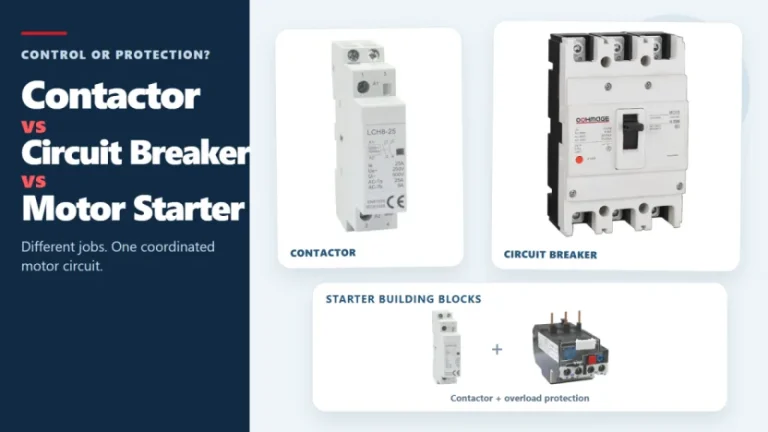
Figure 1. Contactors, circuit breakers, and motor starters solve different control and protection tasks. These three devices often appear in the same motor-control panel, but they solve different problems. A contactor handles frequent, remote, or automatic switching during normal operation. A circuit breaker interrupts abnormal current within its rated capability. A motor starter normally combines […]
The main types of circuit breakers used in low-voltage distribution include miniature circuit breakers (MCBs), molded case circuit breakers (MCCBs) and residual-current devices such as RCCBs and RCBOs. They are not interchangeable. MCBs and MCCBs are selected for overcurrent protection in different circuit roles, an RCCB provides residual-current protection without integral overcurrent protection, and an […]
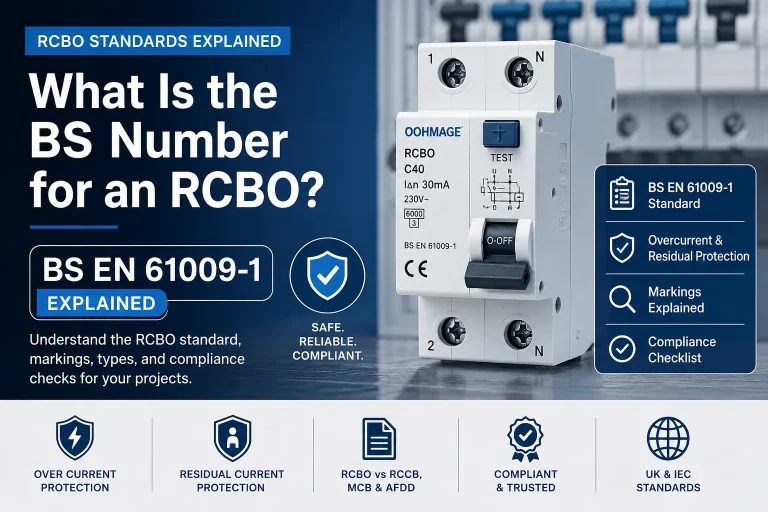
Introduction If you are searching for the RCBO BS number, the answer most commonly required in UK and IEC-based electrical procurement is BS EN 61009-1. This is the principal product standard associated with residual current circuit breakers with overcurrent protection used in residential, commercial, and similar installations. However, merely the BS number is not sufficient […]