What is CE Marking Certification on Electrical Equipment?
Published: Author: Conor
You cannot access niche markets legally if the relevant regulations are not observed on your electronic equipment. CE marking is essential for any electrical product sold therein.
Indeed, CE marking, one of the pivotal requirements for electrical products being marketed in the European Economic Area (EEA), means that such items comply with EU safety, health, and environmental standards. What is CE Marking, and where does its significance lie? From this point, we will proceed to consider the compliance process and what it means for customers and sellers focused on the European market.
What Is CE Marking Certification?
CE marking (Conformité Européenne) is a directive certificate that indicates a product complies with all relevant EU safety, health, and environmental regulations. Manufacturers put the mark on their products, showing it meets EU directives and can be legally marketed in the EEA.
The CE mark, for electrical products, means compliance with particular directives above all the Low Voltage Directive (LVD), which is for equipment operating within certain voltage ranges.
On electrical equipment, the CE marking means that this product is safe for use and will not harm people or property, nor if disposed of properly does it damage the natural environment.
The Low Voltage Directive (LVD) governs electrical equipment operating at voltages between 50 to 1000 voltsfor alternating current (AC) and 75 to 1500 volts for direct current (DC).
The LVD is the basic safety objective that electrical equipment must meet in order to pass compliance inspection and be sold throughout the EEA. This certification demonstrates high product quality and design, years of testing in various environmental conditions, and ample protection against fire and explosion hazards.
The LVD came into effect on April 20, 2016, replacing the older 2006/95/EC directive. The directive ensures that electrical equipment within the voltage range specified operates safely under normal conditions and even under fault conditions.
To enter the EEA market, manufacturers must satisfy the basic requirements for safe operation demanded by the LVD, or similar directives for components, circuits, or subassemblies.
The EMC Directive ensures that electrical products do not emit electromagnetic interference (EMI) that could disrupt other devices.
Additionally, it ensures that the equipment is immune to EMI, which might otherwise affect its performance. Ensuring electric equipment suppliers conform with the requirements for EMC brings harmony to Europe’s electrical equipment market and means everyone is at ease.
Electrical equipment must also comply with the RoHS Directive (2011/65/EU). It restricts the use of hazardous substances, such as lead, mercury, and cadmium, in electrical and electronic equipment.
This directive is essential to protect human health and the environment, and a CE marking ensures the product adheres to RoHS regulations.
Other Directives
Depending on the product’s type and usage, other EU directives may apply. These include the Radio Equipment Directive (RED) for devices that communicate via radio waves, and the Machinery Directive, which applies to certain electrical machines.
How Manufacturers Do in The CE Marking Conformity Assessment Process
1. Risk Assessment
The first step of CE marking certification for electrical equipment is a risk assessment. Manufacturers must consider the potential hazards of the product and its usage. This process involves identification and evaluation of safety hazards (such as electric shock or fire), as well as environmental and operational risks.
2. Testing and Evaluation
Secondly, manufacturers must ensure their electrical equipment undergoes rigorous testing and evaluation.
Testing standards, such as EN 60335-1 for household appliances or EN 60950-1 for information technology equipment, provide guidance on the technical specifications.
Some items may require additional assessments by third-party notified bodies. They are independent organizations authorized by EU member states to weigh compliance with regulatory requirements. Therefore, these bodies may be required for new devices that have higher risks or complex technologies.
3. Technical Documentation
A key aspect of the CE marking process is preparing a technical file. This file must contain some requirements.
Product design documentation (including material information, specifications, and electrical schematics)
Testing results from harmonized standards
Risk assessments
Certificates from notified bodies (if necessary)
4. Declaration of Conformity (DoC)
After testing and evaluation, the manufacturer must issue a Declaration of Conformity (DoC). This is a formal statement by the manufacturer that the product complies with all relevant EU regulations and legal matters. The DoC must include the product name, model, testing standards, and the directives the product complies with.
What Does CE Marking Mean?
Market Access
The CE mark gives manufacturers access throughout the European Economic Area (EEA) to sell their electrical equipment. It’s like an entry ticket, eliminating the need for separate approvals by each EU member state.
Consumer Confidence
When the CE mark appears on a product, it signifies to consumers that the product has been tested and meets rigorous standards.
This helps to build up trust among your consumers, which is especially important for electrical equipment where safety is a top priority. To support your business, you should choose an electrical equipment supplier who can provide CE marking certification.
Legal Obligations
Manufacturers are obligated by law to keep on complying. This means that after launching the product on the market, manufacturers must continue to monitor its performance and safety. If there are any non-compliance problems, they must take actions, including potential recalls, and maintain accurate documentation.
Common Considerations for Choosing the Right Manufacturer
Complex Compliance
The process of obtaining CE marking can be complicated, particularly for manufacturers unfamiliar with the regulations. A range-of documentation and different assessments are necessary for each product type. Harmonized standards are available, but they are quite hard to follow.
Role of Notified Bodies
Not all products need third-party testing from a notified body, but for some high-risk ones, a third party assessment is mandatory. Manufacturers must understand which regulations and directives apply to their product to decide whether a notified body is necessary.
When choosing a reliable manufacturer, you can check the third-party test results for some high-risk electrical equipment.
Post-Market Surveillance
Even after CE marking, manufacturers are responsible for ensuring that their products continue to meet EU standards.
Ongoing market surveillance ensures that products are safe throughout their lifecycle and that any identified issues are addressed promptly. A trusty supplier isn’t only for quality equipment, but also for responsive after-sales services.
Summary
CE marking is a key certification for electrical equipment, ensuring compliance with EU safety standards and enabling manufacturers to access the European market.
By following the required compliance processes, conducting proper risk assessments, and adhering to relevant EU directives, manufacturers can ensure their products meet safety, health, and environmental protection standards.
The CE marking not only enhances consumer confidence but also protects manufacturers by ensuring their products are legally compliant across the EU. Remember to choose the right supplier with a specific certification in your target market.
FAQ
What is the CE marking for electrical equipment?
The CE marking shows that an electrical product complies with relevant EU safety and environmental standards. It is mandatory for electrical products to be sold in the European Economic Area (EEA).
Why do electrical products need CE marking?
CE marking is required to ensure that electrical equipment is safe to use and complies with European regulations, such as the Low Voltage Directive (LVD), the EMC Directive, and the RoHS Directive. Without the CE mark, products cannot be legally marketed in the EU.
How can I obtain a CE marking for my electrical product?
To obtain CE-marked products, you can reach out to a manufacturer or supplier with CE marking certification.
Manufacturers must conduct a risk assessment, meet safety standards, compile the necessary technical documentation, and issue a Declaration of Conformity. Some high-risk products may require third-party testing by a notified body.
What are the key directives that electrical products must comply with?
Electrical products must obey various EU directives, including the Low Voltage Directive (LVD), Electromagnetic Compatibility (EMC) Directive, and RoHS (Restriction of Hazardous Substances) Directive.
About OOHMAGE
OOHMAGE stands out as a reliable and innovative electrical equipment supplier, offering a comprehensive range of products and services tailored to meet the diverse needs of its clients.
With a focus on quality, and continuous improvement, OOHMAGE is well-positioned to support your electrical equipment requirements, ensuring safety, efficiency, and reliability in every project.
We are an ISO 9001:2015 certified electrical equipment supplier. With the CE marking, our products are widely used in various applications and ensure high-level safety. Contact us today and get more information on our electrical equipment!
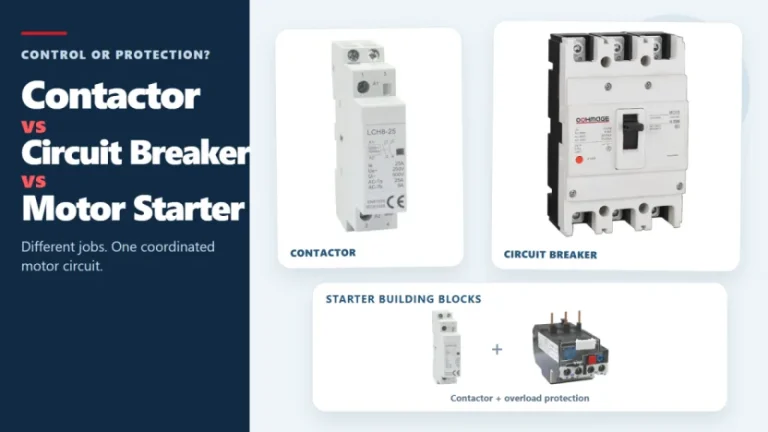
Figure 1. Contactors, circuit breakers, and motor starters solve different control and protection tasks. These three devices often appear in the same motor-control panel, but they solve different problems. A contactor handles frequent, remote, or automatic switching during normal operation. A circuit breaker interrupts abnormal current within its rated capability. A motor starter normally combines […]
The main types of circuit breakers used in low-voltage distribution include miniature circuit breakers (MCBs), molded case circuit breakers (MCCBs) and residual-current devices such as RCCBs and RCBOs. They are not interchangeable. MCBs and MCCBs are selected for overcurrent protection in different circuit roles, an RCCB provides residual-current protection without integral overcurrent protection, and an […]
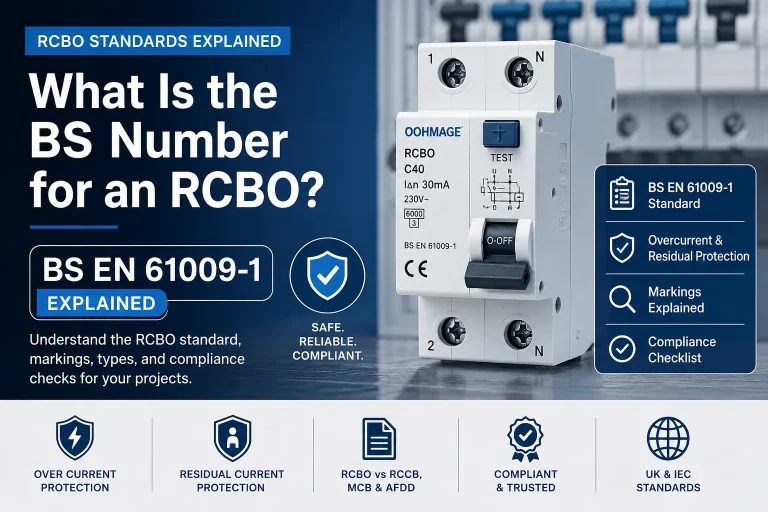
Introduction If you are searching for the RCBO BS number, the answer most commonly required in UK and IEC-based electrical procurement is BS EN 61009-1. This is the principal product standard associated with residual current circuit breakers with overcurrent protection used in residential, commercial, and similar installations. However, merely the BS number is not sufficient […]