MCCB kA Rating: How to Choose the Right Breaking Capacity Before You Buy
Published: Author: Joanna
Introduction
The kA rating refers to the maximum short-circuit current that a circuit breaker can safely interrupt under specified conditions. For MCCB, this value constitutes a part of its interrupting capacity rather than its normal rated operating current. Choosing the correct kA rating helps to prevent the circuit breaker from malfunctioning when the fault current exceeds the limit that the equipment can clear.
For the purchasers who are comparing the options of MCCB, the kA rating is one of the most important technical details that need to be confirmed before making a quotation. A circuit breaker may have the correct rated current, pole configuration and physical size, but if its interrupting capacity is lower than the expected short-circuit current at the installation point, it may still not be applicable.
This guide uses practical procurement language to explain the kA rating value as well as parameters such as Icu, Ics, Icm and Icw. It is aimed at electrical procurement personnel, cabinet manufacturers and installers, engineers and procurement teams, helping them discuss the selection of MCCB more clearly before referring to the final specification sheet and project technical specifications.
What Is kA Rating on a Circuit Breaker?
The “kA” rating on a circuit breaker refers to its breaking capacity or interrupting capability. The letter “kA” represents kilo-ampere, so 1 kA equals 1,000 amperes. When a circuit breaker is rated at 10 kA, it means that the equipment is designed to be able to interrupt a short-circuit current of up to 10,000 amperes under the specified tests and applications.
The reason why this rated value is important is that the short-circuit current is vastly different from the normal load current. A distribution feeder may carry 100 A, 250 A or 400 A of current during normal operation, but in the event of a short circuit, it will generate currents of thousands or even tens of thousands of amperes in a short period of time. The circuit breaker must be able to break the circuit without causing rupture, contact welding, or excessive damage to the distribution panel.
In the actual procurement discussions, the kA rating answers a core question: If this distribution panel experiences a severe failure, will the selected circuit breaker be able to safely clear the fault current? This is why the same rated current level may be equipped with different breaking capacity levels.
kA Rating vs Rated Current: Why 100A Does Not Mean 100 kA
Many people tend to make a mistake by treating the rated current (A) and the kA rated value as the same thing. In fact, they are completely different concepts. The rated current refers to the maximum current that this circuit breaker can withstand for a long time under normal operating conditions; while the kA rated value indicates the maximum current that it can safely cut off in case of a short circuit.
For example: A 100A MCCB does not mean it has a breaking capacity of 100kA. 100A merely indicates that the normal current of the applicable circuit is around 100A. As for how high the short-circuit current it can actually break, it depends on the product series, usage environment, installation method, and whether capacity reduction is required. This value could be 10kA, 25kA, 36kA, 50kA, or other values, and it entirely depends on the specific model and working voltage.
Rating item
What it describes
How buyers should use it
Rated current (In)
The continuous current the breaker can carry under specified conditions.
Match it to the load current, cable capacity, panel design and protection requirement.
kA rating / breaking capacity
The maximum short-circuit current the breaker can interrupt safely.
Confirm it is not lower than the available fault current at the installation point.
Rated voltage (Ue)
The operating voltage level for which the breaker ratings apply.
Check kA capacity at the correct voltage, because breaking capacity can vary by voltage.
Pole configuration
The number of protected or switched conductors, such as 3P or 4P.
Match it to the electrical system, neutral requirement and panel design.
This difference is particularly crucial for cabinet manufacturing plants (complete equipment factories). The two circuit breakers may look similar and have the same rated current, but one of them has a lower breaking capacity. If the circuit breaker with the lower breaking capacity is used in a place with high short-circuit current, it would be a serious selection error with significant potential problems.
What Does kA Rating Mean for MCCB Selection?
For MCCB, the kA rating is part of the basic protection decision. Molded-case circuit breakers are typically used in low-voltage distribution cabinets, feeder circuits, motor circuits, generator outputs, photovoltaic systems, and industrial loads, among other applications. In these applications, the circuit breaker must be able to handle both normal operating currents and abnormal short-circuit currents.
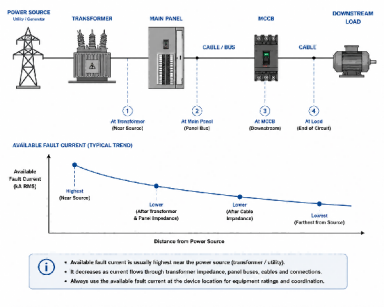
The simplest principle when selecting a circuit breaker is that the breaking capacity of the selected MCCB must be greater than or equal to the expected short-circuit current at the installation point. The magnitude of the expected short-circuit current is influenced by many factors, such as the transformer capacity, transformer impedance, cable length, short-circuit capacity of the upstream power grid, feedback contributions from generators and motors, and the specific location of the distribution panel in the system.
For example: The short-circuit current that a circuit breaker installed next to the transformer or near the main distribution panel may experience is often much greater than that of a circuit breaker installed downstream after passing through a long cable. Therefore, there cannot be a universal recommended kA value applicable to all projects. The correct rated value must be calculated or confirmed by qualified electrical professionals, and then selected based on the specifications of the MCCB.
When making the selection, other details also need to be considered simultaneously. The enclosure class, trip rated current, trip device type, pole number, rated voltage, accessories, and installation environment all affect the final MCCB selection. The KA rated value is indeed crucial, but it is not the only factor to be taken into account.
Icu vs Ics in MCCB: The Difference Buyers Should Know
When purchasing personnel discuss the breaking capacity of MCCB, they often come across terms like Icu and Ics in the specification documents. These parameters are used to describe the performance of the circuit breaker when it is subjected to large short-circuit currents. They should not be regarded merely as decorative words in the catalogue; they directly affect whether this circuit breaker can be used safely in the actual power distribution system.
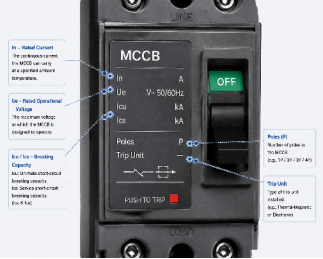
ICU usually refers to the ultimate short-circuit breaking capacity. It indicates the maximum short-circuit current value that a circuit breaker can break under the specified test conditions. However, after completing this breaking operation, according to the product standards and test procedures, the circuit breaker may no longer be able to function normally and needs to be inspected or replaced.
Ics refers to the short-circuit breaking capacity. It represents the current value at which the circuit breaker can still operate normally after breaking the short-circuit current of that level. Ics is usually expressed as a percentage of Icu, such as 50%, 75%, or 100%, depending on the product design and standards. The exact value must be confirmed from the specification of the selected MCCB.
Term
General meaning
Practical meaning for MCCB buyers
Icu
Ultimate short-circuit breaking capacity.
Shows the maximum fault current the breaker can interrupt under specified conditions. Confirm the value at the correct voltage.
Ics
Service short-circuit breaking capacity.
Shows the interruption level connected with continued service capability under defined conditions. Higher Ics can be important for critical panels.
Icm
Short-circuit making capacity.
Describes the peak current the breaker can make onto under specified short-circuit conditions. It relates to electrodynamic stress.
Icw
Short-time withstand current.
Describes the current the device can withstand for a short time. It is more commonly emphasized in selective systems and some air circuit breaker applications.
For a deeper explanation of general interrupting capacity terms, see OOHMAGE’s support article on breaking capacity of circuit breaker. Use that page as background, then confirm the final rating from the selected MCCB series.
Common kA Ratings for MCB, MCCB and ACB
Different types of circuit breakers are commonly offered with different breaking capacity ranges. However, these ranges should be treated as typical market references, not universal rules. Exact values depend on rated voltage, product standard, frame size, design, application and manufacturer datasheet.
Breaker type
Common application area
Typical breaking-capacity discussion
MCB
Final circuits, small distribution boards and light commercial loads.
Often discussed around lower kA levels such as 4.5 kA, 6 kA or 10 kA, depending on market and standard.
MCCB
Feeders, distribution panels, motor circuits, generator outputs and industrial loads.
Often available across wider kA levels, such as 10 kA, 25 kA, 36 kA, 50 kA, 70 kA or higher by series and voltage.
ACB
Main incomers, large distribution systems and selective protection schemes.
Often selected for high-current systems where breaking capacity, short-time withstand and coordination are important.
The crucial point is that one cannot make a selection solely based on common specification ranges. A 10kA circuit breaker might be just right when placed in a downstream distribution box, but it might not be sufficient when placed in the main distribution cabinet near the transformer. A 50kA circuit breaker, which might be necessary in an industrial project, could be a waste of resources for a small distribution panel with a much smaller short-circuit current.
From a procurement perspective, the most reliable approach is as follows: First, based on the project technical specifications, short-circuit current calculation results, local electrical regulations, and cabinet design plans, determine the specific kA rated value required. Then, match the corresponding series of circuit breakers and the parameter specifications.
How to Choose the Right kA Rating for an MCCB
When choosing the correct MCCB kA rating, one should start from the electrical system itself rather than from the cheapest option in the product catalogue. Purchasing personnel, engineers or cabinet manufacturers should first determine where the circuit breaker will be installed and the magnitude of the short-circuit current that may occur at that point. Then, they should select an MCCB with a breaking capacity that meets or exceeds this value, while also leaving an appropriate margin according to the project requirements.
The following checklist can help you clarify the selection communication before making the inquiry. It cannot replace the formal engineering calculations, but it is helpful in avoiding the omission of key information that usually determines the final product series.
Selection item
What to confirm
Why it matters
Rated voltage
System voltage, AC/DC condition and applicable standard.
Breaking capacity must be checked at the correct voltage. A value at one voltage may not apply at another.
Available fault current
Calculated or specified short-circuit current at the MCCB installation point.
The selected kA rating should not be lower than the available fault current.
Required breaking capacity
Project kA requirement or target Icu/Ics value.
This determines whether a standard, high-breaking or higher-performance series is needed.
Rated current / frame size
Load current, frame size, trip rating and derating conditions.
The breaker must carry normal current without nuisance operation or overheating.
Cable and panel rating
Cable size, busbar design, enclosure rating and panel short-circuit rating.
The breaker should fit the complete assembly rating, not only the individual component rating.
Pole count
3P, 4P or other system requirement.
Pole selection affects circuit arrangement, neutral switching and panel wiring.
Trip unit
Thermal magnetic, electronic, adjustable or fixed settings as applicable.
Trip behavior affects overload, short-circuit protection, coordination and application flexibility.
Icu / Ics relationship
Ultimate and service breaking capacity from datasheet.
Critical or continuously operated systems may require stronger service performance confirmation.
Destination market
IEC, UL or local code expectations and documentation needs.
Certification, labeling and testing requirements depend on the market and product series.
Application
Distribution feeder, motor, generator, solar, industrial panel or other use.
Application affects protection characteristics, accessories and coordination needs.
For instance, the purchaser might request a 400A, 3-pole MCCB. But this information is still far from sufficient. The supplier also needs to know: What is the system voltage (400V, 415V, 480V or other values)? What is the required breaking capacity (25kA, 36kA, 50kA or higher)? Is the trip unit fixed or adjustable? Does the product need to meet the document certification requirements of specific markets?
When the information is incomplete, a responsible supplier should proactively clarify the situation to the customer instead of presumptuously providing a generic model. This approach not only demonstrates responsibility towards the purchasing party, but also towards the cabinet manufacturer and the final installation site.
Example: Reading a 400A MCCB With 36kA or 50kA Breaking Capacity
Let’s take a hypothetical project example: The requirement is for a 400A MCCB. The 400A here refers to the rated current or trip current value under the selected product configuration. It does not tell you the short-circuit breaking capacity of this circuit breaker. To make the requirement technically complete, the purchaser must also specify the required breaking capacity, such as whether it is 36kA or 50kA at the corresponding voltage.
If the expected short-circuit current at the installation point is 30kA, then from the perspective of breaking capacity, a 36kA MCCB might be sufficient – of course, other factors such as rated voltage, Icu/Ics, cabinet design, protection coordination, and local regulations should also be taken into consideration. However, if the expected short-circuit current is 42kA, the 36kA option might not be sufficient, and a 50kA or higher specification solution would need to be considered.
It is important to note that this is merely a simplified example. The final selection must be confirmed based on the actual short-circuit calculation results of the project and the product specification documents.
Label item
What the buyer might see
How to interpret it
400A
Rated current or trip rating.
Normal-current selection item. It does not mean 400 kA.
36 kA or 50 kA
Breaking capacity at a stated voltage.
Fault-current interruption capability. It must be equal to or above the required fault-current level.
3P / 4P
Pole configuration.
Match to the system wiring and neutral requirement.
Trip unit
Fixed, adjustable, thermal magnetic or electronic depending on series.
Affects protection behavior and coordination flexibility.
Voltage marking
Example: Ue rating at a specified voltage.
Confirm that the kA value applies at the project voltage.
This example demonstrates why when making an inquiry for MCCB, one must never simply say “I need a circuit breaker with a rating of 400A”. A complete inquiry should provide the supplier with sufficient information so that he can help you select the appropriate series, rather than merely matching a specific rated current value.
Common Mistakes When Selecting MCCB kA Rating
The first common mistake is confusing the rated current with the kA rated value. The purchaser might have chosen a circuit breaker simply because its current rating matched the load, but completely failed to consider whether it could safely interrupt the short-circuit current at the installation point. This is the most common problem – at first glance, the circuit breaker seems to be the right choice, but technically speaking, it is completely unsuitable.
The second mistake is to only consider the price without considering the installation location. Low-kA circuit breakers are indeed cheaper, but if they are installed next to the transformer, at the generator outlet, or near the main distribution panel, they might not be sufficient because the short-circuit current in these areas is often higher. The price should be considered after confirming the basic electrical suitability.
The third mistake is to overlook the influence of the rated voltage. The interrupting capacity is not an isolated value. The same circuit breaker may have one interrupting capacity at this voltage, but it could be a different value at a different voltage. It is essential to consult the specification sheet in accordance with the actual system voltage.
The fourth mistake is to focus solely on the circuit breaker itself and fail to consider the entire distribution panel. The cabinet, busbar system, cables, upstream protection devices, as well as the short-circuit tolerance capacity of the distribution panel itself, all need to be taken into account. A high-breaking-capacity circuit breaker does not mean that the entire system can withstand the same level of faults.
The fifth mistake is to simply replace the circuit breaker without investigating the cause after it has experienced a serious fault. If the MCCB has already disconnected a high fault current, then the installation should be inspected according to the product documentation, maintenance procedures, and safety rules. Whether to replace it or not should be decided by qualified personnel.
A standardized procurement process can prevent these problems. The key lies in treating the KA rating as a mandatory technical parameter, rather than an optional add-on item in the product catalogue.
When to Ask OOHMAGE for MCCB Selection Support
OOHMAGE supplies low-voltage electrical products, including MCCB solutions suitable for power distribution, industrial and project applications. The more clear the project requirements are, the faster and more accurately the model matching can be achieved. If the requirements are incomplete, the first step should be to clarify the electrical conditions on site instead of guessing the appropriate size of the circuit breaker.
Before requesting MCCB model support or quotation, send the following information if available:
Rated voltage and AC/DC system type.
Rated current or expected load current.
Required kA breaking capacity or calculated available fault current.
Pole count, such as 3P or 4P.
Trip unit preference, such as fixed, adjustable, thermal magnetic or electronic, if specified.
Quantity, destination market and required documentation.
Application, such as distribution panel, motor feeder, generator output, solar system or industrial load.
With these detailed information, OOHMAGE is able to assist in reviewing the appropriate MCCB series solutions and to formulate a clearer quotation path. However, specific values, certification certificates, accessory configurations, inventory status, and market entry qualifications for the target market still need to be confirmed one by one based on the selected product series, specification documents, order requirements, and the final usage location.
Final Thoughts
The kA rating of an MCCB links the system’s available fault current to the breaker’s safe interruption capability. Correct selection starts with the installation point: determine the fault current, then verify rated voltage/current, Icu/Ics, pole count, and trip unit from the datasheet.
Buyers and panel builders should never select by amp rating alone—always confirm breaking capacity, especially for main panels, industrial feeders, generator outputs, and other high-fault locations. With complete project data, OOHMAGE can assist in selection and quotation review based on clearly defined technical requirements.
MCCB kA Rating FAQs
What does kA mean on a circuit breaker?
kA means kiloampere. On a circuit breaker, it usually refers to the short-circuit current level the breaker can interrupt safely under specified conditions. For example, 10 kA means 10,000 amperes of interrupting capacity, subject to voltage, standard and datasheet confirmation.
Is kA rating the same as amp rating?
No. Amp rating describes normal continuous current, such as 100A or 400A. kA rating describes short-circuit breaking capacity, such as 10 kA, 25 kA or 50 kA. Both values are needed when selecting an MCCB.
What is the kA rating of an MCCB?
The kA rating of MCCB depends on the product series, enclosure grade, rated voltage and applicable standards. Usually, when selecting, one may encounter ratings of 10kA, 25kA, 36kA, 50kA, 70kA or higher, but the specific value must be confirmed based on the specification sheet and project requirements.
What is the difference between Icu and Ics in MCCB?
Icu is ultimate short-circuit breaking capacity, while Ics is service short-circuit breaking capacity. In buyer terms, Icu indicates the highest defined interruption capability, and Ics indicates service performance under defined short-circuit conditions. The relationship must be checked in the chosen MCCB datasheet.
Can I use a 10kA breaker instead of a 6kA breaker?
In many cases, a higher breaking capacity can meet or exceed a lower required kA level, but selection is not based on kA alone. You still need to confirm rated voltage, current rating, pole count, trip unit, physical fit, standard, panel rating and local code requirements.
What happens if the breaker kA rating is too low?
If the available fault current is higher than the breaker breaking capacity, the breaker may be unable to interrupt the fault safely. This can increase the risk of equipment damage, arc energy, enclosure failure or unsafe conditions. The installation should be reviewed by qualified personnel.
How do I know what kA rating my panel needs?
The required kA rating should be determined based on the results of short-circuit calculations or the project technical specifications. The influencing factors include the transformer capacity and its impedance, the cable length, the short-circuit capacity of the upstream power grid, the contribution of the generator or motor’s feedback current, and the installation position of the distribution panel in the system. The specific expected short-circuit current value should be confirmed by qualified electrical professionals.
Does a higher kA rating mean better protection?
A higher kA rating indicates a stronger interrupting capacity, but this does not necessarily mean that the overall protection effect will be better. Correct protection also depends on multiple factors such as rated current, trip setting value, protection coordination, voltage level, specific application, and cabinet design. The most suitable choice is always the one that matches the actual system requirements.
What information should I send before requesting an MCCB quotation?
When making an inquiry, please provide the following information: rated voltage, rated current, required kA value or expected short-circuit current, pole number, type of trip device requirement, purchase quantity, target market and application scenario. These details will help the supplier recommend a more suitable MCCB series for you, avoiding blind recommendations.
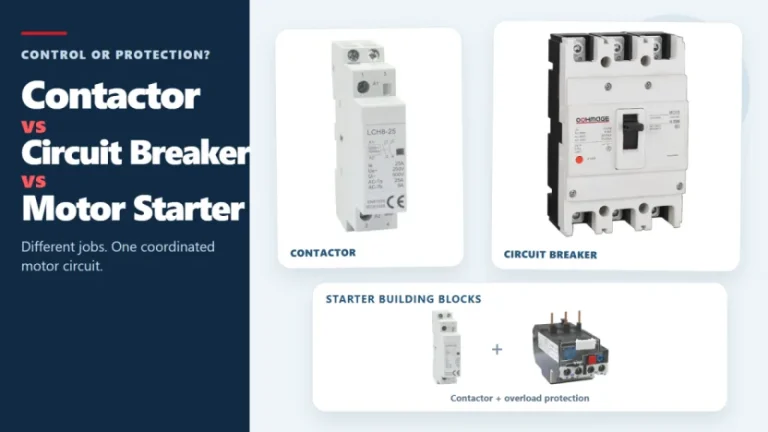
Figure 1. Contactors, circuit breakers, and motor starters solve different control and protection tasks. These three devices often appear in the same motor-control panel, but they solve different problems. A contactor handles frequent, remote, or automatic switching during normal operation. A circuit breaker interrupts abnormal current within its rated capability. A motor starter normally combines […]
Introduction The concept of remote tripping is simple, but in actual operation, project teams often encounter difficulties in specifying the components. The panel factory may require circuit breakers triggered by fire alarm relays, PLC outputs, building management system instructions, or other coordinated control. At this point, “diversion tripping” is only the first step in the […]
The main types of circuit breakers used in low-voltage distribution include miniature circuit breakers (MCBs), molded case circuit breakers (MCCBs) and residual-current devices such as RCCBs and RCBOs. They are not interchangeable. MCBs and MCCBs are selected for overcurrent protection in different circuit roles, an RCCB provides residual-current protection without integral overcurrent protection, and an […]