Electrical Distribution Box Selection Checklist: 7 Details to Confirm Before Quotation
Published: Author: Joanna
Introduction
The buyer sent a seemingly clear request: “I need a 24-way distribution box.” However, this message did not specify whether only the shell was needed or if the complete circuit board was included; nor did it mention which devices needed to be installed, the installation method to be adopted, or the site environment.
Lacking these crucial details often leads to delays in quotations and repeated back-and-forth emails. Although quantity calculation is the basis, suppliers must also obtain information such as equipment layout, incoming line method, usage environment, purchase quantity, target market, and document specifications before determining the appropriate series.
This guide is specifically written for distributors, contractors, project teams, and procurement personnel, aiming to help you submit inquiry requests efficiently and accurately. It is not a wiring technology manual and does not replace on-site inspections, design reviews, or professional installation services.
What Is an Electrical Distribution Box?
The electrical distribution box is a sealed enclosure used to install protective and switching equipment and distribute the input electrical energy to multiple output circuits. According to project requirements, the box can be equipped with miniature circuit breakers, leakage protection devices, surge protectors, terminal blocks, neutral wire blocks, grounding wire blocks, and related accessories.
The selection should not be based solely on quantity, but should also take into account the equipment size, circuit layout, installation method, cable routing, available wiring space, environmental conditions, and local project specifications. Therefore, before confirming the specific model, suppliers usually require a basic layout diagram or component list.
In business communication, the term “distribution box” has a broad meaning. It could refer to an empty casing, an installation box specifically reserved for a certain device, or a complete distribution board with pre-installed components. To prevent suppliers from making errors in quotations due to misunderstandings, please clearly specify the power supply range and application scenarios during the inquiry to ensure the accurate classification of the product category.
Distribution Box, Distribution Board, Panel Board and DB Box: Are They the Same?
The terminology for low-voltage power distribution equipment varies depending on the market, application scenarios, and enterprise practices. Buyers sometimes interchange these terms, but the required product structure may still differ significantly. To avoid misunderstandings, the most reliable approach is to clearly describe the expected functions and power supply range, rather than relying on specific terms in a certain region.
Term
Common market or use
What buyers may mean
How to explain it to a supplier
Electrical distribution box
Broad international use
Circuit-distribution enclosure
State ways, devices, mounting, environment, and supply scope
Distribution board
Common across many markets
Distribution assembly or enclosure
Clarify empty, partly fitted, or complete
DB box
Informal abbreviation
Usually a distribution box
Provide the full layout and application
Panel board
Often North American commercial use
Incoming and branch-circuit assembly
Confirm system and required scope
Consumer unit
UK residential use
Domestic distribution enclosure
Use only for that format
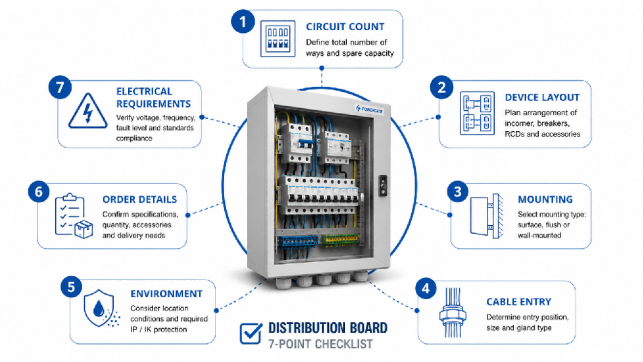
The 7 Details to Confirm Before Requesting a Distribution Box Quote
There is a complete quotation request form that enables suppliers to directly assess the chassis structure and layout plan without any guesswork. Therefore, the following seven fields constitute the minimum practical information requirements. Additionally, if a panel arrangement diagram, material list, component list or annotated photos are provided at the same time, it will significantly accelerate the review process and improve the accuracy of the selection.
Information to confirm
Example buyer input
Why the supplier needs it
1. Way count
18 outgoing circuits
Defines basic capacity
2. Device layout
MCBs, RCCB and SPD positions
Confirms internal space
3. System context
Single- or three-phase, if known
Clarifies application context
4. Mounting and space
Surface-mounted; width limit
Checks enclosure fit
5. Cable entry
Incoming below; outgoing above
Checks wiring room
6. Environment/IP
Covered outdoor, dusty, water spray
Checks enclosure suitability
7. Order details
Quantity, market and documents
Supports an accurate quote
Confirm the way count or circuit count. State active circuits and any specified spare ways. Device format still matters because equal way counts can use space differently.
Provide the protective-device layout. List the device types and quantities or attach a component schedule. The enclosure must support the real arrangement, not a generic circuit total.
Describe the system context when known. State single-phase or three-phase context only when confirmed. Final protection and conductor decisions remain with the qualified project team.
Confirm mounting and available space. Identify surface, recessed, or other approved mounting and provide maximum available dimensions where space is restricted.
Show cable-entry direction. State top, bottom, side, or rear entry preferences. Cable quantity, size, terminals, and bending space can change enclosure suitability.
Define the actual environment. Describe dust, spray, sunlight, corrosion, temperature, and shelter conditions instead of using “waterproof” as the whole specification.
Include commercial and document details. Provide quantity, market, packaging, labeling, and required files. Model-specific certification or document availability must be confirmed.
Way Count Is Important, but It Is Not Enough
A 12-way, 18-way, or 24-way description does not fully define the box. Projects with the same circuit count may need different enclosures because their devices, wiring space, accessories, and mounting conditions differ.
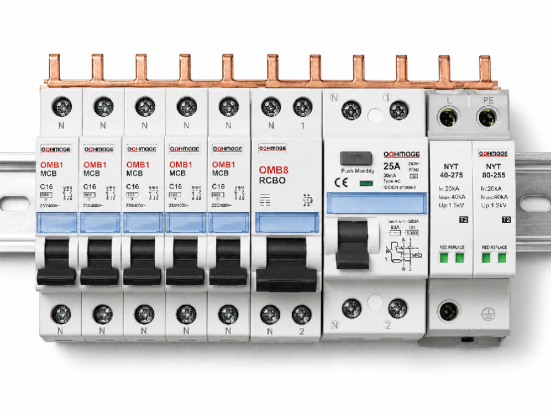
The layout featuring MCB (miniature circuit breaker) is quite different from the one integrating RCCB (residual current circuit breaker), RCBO (residual current protection switch), SPD (surge protector) and additional terminals. Moreover, factors such as the configuration of neutral wire and grounding wire, the occupied space by incoming equipment, various accessories, and cable bending radius will also affect the final selection.
Currently, OOHMAGE offers two series of distribution cabinets, namely HA and HT, which cover various circuit options. The determination of specific series and models should be based on the actual layout plan, order details, and product technical documentation. Unless there are explicit instructions on the relevant product pages or catalogues, do not assume specific dimensions or component compatibility rules on your own.
Indoor, Outdoor and IP65-Rated Distribution Boxes
The indoor electrical room, dusty workshops, and sheltered outdoor areas expose the equipment shells to varying degrees of dust, moisture, sunlight exposure, corrosive substances, and temperature fluctuations.
Important IP65 noteIP65 is not the same as immersion protection. It describes defined protection against dust ingress and water jets under the relevant test conditions. It should not be presented as a universal “waterproof” guarantee or proof that every installation is suitable for every outdoor environment.
The outdoor applicability depends on the material, sealing grade, installation method, cable entry form, degree of ultraviolet exposure, corrosion resistance, maintenance convenience, and local specific regulations. The installation method must follow the corresponding operation instructions and be carried out by qualified professionals.
When making an inquiry, please describe the actual environmental exposure situation instead of merely stating “requiring IP65” or other general protection grades. Only in this way can the supplier accurately match the existing series and configurations based on the environmental conditions you have described and refer to the available options.
Which Protective Devices May Go Inside the Box?
The selection of protection devices directly affects the layout of the chassis. Due to their varying widths, different connection methods, and the possibility of requiring additional wiring or accessory space, this table summarizes the basic functions of various protection devices, but does not provide configuration suggestions for specific projects.
Device
Basic role
Why it affects box selection
MCB
Overcurrent and short-circuit protection
Poles, width and quantity affect rail space
RCCB
Residual-current protection
Needs space and coordination with overcurrent protection
RCBO
Residual-current plus overcurrent protection
Its format changes the layout
SPD
Surge protection when required
Needs dedicated space and connections
Subject to the design of the chassis and the layout of the project, a single distribution box can accommodate various types of protection equipment. However, the final selection of protection devices, determination of their rated values, wiring schemes, and equipment compatibility must all be completed by qualified electrical professionals in accordance with the specific requirements of the project and applicable standards.
What to Send a Supplier for Faster Model Confirmation
The following inquiry form template can be directly copied and pasted into emails or consultation forms. Please truthfully fill in the known information. For uncertain technical projects, please mark them as “to be confirmed” or “subject to review”. Do not make random guesses.
Copyable buyer RFQ templateProject type: Required way count: Protective devices to install: Single-phase / three-phase context, if known: Indoor or outdoor environment: Required IP rating, if specified: Mounting method: Available installation space: Cable-entry preference: Empty enclosure or devices included: Quantity: Target market: Packaging and labeling requirements: Documentation requirements: Photos, panel schedule, BOM, or component list attached:
A clear quotation request should be concise and to the point, avoiding redundant information. Panel layout diagrams and accurate product photos often provide more reference value than subjective guesses. If a complete list of components cannot be provided, at least the expected equipment type and quantity should be listed.
OOHMAGE can assist you in reviewing the layout plan and order details to ensure the compatibility of the product series. When making the final selection, please make sure to verify the availability of the selected model in the target market, and confirm whether the relevant documents, certifications, rated parameters and configurations are complete.
Common Mistakes That Delay Distribution Box Quotations
Most quotation delays are caused by incomplete scope rather than difficult technical questions. Common issues include:
Sending only “I need a 24-way box” without a device layout or component list.
Failing to state whether the request is for an empty enclosure or an assembled distribution board.
Using “waterproof” as the entire environmental specification without describing actual exposure.
Omitting quantity, destination market, mounting method, or cable-entry requirements.
Requesting certificates, drawings, or other documents without identifying the model or order context.
Providing a blurry reference photo with no dimensions, labels, or explanation of which features must be matched.
The buyer might think that providing reference pictures is sufficient, as the desired product looks very familiar. However, shells that are similar in appearance may have significant differences in key details such as size, sealing level, installation method, internal space, and equipment layout. To prevent the supplier from making a wrong judgment based solely on appearance, it is recommended to attach a brief written specification as a supplement.
When Should You Ask for Engineering or Local Electrical Review?
When the project involves the following scenarios, it is essential to entrust qualified engineering technicians or local electrical professionals to conduct a specialized review: high-load power distribution, three-phase power supply systems, uncertain selection of protection devices, outdoor exposed environments, safety-critical infrastructure, local acceptance and approval requirements, or situations where the configuration differs significantly from standard product layouts.
The product supplier can assist in confirming whether the selected enclosure or product series meets the requirements listed in the project, but they cannot replace the work of project designers, protection coordination analysis, local code review, or the preparation of installation instructions. All electrical parameters, conductor specifications, protection settings, grounding systems, wiring schemes, and final installation must be carried out by qualified professionals based on the reviewed project data.
This division of responsibilities provides protection for both parties: the buyer obtains reliable quotations based on a clear product scope, while all technical decisions are independently made by the responsible engineering and installation team.
OOHMAGE Distribution Box Support for Project Buyers
OOHMAGE specializes in the production and supply of low-voltage electrical products, offering a variety of distribution box solutions to project purchasers. Currently, the main promoted series that fall within the established product range include the HA and HT series. Both have distinct approaches in terms of incoming and outgoing line methods, meeting different layout requirements.
To accelerate the progress of model confirmation, please provide the following key information during the inquiry: the number of required circuits, the configuration plan of the protection device, the installation method, environmental conditions, the preference for cable inlet and outlet, the purchase quantity, the target market, and the relevant document requirements. OOHMAGE will precisely match these information with the existing product series and quotation range.
At this stage, the most effective approach is not to simply submit an “immediate purchase” request, but to send a complete request for quotation (RFQ), allowing the supplier to systematically compare your project layout with the verified product information, thereby ensuring accurate selection and efficient pricing.
Electrical Distribution Box FAQs
What information do I need before requesting an electrical distribution box quote?
Provide way count, device layout, system context if known, mounting, cable entry, environment/IP requirement, quantity, target market, and documents. Attach a panel schedule, BOM, component list, or clear photographs when available.
Is a distribution box the same as a distribution board?
The terms may overlap, but usage varies by market. Describe the function, internal devices, and whether you need an empty enclosure or a complete assembly.
Is IP65 waterproof enough for outdoor use?
IP65 covers defined dust and water-jet conditions, not immersion. Outdoor suitability also depends on exposure, mounting, cable entry, material, sealing, corrosion, sunlight, and local requirements.
Can MCBs, RCCBs, RCBOs and SPDs be installed in one distribution box?
They may be used together when the design and enclosure layout support them. Device width, poles, wiring space, and coordination must be confirmed by qualified professionals.
How many ways should my distribution box have?
Way count depends on device quantity and size, circuit arrangement, incoming-device space, wiring room, specified spares, and future expansion. Confirm it from a panel schedule or component list.
What should I attach when contacting a supplier?
Attach a panel schedule, BOM, component list, photographs, space dimensions, and approved references. State quantity, market, mounting, environment, cable entry, packaging, labeling, and document needs.
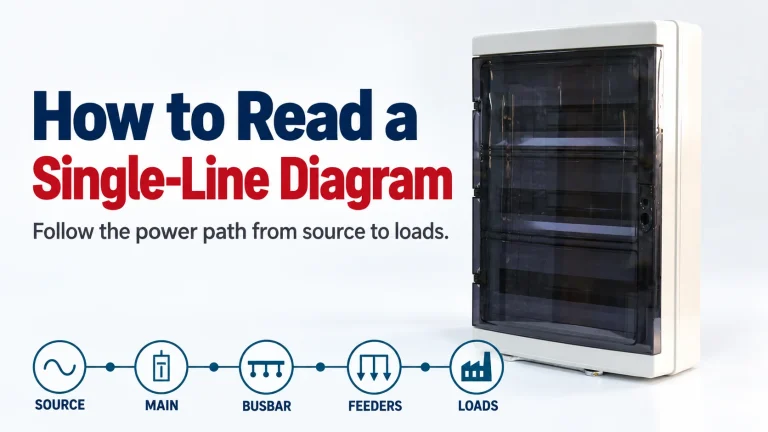
A single-line diagram can look simple and still be difficult to read. One line may represent a multiphase circuit, a small symbol may stand for a major protective device, and a short label may carry the information that determines what equipment belongs downstream. The most reliable way to read a single-line diagram is to follow […]
Figure 1. Three-phase SPD selection starts with system facts, not the largest kA number. A three-phase surge protector should not be selected by the largest kA number on its label. First confirm the system voltage, whether a neutral is present, the earthing arrangement, the installation point, and the required SPD type. Then compare Uc, Up, […]
An AC-only miniature circuit-breaker,you cannot treat it as a DC circuit by default.Confirm before using: If the manufacturer explicitly rates the selected model for the required DC voltage, pole arrangement, polarity where applicable, fault current, and breaking capacity.Some breakers carry both AC and DC ratings, but these alone cannot reflect the actual situation. If the […]