MCCB Types Explained: How to Classify and Select an MCCB
Published: Author: Conor
Quick answer: how many types of MCCB are there?
There is no single universal number of MCCB types. A moulded case circuit breaker can be grouped in several independent ways: by trip-unit technology, number of poles, AC or DC rating, fixed or adjustable protection settings, utilisation category and product family. These are different classification axes, so adding them together does not produce one meaningful total.
The familiar B, C, D, K and Z curve labels should not be treated as five universal MCCB types. For an MCCB, use the manufacturer’s time-current curve, trip-unit data and declared ratings for the exact model.
What does IEC 60947-2 cover?
IEC 60947-2:2024 covers low-voltage circuit-breakers intended for instructed or skilled persons, including devices up to 1,000 V AC or 1,500 V DC within its stated scope. The current edition also records the removal of several older design-based classifications.
Compliance with a product standard does not select a breaker for a circuit by itself. The designer still has to verify system voltage, load current, prospective short-circuit current, breaking capacity, protection settings, conductor protection, coordination and local installation rules.
Practical ways to classify MCCBs
Classification axis
Common declarations to compare
Why it matters
Trip-unit technology
Thermal-magnetic, electronic or another manufacturer-declared design
Determines available protection functions, adjustment and curve behaviour.
Number of poles
The pole configurations offered in the selected product family
Must match the system and neutral-switching requirements.
Current system
AC rating, DC rating and polarity or series-pole instructions
An AC rating must not be assumed to apply to DC.
Protection adjustment
Fixed or adjustable long-time, short-time, instantaneous and ground-fault functions, where provided
Settings must coordinate with the load, conductors and other protective devices.
Utilisation category
The category declared for the exact breaker
Affects coordination and short-time withstand considerations; verify the manufacturer’s declaration.
Frame and current rating
Frame size, rated current and trip-unit range
A larger current rating is not automatically safer; it must protect the circuit correctly.
Breaking performance
Icu, Ics and the voltage at which each value applies
The breaker must be suitable for the prospective fault current at the installation point.
Manufacturer catalogues illustrate why model-level data matters. For example, ABB’s official MCCB technical catalogue shows thermal-magnetic and electronic trip units with different fixed or adjustable thresholds. The settings and curves belong to the specified product and cannot be replaced by a generic “Type B/C/D” rule.
Thermal-magnetic and electronic trip units
A thermal-magnetic trip unit normally combines an overload element with a magnetic short-circuit element. Depending on the product, one or both thresholds may be fixed or adjustable.
An electronic trip unit measures current electronically and may offer additional adjustment, indication, metering or communication functions. Available functions vary by series and trip unit. Do not assume that every electronic MCCB includes short-time delay, ground-fault protection or communications.
The correct choice depends on the protection study and the exact model data, not on whether one technology sounds more advanced.
AC and DC MCCBs are not interchangeable by default
DC fault interruption has different requirements from AC interruption. Use a breaker only at the voltage, current, pole arrangement and polarity declared for that application. For PV or battery systems, also verify the manufacturer’s series-pole connection instructions and the applicable system standard.
MCCB selection checklist
Before requesting a model or quotation, prepare:
system voltage, frequency and AC/DC arrangement;
load current and expected operating profile;
prospective short-circuit current at the installation point;
required Icu and Ics at the stated voltage;
number of poles and neutral requirements;
conductor size and the protection study;
required long-time, short-time, instantaneous or ground-fault functions;
upstream/downstream selectivity or backup requirements;
ambient temperature, enclosure and installation conditions; and
applicable product and installation standards.
Are B, C and D MCCB types?
Not as a universal rule. Some search results and catalogues use lettered labels in specific contexts, but an MCCB must be selected from the exact manufacturer’s curve, trip-unit settings and declared ratings. Do not transfer a miniature circuit-breaker curve label or a different product family’s rule to an MCCB without evidence.
Does a higher MCCB current rating provide better protection?
No. Oversizing can leave conductors or equipment inadequately protected. The rated current and settings must be coordinated with the circuit design, load, conductors and protective devices.
How often should an MCCB be inspected or tested?
Use the manufacturer’s instructions, the installation’s maintenance programme, operating duty, fault history and local rules. A single universal 6–12 month interval is not appropriate for every MCCB or installation.
Compare an MCCB product range
Need a model-level check? Review the OOHMAGE MCCB product range and send the single-line diagram, system voltage, load current, prospective short-circuit current, pole requirement, protection functions and applicable standard with your enquiry. OOHMAGE can confirm catalogued options; final selection, settings and installation remain the responsibility of the qualified designer or installer.
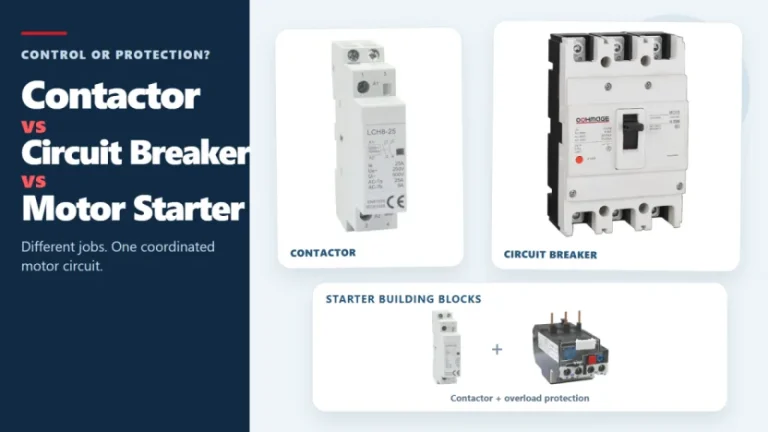
Figure 1. Contactors, circuit breakers, and motor starters solve different control and protection tasks. These three devices often appear in the same motor-control panel, but they solve different problems. A contactor handles frequent, remote, or automatic switching during normal operation. A circuit breaker interrupts abnormal current within its rated capability. A motor starter normally combines […]
Introduction The concept of remote tripping is simple, but in actual operation, project teams often encounter difficulties in specifying the components. The panel factory may require circuit breakers triggered by fire alarm relays, PLC outputs, building management system instructions, or other coordinated control. At this point, “diversion tripping” is only the first step in the […]
The main types of circuit breakers used in low-voltage distribution include miniature circuit breakers (MCBs), molded case circuit breakers (MCCBs) and residual-current devices such as RCCBs and RCBOs. They are not interchangeable. MCBs and MCCBs are selected for overcurrent protection in different circuit roles, an RCCB provides residual-current protection without integral overcurrent protection, and an […]