What happens when a surge hits your equipment? When a surge hits your equipment, the momentary high voltage can cause overloading of internal circuits, damage to components, or even permanent failure. How does surge protection work? Surge protectors work by detecting overvoltage and safely transferring it to ground through specialized components.
Understanding the sources of surges and their protection mechanisms can help you effectively extend the life of your equipment and avoid potential financial losses.
What Causes Power Surges?
Surges are transient voltage surges in electrical systems that can cause serious damage to electronic equipment. The main sources of surges can be categorized as external and internal:
External: mainly triggered by lightning strikes and grid failures.
When lightning strikes a power facility or the grid experiences transformer damage or line short circuits, the instantaneous ultra-high voltages generated will be transmitted through the lines to the end equipment.
Internal: accounting for 60% – 80% of all surge events, common in high-power appliances (such as air conditioners, refrigerators), start and stop the current generated by the sudden change, as well as overloaded circuits, line aging, or poor contact triggered by voltage fluctuations.
Transient high-voltage can cause multiple hazards: light equipment performance degradation, data loss or component overheating, or heavy damage directly through the circuit board, triggering a fire hazard.
Due to the sudden and unpredictable nature of power surges, the use of surge protection devices, standardized electrical wiring, and regular inspection of the electrical system are key measures to ensure the safety of equipment.
How Do Surge Protection Devices (SPDs) Work?
The core function of a Surge Protective Device (SPD) is to protect circuit equipment by transferring or clamping excess voltage to ground or a safe level.
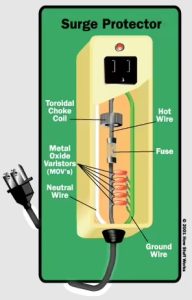
Its operation relies on non-linear components (e.g. metal oxide varistors MOV, gas discharge tubes GDT, transient voltage suppression diodes TVS, etc.).
These components dynamically adjust their impedance state in response to voltage changes:
At normal voltages, the SPD is in a high impedance state (similar to an open circuit) and has no effect on the system
When the voltage exceeds the safety threshold (e.g., a lightning strike or surge), the SPD’s impedance drops to a low-impedance state in nanoseconds, forming a conductive path that directs most of the transient current to ground or to a safety circuit while clamping the overvoltage to a tolerable range for the equipment
After the surge is over, the SPD automatically returns to a high impedance state to maintain normal power supply to the system
Surge Protection Device Basics: Key SPD Components
Metal Oxide Varistor (MOV): Responds to sudden voltage changes through ceramic semiconductor material, conducts and shunts at high voltage, widely used for primary protection of low-voltage circuits.
Gas Discharge Tube (GDT): using inert gas ionization discharge characteristics, can withstand very high energy impact, commonly used in lightning protection of the first level of current relief.
Transient voltage suppression diode (TVS): extremely fast response speed (picosecond level), suitable for precision electronic equipment, the end of the fine protection.
Types of SPDs
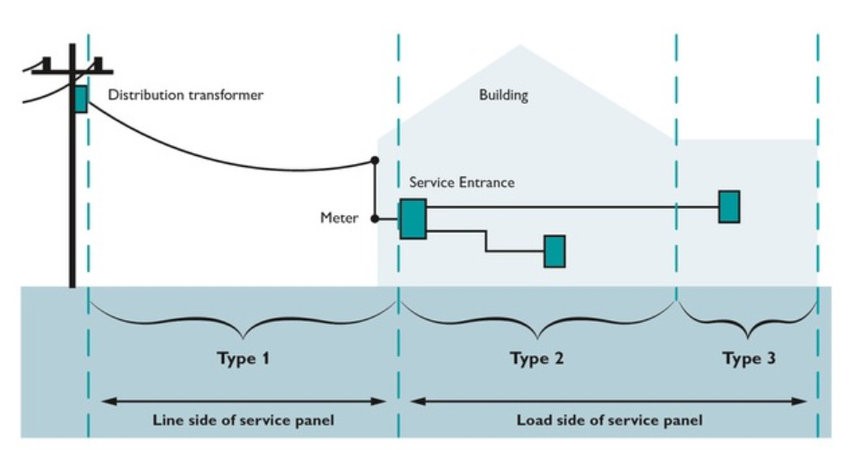
Surge Protection Devices (SPDs) are essential for protecting electrical systems from voltage surges. There are three main types of SPDs, each designed to address a different level of surge protection.
Type 1 SPDs are installed on the main electrical panel of a building to block direct lightning strikes (10/350μs surge) with surge currents of up to 200kA. They are critical for lightning-prone areas and are used in conjunction with external lightning rods to safely transfer energy.
Type 2 SPD: Everyday surge protection
Type 2 spd’s are installed in sub-panels or cabinets to handle residual surges from indirect lightning strikes or internal problems such as motor starting.
For AC distribution boards that require Type 2 protection, the OMYT40 Type 2 AC SPD series can be reviewed as part of model selection after confirming pole configuration and system voltage.
Using metal oxide varistors (MOVs), they limit the voltage to a safe level and are ideal for homes and businesses that face moderate energy surges.
Type 3 SPD: Device-level safety
Type 3 spd’s are in direct proximity to electronic equipment (computers, medical devices) and can neutralize small high-frequency transients that pass through Type 1/2 defenses. They are typically built into power strips to protect against data loss, fire, and equipment damage.
Type
Installation
Key Role
1
Main panel
Stops lightning (10/350μs)
2
Subpanels
Manages daily surges (MOVs)
3
Near devices
Protects sensitive gear
How Does Surge Protection Work in Real-World Applications
Surge Protection Device (SPD), as a core protection component of modern power systems, effectively suppresses damage to electrical equipment caused by Transient Overvoltage (TOV) through a multi-level energy discharge and voltage clamping mechanism.
These devices work by transferring excess voltage to ground, ensuring that our electronic devices and appliances remain safe.
Residential Use
In the home, SPDs sit between expensive electronics and an unpredictable power grid. The average U.S. home has about $15,000 worth of electronics, from smart TVs and game consoles to refrigerators and HVAC systems. Without protection, a single surge can render these investments useless in milliseconds.
A whole-house surge protector mounted on the electrical panel provides a comprehensive shield for your entire electrical ecosystem.
Unlike point-of-use strips that only protect devices that are directly plugged in, panel-mounted SPDs protect all devices connected to your home’s electrical system. This multi-layered approach creates a fortress around electronic equipment, potentially saving thousands of dollars in replacement costs while extending the life of your equipment.
Commercial and Industrial
For businesses, surge protection isn’t just about saving equipment, it’s also about maintaining revenue streams and continuity of operations.
According to an industry study by the Electric Power Research Institute, manufacturing facilities that are down for just one hour due to surge-damaged equipment could face losses of more than $100,000.
Advanced industrial SPDs utilize sophisticated technology specifically calibrated for high-risk environments that don’t allow for equipment failure. These robust systems protect against external threats such as lightning strikes and internal surges generated by heavy mechanical cycling of switches.
The return on investment becomes clear when considering that a single protected manufacturing controller can prevent production line downtime lasting days or weeks.
Monitoring and IoT Integration
The proliferation of IoT devices has created new vulnerabilities in our power grid. These sensitive systems often operate with minimal power margins, making them particularly vulnerable to even small voltage fluctuations that traditional devices may have no problem withstanding.
Modern smart SPDs have moved beyond passive protection to become active system players. They convey real-time status updates, predict potential failures before they occur, and integrate with building management systems.
Some advanced models can even test themselves periodically and alert maintenance teams when they need to be replaced – long before protection is compromised.
This proactive approach transforms surge protection from a policy to a strategic asset. For critical facilities such as data centers or hospitals, which must operate continuously, these intelligent systems ensure that protection remains reliable and verifiable at all times.
The promise is simple but powerful: no surprises, no unexpected failures, and no compromise on protection.
Choose the Right SPD in Different Standards
Selecting the right Surge Protector (SPD) needs to be considered according to different standards.
1. UL 1449 (American Standard)
UL 1449 categorizes SPDs into Type 1/2/3, which correspond to different scenarios:
Type 1: Installed at building entrances to protect against 10/350μs waveform currents from direct lightning strikes (e.g., switchboard entrances);
Type 2: Used in main switchboards to protect against 8/20μs waveform current from indirect lightning strikes, with a typical rated discharge current (In) of 20kA;
Type 3: end-device protection (e.g. socket outlets) with faster response time, suitable for precision instruments.
Key Parameters
VPR (Voltage Protection Rating): e.g. 330V, indicates that the surge voltage is limited to less than 330V.
2. IEC 61643 (international standard)
Class I: Resistant to direct lightning strike (10/350μs waveform), Iimp≥5kA, applicable to high risk scenarios such as photovoltaic power plants17;
Class II: Resistance to induced lightning (8/20μs waveform), In≥20kA, for building branch distribution boxes;
Class III: fine protection (compound wave 1.2/50μs + 8/20μs), for terminals such as medical equipment.
Key differences
IEC standards are more concerned with Up (residual voltage), and industrial equipment is recommended to have Up < 1.5kV;
UL and IEC test currents are different (e.g. IEC Class I corresponds to UL Type 1, but the waveform requirements differ greatly.
3. BS 7671 (British Standard)
Rural/high-rise buildings: Class I SPD (Iimp ≥ 25kA) required to withstand high lightning strike probability;
Urban commercial buildings: minimum requirement is Class II SPD (In ≥ 20kA/phase).
Implementation points
Cascade coordination: Class I for main distribution boxes, Class II for branch distribution boxes, and Class III for terminals.
Conclusion
In this age of dependence on electronic devices, surges have become an invisible threat to equipment safety. It’s smarter to understand how surges form and take preventative measures than to fix them after the fact.
By installing proper surge protection, regularly inspecting your electrical system, and familiarizing yourself with surge warning signs, you can effectively reduce the risk of equipment damage.
This knowledge will help you more fully protect your electronic equipment from the damaging effects of surges.
OOHMAGE: The Comprehensive Supplier for Surge Protectors
Consulting qualified professionals when planning an electrical installation can help determine the best devices. Partnering with a reliable supplier can make all the difference.
OOHMAGE stands out as a trusted name in electrical safety equipment, offering a comprehensive range of high-quality isolation switches, disconnect switches, and related components.
Can surge protectors protect against lightning strikes?
A surge protector cannot completely protect equipment from direct lightning strikes, but it can provide an additional layer of protection against damage caused by indirect lightning strikes.
When do I need to replace a surge protector?
A Surge Protector needs to be replaced if its protective circuitry is damaged (e.g. the automatic shutdown function is triggered or the indicator light goes out).
What is the difference between a power surge and a power outage?
A power surge is a brief spike in electrical voltage, while a power outage is a complete loss of power supply. Both present different risks and require different responses.
How to select SPDs in coastal areas?
Selecting salt spray corrosion-resistant SPDs (with enclosures labeled IP66 or higher) can extend the life of the SPD by up to 30% compared to ordinary models.
Figure 1. Three-phase SPD selection starts with system facts, not the largest kA number. A three-phase surge protector should not be selected by the largest kA number on its label. First confirm the system voltage, whether a neutral is present, the earthing arrangement, the installation point, and the required SPD type. Then compare Uc, Up, […]
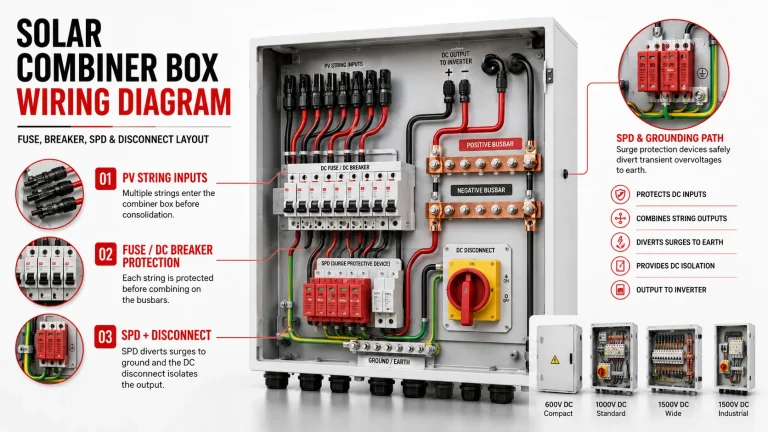
Introduction The wiring diagram of the solar energy combiner box shows how multiple photovoltaic strings enter the combiner box, pass through the string protection device, connect to the positive and negative busbars, ground the surge protection device, and connect to the inverter through the DC circuit breaker. In other words, this diagram not only indicates […]
Sudden power problems do not damage electrical equipment in the same way. Some failures come from long-term voltage instability, while others happen in a split second due to high-energy surges. That’s exactly why a voltage protector and a surge protector serve different purposes—and why using the wrong one can still leave your equipment exposed. In […]