How to Diagnose and Address a Circuit Breaker That Keeps Tripping?
Published: Author: Conor
If a circuit breaker keeps tripping, it’s not random—and it’s not a nuisance. It means your electrical system is repeatedly operating outside safe limits, and the breaker is doing exactly what it’s designed to do: stop damage before it gets worse.
In commercial buildings, industrial facilities, and OEM-installed systems, we see this mistake all the time. Someone resets the breaker to get power back, the system runs again, and then it trips—sometimes multiple times a day. Each reset hides the real problem while adding more heat, stress, and wear to the system.
In this guide, we’ll walk you through what repeated breaker tripping really means, why it happens, how to diagnose it step by step, and when it’s time to stop resetting and escalate the issue before it turns into downtime or a safety incident.
What Does It Mean When a Circuit Breaker Keeps Tripping?
Repeated tripping means the breaker is detecting the same abnormal condition over and over—and refusing to ignore it. Circuit breakers don’t trip by accident. Every trip is tied to a specific protection function doing its job.
A single trip might come from a short-lived issue, like startup conditions or a temporary overload. But when the breaker keeps tripping, it’s responding to a problem that never went away.
This is where risk starts to build. Each trip adds heat, mechanical wear, and stress to conductors and connections. Treating repeated trips as a “breaker problem” instead of a system problem is one of the fastest ways to turn a manageable issue into a failure.
Occasional Trips vs Repeated Trips
Occasional trips usually point to short-term stress. Repeated trips point to a system that’s under constant strain. That difference matters more than most people realize.
An occasional trip during motor startup, commissioning, or extreme operating conditions may be expected and manageable. But if the same breaker trips under normal operating conditions—day after day—the system is telling you it’s running too close to its limits. This difference matters because repeated tripping means the system is operating in a degraded state, even if power can be temporarily restored.
From a maintenance perspective, repeated trips should always trigger a structured response. Every reset increases the chance that heat buildup, insulation damage, or loose connections will turn into an outage—or worse.
Immediate Tripping vs Delayed Tripping
Immediate tripping usually points to a fault-level issue. Delayed tripping usually points to overload. Timing tells you which protection function is active.
If a breaker trips within seconds of being reset, you’re often dealing with a short circuit, ground fault, or severe leakage condition. Delayed trips—minutes or hours later—usually mean the circuit is carrying more current than it can safely handle over time.
Case example: We’ve seen this happen in control panels after rushed modifications. In one case, a breaker tripped instantly every time it was reset. At first, the breaker was blamed. A closer inspection revealed a pinched conductor from recent panel work. The breaker wasn’t too sensitive—it was preventing a serious fault escalation.
Circuit breakers trip repeatedly because one or more protection mechanisms keep seeing the same unsafe condition. The breaker isn’t guessing—it’s responding to specific electrical stress that hasn’t been removed.
Modern breakers use multiple protection layers, each designed to react to a different type of problem. Once you understand which mechanism is active, diagnosing the root cause becomes much faster—and a lot less frustrating.
Main Protection Mechanisms Behind Repeated Tripping
Most repeated breaker trips come from three protection functions: overload protection, short-circuit protection, and ground fault or leakage detection. Each one points to a very different type of problem, which is why identifying the active mechanism matters before you touch anything else.
Protection Mechanism
Typical Trip Timing
What It Usually Indicates
Common Real-World Causes
Diagnostic Priority
Overload Protection
After minutes or hours
Sustained current above thermal limits
Added equipment, longer runtimes, high ambient temperature
Moisture ingress, aging insulation, long cable runs
Inspect insulation and environment
The table above gives you a fast way to narrow down which protection function is active. Once you know that, the next step is understanding why that mechanism is being triggered repeatedly—and what usually gets overlooked during troubleshooting.
Overload Protection
Overload protection trips when a circuit carries too much current for too long. This is one of the most common causes of repeated tripping—and one of the easiest to underestimate.
Overloads rarely appear overnight. We usually see them develop slowly as equipment gets added, operating hours increase, or processes change. Ambient temperature plays a role too. A circuit that was fine in winter may start tripping once the room gets hotter.
Because overload protection is intentionally delayed, the system can appear “normal” for minutes or hours before the breaker trips. That delay often tricks people into thinking the breaker is the problem, when it’s actually warning that the circuit is running out of thermal margin.
Overload conditions are especially common in facilities that grow incrementally without revisiting original electrical designs. What was once a comfortably loaded circuit can become marginal over time.
Short-Circuit Protection: High-Fault Conditions
Short-circuit protection trips almost instantly because current levels rise to dangerous values. When this happens, the breaker is reacting to a direct fault—not a borderline condition.
These trips often come with obvious signs: loud noise, visible disturbance, or a complete shutdown. Common causes include damaged insulation, loose or overheated terminations, pinched conductors, or internal equipment failures.
Short-circuit trips should never be treated as routine. They involve high fault energy and can escalate quickly if the system is re-energized without correction.
Ground Fault or Leakage-Related Tripping
Ground fault or leakage protection trips when current flows where it shouldn’t—usually to ground. These are often the most frustrating trips to diagnose because they can appear and disappear.
Moisture, aging insulation, long cable runs, and sensitive electronic loads are common contributors. In many facilities, these trips show up only under certain conditions, like high humidity or after equipment warms up.
While intermittent, ground fault trips shouldn’t be ignored. They often signal insulation breakdown or shock risk long before a visible failure occurs.
Is the Problem the Breaker or the Electrical System?
In most repeated tripping cases, the breaker is not the problem—the electrical system is. The breaker is simply the first component to complain when something upstream or downstream is no longer safe.
If you replace a breaker without understanding system conditions, the new one usually trips the same way. That’s not bad luck. It’s a missed diagnosis.
Common System-Side Causes of Repeated Tripping
System-side issues are the most common reason breakers trip repeatedly. In practice, we usually see a combination of gradual load growth, aging components, and untracked changes—not a single dramatic failure.
Common system-related causes include:
Sustained overload from added equipment or longer operating hours
Aging or damaged insulation in cables and motors
Loose, overheated, or deteriorated terminations
Faulty downstream equipment, such as failing motors or power supplies
Temporary installations that quietly became permanent
In many cases, the breaker trips first because it’s designed to react before these problems turn into visible damage.
When the Circuit Breaker Itself May Be the Issue
Sometimes, the breaker really is the issue—but this is far less common than most people think. Breaker-related problems usually appear after years of service, frequent tripping, or exposure to harsh conditions.
Breaker-related causes may include:
Mechanical wear from repeated trip cycles
Thermal damage caused by sustained near-limit operation
Increased contact resistance inside the breaker
Calibration drift after high fault-energy events
These failures don’t happen quietly. They tend to show up as unpredictable or inconsistent trips under otherwise stable conditions.
Case example: In one production facility, a breaker began tripping unpredictably even though loads had not changed. Initial checks focused on the electrical system, but load measurements and insulation tests showed stable conditions.
Further inspection revealed elevated contact resistance inside the breaker, likely caused by years of repeated tripping and thermal stress. Replacing the molded case circuit breaker resolved the issue, confirming internal component degradation rather than a system-side fault.
This kind of case is the exception—not the rule—but it shows why diagnosis must come before replacement.
How to Diagnose a Breaker That Keeps Tripping?
Diagnosing repeated breaker tripping requires a disciplined, step-by-step approach rather than repeated resets. If you don’t follow a structured sequence, it’s easy to chase symptoms, replace the wrong component, or miss a developing safety issue.
The steps below help you identify why the breaker is tripping before deciding whether the issue is the breaker itself or the electrical system.
Step
What to Check
What It Usually Indicates
Risk Level
Step 1
Trip timing (instant / delayed / intermittent)
Short circuit, overload, or ground fault
High
Step 2
Connected loads and recent changes
Load growth or duty cycle changes
Medium
Step 3
Breaker rating and trip curve
Undersized or mismatched protection
Medium
Step 4
Connections, cables, downstream equipment
Heat damage or insulation degradation
High
Step 5
Clarity of root cause and risk control
Whether to fix or escalate
Critical
Step 1: Identify the Type of Trip Event
Start by observing how and when the breaker trips. Trip timing is one of the fastest ways to narrow down the active protection mechanism.
Instant trips usually point to short circuits or severe faults
Delayed trips often indicate sustained overload
Intermittent trips are commonly linked to ground faults or environmental conditions
Before touching the breaker, note the timing, operating condition, and whether the trip is repeatable. That information will guide every step that follows.
Step 2: Review Load Conditions and Recent Changes
Next, review what the circuit is actually powering—and what may have changed. Repeated tripping often starts after small modifications that were never documented.
Focus on:
Equipment added or upgraded on the circuit
Longer operating hours or duty cycles
Temporary loads that became permanent
Seasonal or ambient temperature changes
If the breaker only trips under specific operating conditions, you’re likely dealing with an overload or thermal margin issue rather than a fault.
Step 3: Evaluate Breaker Rating and Trip Characteristics
Confirm that the breaker is still correctly sized for the circuit it protects. A breaker that was selected years ago may no longer match today’s load profile.
Check:
Rated current versus measured operating current
Trip curve suitability for connected equipment
Coordination with upstream and downstream protection
A breaker operating close to its thermal limit may not be faulty—it may simply be undersized for current conditions.
Case example: In a data processing facility, repeated trips began after server upgrades. Load measurements showed sustained current near thermal limits. Redistributing loads and upgrading feeders eliminated the trips without replacing the breaker.
Step 4:Inspect Connections, Cables, and Downstream Equipment
If load and ratings look reasonable, inspect the physical system. Many repeated trips are caused by heat, aging, or mechanical issues that aren’t visible from the panel door.
Pay attention to:
Loose or overheated terminations
Discolored conductors or insulation damage
Motors or power supplies nearing end of life
Signs of moisture or contamination
This step often reveals problems that measurements alone can’t catch.
Step 5:Decide Whether to Continue or Escalate
Stop troubleshooting when uncertainty or risk increases. At some point, repeated tripping stops being a diagnostic exercise and becomes a reliability and safety issue.
If the circuit supplies critical loads, trips become unpredictable, or fault exposure increases, escalation is the correct response. At this stage, further investigation often overlaps with MCCB maintenance, where internal condition, contact wear, coordination, and long-term performance are evaluated systematically.
Knowing when to stop field-level troubleshooting—and move into structured maintenance or engineering review—is what prevents repeated trips from turning into failures.
Why Repeatedly Resetting a Tripping Breaker Is Risky?
Repeatedly resetting a tripping breaker increases risk every single time you do it. It may restore power for a moment, but it also allows stress, heat, and fault energy back into a system that has already signaled something is wrong.
If you’ve ever thought, “Let’s just reset it and deal with it later,” this is the section that explains why that approach backfires.
What Repeated Tripping Signals About System Risk
Repeated tripping is a warning that safety margins are shrinking. Each trip-and-reset cycle adds heat, mechanical wear, and electrical stress to conductors, terminations, and equipment.
Over time, insulation hardens and cracks, contact resistance increases, and connections loosen. None of this happens instantly—but all of it moves the system closer to failure. The danger is that the system may still appear functional right up until it isn’t.
Why Resetting Hides the Real Problem
Resetting a breaker doesn’t fix the problem—it masks it. Every successful reset creates the illusion that the issue is temporary, even when the underlying condition hasn’t changed.
This false sense of recovery often delays proper diagnosis. Meanwhile, thermal damage, insulation breakdown, or equipment degradation continues unchecked. By the time the breaker refuses to reset—or fails catastrophically—the window for a simple fix is usually gone.
Case example: In a commercial retail facility, staff repeatedly reset a breaker supplying refrigeration equipment to avoid downtime. Each reset restored power temporarily, so the issue was treated as minor.
Over time, heat buildup in a downstream conductor went unnoticed. Eventually, the conductor failed catastrophically, causing major equipment damage and extended downtime. A structured investigation after the first few trips would have prevented the failure entirely.
Why “It Worked Last Time” Is a Dangerous Assumption
The fact that a breaker reset worked yesterday doesn’t make it safer today. Electrical stress is cumulative. Heat damage and insulation aging don’t reset when the handle is pushed back on.
Every additional reset narrows the margin between normal operation and failure. Eventually, the system reaches a point where recovery is no longer possible.
Repeated resetting turns a protective device into a delayed failure trigger. That’s why “fixing” a tripping breaker professionally means addressing the cause—not forcing the system to run
What “Fixing” a Breaker Really Means in a Professional Context?
Fixing a tripping breaker doesn’t mean getting the power back on. In a professional context, it means removing the condition that caused the breaker to trip in the first place.
If the breaker trips again after your “fix,” then nothing was actually fixed. The system is still operating outside safe limits.
Operational Adjustments vs Corrective Actions
Professional fixes fall into two categories: operational adjustments and corrective actions. Knowing which one you’re applying—and why—matters.
Operational adjustments reduce stress without changing hardware. These include:
Redistributing loads across circuits
Adjusting operating schedules or duty cycles
Improving ventilation or ambient conditions
Corrective actions remove the root cause of the problem. These include:
Repairing or replacing faulty equipment
Fixing damaged conductors or insulation
Correcting improper connections or terminations
Operational adjustments buy margin. Corrective actions restore safety. Confusing the two often leads to repeated trips returning weeks later.
When Breaker Replacement Is the Correct Solution
Replacing the breaker is the right fix only when internal degradation is confirmed. This usually means inspection or testing has shown wear, heat damage, or abnormal contact resistance inside the device.
Breaker replacement should be a conclusion—not a first step. When replacement is driven by convenience instead of evidence, repeated tripping almost always returns.
When System-Level Changes Are Required
Sometimes, the breaker is fine and the system has simply outgrown its original design. When loads increase, duty cycles extend, or fault levels change, no amount of breaker swapping will solve the problem.
System-level fixes may include:
Adding or upsizing feeders
Upgrading conductors or distribution equipment
Redesigning parts of the electrical architecture
These changes take more effort, but they eliminate the conditions that cause repeated tripping rather than working around them.
Fix vs Replace case study A manufacturing plant replaced a tripping breaker twice with no improvement. Each replacement restored power briefly, but trips continued under normal operation. A later system review showed sustained overload caused by production expansion. Once feeders were upgraded and loads redistributed, the trips stopped permanently—without replacing the breaker again.
The difference wasn’t the hardware. It was the diagnosis.
When to Stop Troubleshooting and Escalate the Issue?
Troubleshooting should stop when risk grows faster than certainty. If each additional step adds exposure instead of clarity, escalation is the correct decision—not a failure.
Critical Circuits and High-Risk Applications
Critical circuits should be escalated early—not after repeated trial-and-error. If a breaker supplies life safety systems, essential production processes, or compliance-critical equipment, repeated tripping is already a stop signal.
In these cases, continued troubleshooting under live conditions increases risk faster than it delivers answers. Escalation ensures the problem is addressed with the right tools, authority, and protection measures.
Repeated Trips with No Clear Cause
If trips continue and no clear cause emerges, stop guessing. Unexplained behavior is not a sign to push harder—it’s a sign that surface-level checks have reached their limit.
At this point, advanced testing, deeper inspection, or engineering review is needed. Continuing without new information only increases exposure while delivering diminishing returns.
Case example: In a hospital facility, a breaker began tripping intermittently with no obvious load or fault pattern. Initial checks showed nothing abnormal, and the temptation was to keep monitoring and resetting.
Instead, the issue was escalated. Advanced diagnostics revealed hidden insulation breakdown inside conduit runs—something routine checks would never have caught. Early escalation prevented a major outage and avoided serious safety exposure.
Clear Signals It’s Time to Escalate
Escalation is the right move when:
Trips become unpredictable or harder to reproduce
Fault energy or exposure risk increases
The circuit serves critical or regulated functions
Troubleshooting requires tools, access, or authority you don’t have
Each reset adds pressure to “just keep it running
When these signals appear, stopping is the safer and more professional choice.
Final Thoughts
A circuit breaker that keeps tripping is not a nuisance—it’s an early warning. It signals that the electrical system is operating outside safe limits, even if power can be temporarily restored.
In professional environments, repeated tripping should be treated as a diagnostic signal, not something to work around. Resetting may buy time, but it also allows stress and damage to accumulate in the background.
The correct response is never blind resetting. It’s structured diagnosis: identifying the active protection mechanism, verifying load behavior, evaluating equipment condition, and deciding whether the issue lies with the breaker, the system, or both.
Some issues can be resolved with operational adjustments. Others require corrective maintenance or system-level changes. Knowing when to escalate is just as important as knowing how to troubleshoot.
At Oohmage, we work with industrial and commercial electrical systems where reliability and protection coordination matter. If your facility is dealing with repeated breaker trips on critical circuits, involving experienced professionals early can prevent unnecessary downtime and equipment damage.
FAQs
Can a breaker trip repeatedly without being faulty?
Yes. This is very common in commercial and industrial systems. In most cases, repeated tripping is caused by system-side issues such as sustained overload, insulation deterioration, or failing downstream equipment. The breaker is often operating exactly as designed by disconnecting unsafe conditions. Replacing the breaker without correcting the root cause usually results in the same tripping behavior returning.
Should a tripping breaker always be replaced immediately?
No. Immediate replacement without diagnosis is rarely effective and often wasteful. Breaker replacement is only appropriate when testing, inspection, or historical evidence confirms internal mechanical or thermal degradation. In many cases, system corrections such as load redistribution or equipment repair resolve the issue without replacing the breaker.
Do environmental conditions affect breaker tripping?
Yes. Environmental factors can significantly influence breaker performance. High ambient temperature reduces thermal margin, while humidity, dust, vibration, and corrosive atmospheres accelerate insulation and contact degradation. These conditions often contribute to intermittent trips and should always be considered during diagnosis.
Is nuisance tripping harmless if power can be restored?
No. Even if power is restored quickly, nuisance tripping indicates underlying stress that can escalate. Repeated trips increase thermal cycling, weaken insulation, and raise the risk of conductor or equipment failure over time.
Who should diagnose repeated breaker trips in industrial systems?
Repeated trips in industrial or critical systems should be evaluated by experienced maintenance professionals or electrical engineers. Proper diagnosis requires understanding protection mechanisms, load behavior, and system risk—not trial-and-error resetting.
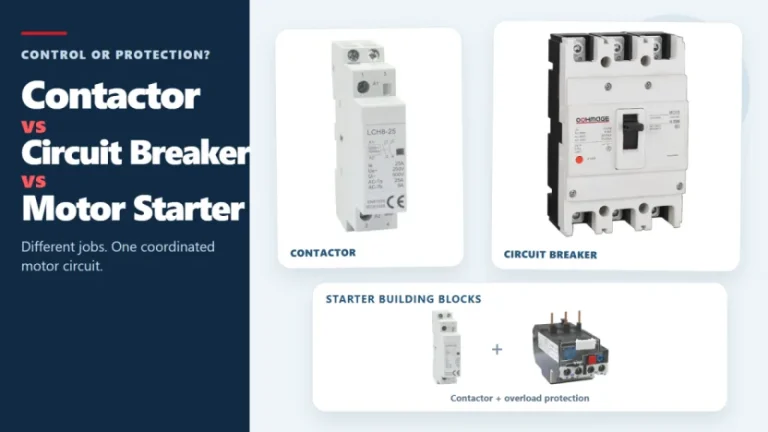
Figure 1. Contactors, circuit breakers, and motor starters solve different control and protection tasks. These three devices often appear in the same motor-control panel, but they solve different problems. A contactor handles frequent, remote, or automatic switching during normal operation. A circuit breaker interrupts abnormal current within its rated capability. A motor starter normally combines […]
Introduction The concept of remote tripping is simple, but in actual operation, project teams often encounter difficulties in specifying the components. The panel factory may require circuit breakers triggered by fire alarm relays, PLC outputs, building management system instructions, or other coordinated control. At this point, “diversion tripping” is only the first step in the […]
The main types of circuit breakers used in low-voltage distribution include miniature circuit breakers (MCBs), molded case circuit breakers (MCCBs) and residual-current devices such as RCCBs and RCBOs. They are not interchangeable. MCBs and MCCBs are selected for overcurrent protection in different circuit roles, an RCCB provides residual-current protection without integral overcurrent protection, and an […]