The Ultimate Category of Electrical Protection Devices
Published: Author: Conor
Electrical devices are an essential component in any house, office, or building. Without them, life would be in stone age. However, they can sometimes turn out to be dangerous, such as electrical surges or overloads. But, for those using electrical protection devices, their appliances can still be a blessing.
As important as it is to keep electrical protection devices, it is equally necessary to know their types and which ones to install where. Choosing the wrong type of electrical protection device can make you pay for that. So, it is better to enlighten yourself with some information about them than to regret it later.
Why Electrical Protection Devices Are Essential?
Electrical protection devices play a vital role in keeping electrical devices and the people working with them safe in every home, office, or other place. They protect from electrical surges, voltage spikes, overloads, or electrical shocks. Without installing the electrical protective devices, the appliances will be at high risk and damage its wiring. Ultimately, the condition will get worse and more dangerous for you.
Circuit breakers prevent excess current, protect from electric shocks, and stop voltage spikes in any unusual conditions. That’s not only limited to your home but also industrial areas. It protects your heavy machinery from getting any harm. Circuit breakers not only safeguard your equipment but also increase their lifespan.
Circuit Breakers
One of the most common and useful electrical circuit protection devices for all kinds of electric appliances is a circuit breaker. Whenever they detect overload, short circuit, or current leakage, they instantly switch off the circuit to stop that.
Circuit breakers even have new features that allow you to monitor and control them easily. And some circuit breakers automatically turn on and off with the installation of innovative features. Besides that, after tripping, they can be reset and will be good to use again.
Depending on the kind of equipment used in different areas, there is always a type of circuit breaker that fits every need.
Miniature Circuit Breakers (MCB)
For electric appliances in homes and commercial areas, a miniature circuit breaker is an ideal protection device. It works best for low-energy-consuming devices. It protects your equipment by instantly cutting off the power supply when it detects any overload or short circuit. They not only protect the equipment but also increase the lifespan and make the devices work more efficiently.
Molded Case Circuit Breaker (MCCB)
If we compare to MCB, “MCCBs” can handle higher currents. Their ability to protect circuits up to 2500 amperes makes them suitable for industrial areas with large machinery. They are the perfect choice for industrial areas and heavy equipment like welding machines, heavy motors, or plants. MCCBs can save these pieces of equipment from massive losses and protect workers from any kind of safety hazards.
Air Circuit Breakers (ACB)
Like MCCB, air circuit breakers are also a good fit for industrial areas and other heavy machinery. The only difference is that they use air as an arc-extinguishing source to protect circuits that carry heavy loads. They are mainly useful for power plants and or large commercial buildings.
In addition to this, ACBs come with a new and innovative monitoring system. This system makes them an easy and reliable option for high-demand applications and their easy inspection.
Fuses
There are other new electrical protective devices, “fuses,” that protect the circuits. Installing the fuses is simple and a quicker way to protect your circuits. Just like circuit breakers, they also cut off the circuit when an excess amount of current flows through them.
A fuse is for one-time usage. When the excess amount of current crosses the fuse’s limits, its elements start to melt. This results in interrupting the circuit and thus cutting off the power supply.
Standard Fuses
They are very common in small household items. Standard fuses are inexpensive and effective at the same time, which makes them the first choice for people. It protects devices and wires from too much current.
Cartridge Fuses
They are of tabular shape and perfectly fit for industrial areas or with high-power applications. Cartridge fuses efficiently protect high-current appliances like air conditioners or electrical motors.
High-Rupture Capacity (HRC) Fuses
HRC fuses handle extremely high currents, which makes them perfect for industrial use. They don’t explode under pressure and can easily protect from overloads.
Automotive Fuses
As it is clear by the name, they are the best protection devices in electrical circuits for use in vehicles to protect electrical systems from overloads. They protect systems like light, radio, and power windows to make sure that they work properly.
Surge Protection Devices
Surge protection devices protect your equipment from sudden irregularities in voltage. There are many common reasons for such imbalances in voltage, such as lightning strikes, power outages, or other electrical faults. They can divert the access voltage away from your devices and keep your devices unharmed.
There are three types of surge protection devices.
Type 1 SPD
They provide protection from lightning that strikes directly on the electric panel. Because of their ability to handle high voltage, they are very useful in commercial or industrial areas where the risks of surges are higher.
Type 2 SPD
Contrary to type 1, they protect the devices from indirect surges like internal switching operations. They protect the wiring inside the building. Therefore, its best installation location is after the main switchboard.
Type 3 SPD
Type 3 SPDs are used along with type 1 or type 2 to provide an extra layer of protection. They are made to safeguard sensitive and delicate devices like TV or Computer. They are installed near those devices.
Residual Current Devices (RCD)
Residual current devices are kind of breakers that are designed to protect humans from electrical appliances. They focus more on protecting human lives than the device. Installing RCDs is very important in the household to save people from any unnecessary harm.
They save you from electric shocks by immediately detecting current leakage and shutting down the circuit before the current even reaches you. Due to the purpose they serve, they are used in areas like bathrooms, kitchens, or outdoor areas where the chances of electrical shocks are high.
There are two types of Residual Current devices.
Residual Current Circuit Breaker (RCCB)
It works by monitoring the balance between neutral and live current. If it detects any imbalance that can result in leakage of current, it automatically disconnects the power to prevent the electrical shocks.
Residual Current Breaker with Overload (RCBO)
They have a combination of both RCD and MCB. Therefore, it not only protects you from electrical shocks but also protects your devices from getting any harm by overloads. RCBOs are perfect for use when both human safety and circuit protection are important.
Voltage Protectors
In many areas where the power supply is unstable, a voltage protector plays a vital role in keeping electrical devices safe. It helps to regulate your devices from voltage fluctuation in homes or industries to prevent them from getting damaged. They are useful in areas that have over-voltage or under-voltage conditions.
Modular Contractor
In places like office buildings, there is sometimes a need for automation in electrical devices where the light or devices could turn on or off automatically at a certain time. In such cases, a modular contractor is a device that helps to control the switching of electrical devices automatically.
There are systems like lighting or heating where the circuit needs to be turned on or off at a certain time automatically, based on a timer. A modular contractor is used for all those systems to help them work smoothly.
Automatic Changeover Switch
There are places like offices, hospitals, or data centres where continuous electric supply is mandatory. In such cases, an Automatic Changeover Switch helps to ensure a smooth transition between two power sources. When the main power supply goes off, it automatically shafts the load to a backup like a generator without having to do it manually.
They are extremely helpful in many places where a power outage could be a significant problem. Automatic Changeover Switches make sure that the essential devices keep working smoothly even after the power failure.
Isolation Switch
As it is obvious from its name, isolation switches are the safety switches used to completely isolate a certain device from the system. Normally, they are used when maintenance or repair needs to be done. Because of these switches, you will not have to turn off the whole circuit to work on any one device.
Isolation switches reduce the risks of getting electrical shocks or causing short circuits. They are very helpful in industrial environments that have heavy machinery. Besides that, they are also beneficial in residential settings, such as repairing an air conditioner or water heater. They make sure that there is no leakage of current and no signs of short circuits during the working.
Distribution Box
A distribution box is a device that works like a central hub for electricity in a building or anywhere. Its other names are breaker box or electric panel. The box’s job is to divide the main power supply into small circuits and distribute the electricity throughout the building.
The box consists of fuses or circuit breakers that protect each device separately from overloading. In any condition of overflowing of electricity or fluctuations, the breaker will trip and cut off the power supply to protect it from any damage. It prevents overheating, short circuits, or any harm to electric appliances.
In every home, office, or industrial area, it is important to install a distribution box because they make sure that the correct amount of electricity is flowing in each room or appliance. Due to these distribution boxes, the entire electrical system stays organized and protected from any safety hazards.
Final Thoughts
Wherever electricity and devices are common, there it is essential to install some electric protection devices. They ensure that your expensive appliances are safe from any kind of harm. Depending on the kind of appliance you are using or the installation place, there are many kinds of electrical protection devices that can prevent damage.
Among all the useful devices, the most common are circuit breakers, fuses, surge protection devices, residual current devices, voltage protectors, modular contractors, automatic changeover switches, isolation switches, and distribution boxes.
Without these devices, your equipment will be vulnerable to damage or from overload, voltage spikes, or overheating and can even cause life-threatening accidents. Integrating protection devices in electrical circuits will not only protect your appliances but also increase their lifespan and efficiency.
FAQs
What is the difference between a fuse and a circuit?
Even though they both serve the same purpose of breaking off circuits in case of an electrical fault, fuses are usually simpler than circuits. They respond more quickly by melting down their component to shutting the circuit. On the other hand, circuits can ultimately get reset after tripping once.
What is the use of isolation switches, and are they beneficial?
The main purpose of isolation switches is to cut off the electric supply to any equipment separately. It is useful when the appliance needs maintenance and urgent repair. It prevents a certain device from short circuits and any other harm.
What kind of SPD is beneficial for the protection of my sensitive devices?
Type 3 SPDs work wonders for sensitive devices. Its installation is an extra layer of protection after type 1 or type 2 SPD. They are places near sensitive devices.
What is the difference between MCBs and MCCBs?
MCBs are mainly useful in residential and commercial areas because they handle low-energy devices. They work for smaller electrical loads. Meanwhile, MCCBs have the ability to handle up to 2500 amperes current, which makes them the perfect fit for industrial settings. They can efficiently protect heavy-duty machinery.
Where are voltage protectors best to use?
Voltage protectors work in a manner that protects devices from high voltage or under voltage conditions. It stabilizes the power for smooth operations. They make sure that the appliances receive constant voltage and stay away from malfunctioning.
Figure 1. Contactors, circuit breakers, and motor starters solve different control and protection tasks. These three devices often appear in the same motor-control panel, but they solve different problems. A contactor handles frequent, remote, or automatic switching during normal operation. A circuit breaker interrupts abnormal current within its rated capability. A motor starter normally combines […]
The main types of circuit breakers used in low-voltage distribution include miniature circuit breakers (MCBs), molded case circuit breakers (MCCBs) and residual-current devices such as RCCBs and RCBOs. They are not interchangeable. MCBs and MCCBs are selected for overcurrent protection in different circuit roles, an RCCB provides residual-current protection without integral overcurrent protection, and an […]
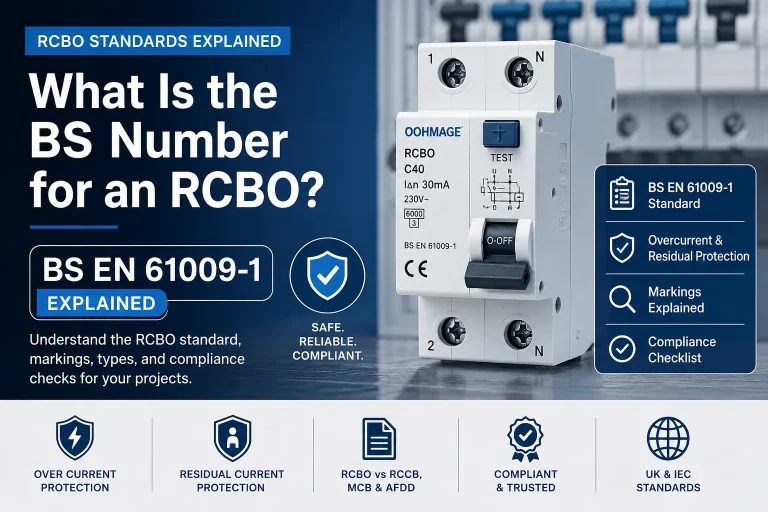
Introduction If you are searching for the RCBO BS number, the answer most commonly required in UK and IEC-based electrical procurement is BS EN 61009-1. This is the principal product standard associated with residual current circuit breakers with overcurrent protection used in residential, commercial, and similar installations. However, merely the BS number is not sufficient […]