Automatic Changeover Switch (ATS): Optimising Power Supply
Published: Author: Conor
Electricity is the backbone of nearly every activity in this technology-driven world. From critical medical equipment in hospitals to smooth operations in manufacturing plants, an uninterrupted power supply is no longer a luxury but a necessity. Power outages, however, remain a common challenge worldwide, causing inconvenience, financial losses, and even endangering lives in extreme cases.
An Automatic Transfer Switch is an intelligent device developed to resolve this problem by enabling smooth power transfer from one supply to another in case of an outage or instability in the supply.
Come with us and explore in depth the details of ATS devices, their types, main features, applications, and benefits in major projects.
What is an Automatic Changeover Switch?
An automatic changeover switch is an electrical device designed to automatically switch between two or more power sources in the event of a failure or an unreliable primary power source. The device is commonly applied on installations involving a utility grid and backup power sources that may include generators or renewable energy systems.
How Does the ATS Work?
Continuous Monitoring: The ATS follows the quality and availability of the principal power continuously.
Automatic Detection: Upon the detection of a failure, fluctuation, or instability, the ATS sends out a signal to the backup power source, instructing it to begin operating.
Seamless Transition: The transfer device shifts the electrical load from the primary source to the backup without human interference.
Restoration: Once the first source stabilizes, the ATS shifts the load back until normalcy is resumed.
This automation ensures a reliable power supply, reduces downtime, and minimizes the risks of manual errors. It’s an essential solution for environments where even brief power interruptions are unacceptable.
Types of Automatic Changeover Switches
ATS devices are categorized based on their operational mechanism and application. Below are the four main types of ATS systems:
1. Open Transition ATS
The Open Transition ATS disconnects the load from the primary source before connecting it to the backup source.
This leads to a brief interruption in the power supply, which may not be suitable for sensitive equipment. Despite this limitation, it is a cost-effective choice for applications where minor delays are tolerable.
2. Closed Transition ATS
A Closed Transition ATS eliminates power interruptions by momentarily overlapping the two power sources during the transfer. This makes it ideal for critical systems, such as medical facilities, data centers, and industrial processes where even a fraction of a second of power loss can have significant consequences.
3. Static Transfer Switches (STS)
Static Transfer Switches use advanced solid-state components to perform ultra-fast transfers, often within milliseconds.
These are particularly valuable for IT infrastructure, high-precision manufacturing, and other environments requiring uninterrupted power supply with minimal switching time.
4. Modular ATS
The Modular ATS provides flexibility and scalability, thus being an ideal solution for large or complex facilities.
Due to its modular design, it is easily customized for multiple power sources and configurations. Such adaptability makes the systems very suitable for industrial plants, airports, and other extensive setups.
Automatic Changeover Switches: Key Features
Automatic Changeover Switches are designed with a host of features to ensure reliability, safety, and adaptability. Key features include:
1. Voltage and Current Capacity
ATS devices come in different voltage and current ratings suitable for various applications. Choosing the appropriate capacity is crucial for optimal performance and safeguarding against equipment damage due to overload.
2. Safety Features
Modern ATS units are equipped with various safety features, including:
Overload Protection: The system automatically disconnects when the flow of current becomes too high to prevent damage.
Phase Failure Monitoring: Analyzes phase loss or imbalance to turn on the backup source.
Surge Protection: Protects connected devices from voltage spikes.
3. Compatibility
ATS devices are designed for compatibility, working with utility grids, diesel generators, or renewable energy sources seamlessly.
4. Remote Monitoring
The advanced ATS systems also have IoT-enabled remote monitoring to monitor performance, diagnose problems, and manage operations through mobile applications or web interfaces.
5. Automatic Testing and Maintenance
Most of the ATS devices have self-testing to keep them functional. This feature decreases the chances of sudden failure and increases the reliability factor.
Applications of Automatic Changeover Switches
1. Commercial Applications
The need for seamless power supplies in retail stores, shopping malls, hotels, and office buildings is maintained by ATS devices during operational continuity and customer satisfaction when an outage occurs.
2. Industrial Applications
Factories and manufacturing plants make use of ATS to reduce any form of downtime that can be costly and disrupt production schedules. The automation of power transfer by ATS systems contributes to workplace safety.
3. Critical Infrastructure
In hospitals, airports, and data centers, among other places, where a power interruption can have serious consequences, ATS devices are indispensable. They keep the essential systems running smoothly, safeguarding lives and critical data.
4. Renewable Energy Integration
With the increasing usage of renewable energy sources such as solar and wind, ATS devices play an important role in integrating these intermittent sources with traditional grids for a consistent power supply.
5. Residential Applications
ATS devices can also be installed in homes to manage power between utility grids and backup generators. They can enhance convenience and safety during blackouts.
Automatic Changeover Switches in Large Projects
Large projects like industrial complexes, skyscrapers, and energy plants have complex power needs. The application of ATS devices in such projects provides the following advantages.
1. Increased Reliability
Automatic switching between the power sources minimizes disruption and ensures that project timelines are not affected.
2. Improved Safety
Equipped with integrated safety features, ATS systems safeguard personnel and equipment while maintaining regulatory compliance.
3. Cost Efficiency
Through the avoidance of downtime, ATS devices enable organizations to avoid the loss of potential revenue and further repair costs associated with power interruptions.
4. Scalability
Modular ATS units can accommodate future expansion, thereby allowing the system to grow with the project’s evolving power demands.
5. Environmental Sustainability
By facilitating the integration of renewable energy, ATS systems contribute to the reduction of carbon footprints in large projects.
Final Thoughts
Automatic Changeover Switches have revolutionized the way power systems are managed, offering reliability, efficiency, and safety across various sectors. From basic open transition models to advanced modular systems, ATS devices cater to a wide range of needs, making them indispensable in modern power management.
Remember, for your next project, the right supplier makes all the difference. With OOHMAGE as your partner, you are assured of state-of-the-art electric protection devices designed to the highest standards.
OOHMAGE: Your Professional Supplier for Electric Protection Devices
When it comes to reliable power systems, choosing reliable electric equipment suppliers is as critical as selecting the device. OOHMAGE has an earned reputation for supplying quality electric protection devices.
Why Choose OOHMAGE?
Product Range: OOHMAGE possesses a comprehensive portfolio of products: ATS devices, Miniature Circuit Breakers, Residual Current Circuit Breakers, and Surge Protection Devices.
Global Standards: Products comply with international standards of safety and quality; they are durable and perform with longevity.
Expert Support: OOHMAGE has experts who can consult over the selection, installation, and maintenance of the product.
With OOHMAGE, you have the confidence to equip your power systems for even the most demanding applications.
FAQ
What is the primary function of an Automatic Changeover Switch?
The primary function of an ATS is to ensure an uninterrupted power supply by automatically switching between primary and backup sources during power outages.
Can ATS devices be used with renewable energy sources?
Yes, ATS systems are compatible with renewable energy sources like solar and wind, making them versatile for diverse applications.
Are ATS devices suitable for small businesses?
Yes, since the devices are designed in a number of sizes and capacities, which makes them fit for both a small business and huge industrial projects.
How often should an ATS be maintained?
Regular maintenance, usually after six months or a year, is necessary for optimal performance and life span extension of the ATS device.
Figure 1. Contactors, circuit breakers, and motor starters solve different control and protection tasks. These three devices often appear in the same motor-control panel, but they solve different problems. A contactor handles frequent, remote, or automatic switching during normal operation. A circuit breaker interrupts abnormal current within its rated capability. A motor starter normally combines […]
The main types of circuit breakers used in low-voltage distribution include miniature circuit breakers (MCBs), molded case circuit breakers (MCCBs) and residual-current devices such as RCCBs and RCBOs. They are not interchangeable. MCBs and MCCBs are selected for overcurrent protection in different circuit roles, an RCCB provides residual-current protection without integral overcurrent protection, and an […]
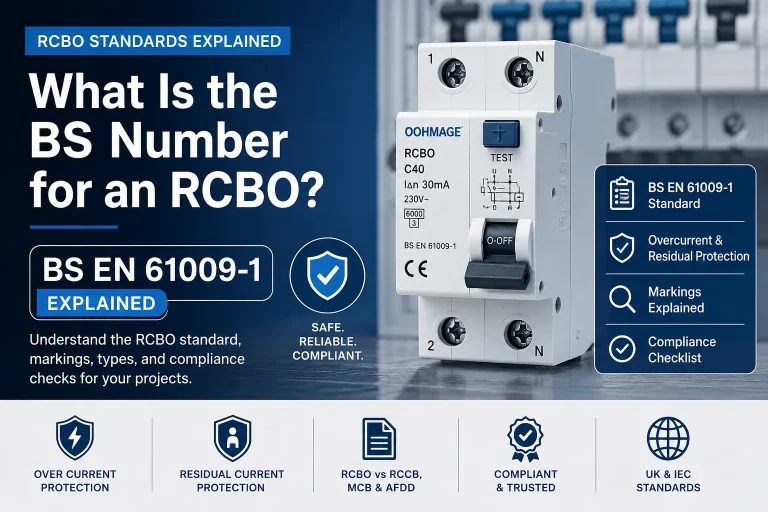
Introduction If you are searching for the RCBO BS number, the answer most commonly required in UK and IEC-based electrical procurement is BS EN 61009-1. This is the principal product standard associated with residual current circuit breakers with overcurrent protection used in residential, commercial, and similar installations. However, merely the BS number is not sufficient […]