Electrical systems in homes, businesses, and industries find great importance in protective devices for equipment and individual safety. Among the electrical protective devices, MCCB vs RCCB is a quite difficult question.
Although both of them are circuit breakers, their functions, applications, and mechanisms are different. This article explores the differences between MCCBs and RCCBs, providing insights into their roles, features, and applications.
Electrical protection is necessary not only to save expensive equipment from damage but also to save human lives. MCCBs vs RCCBs respond to different aspects of safety, and proper knowledge of their respective roles will help in providing effective protection to an electrical installation. By the time you complete reading this article, you will know more clearly which of the two devices best meets your requirements.
Molded Case Circuit Breaker (MCCB)
MCCB stands for Molded Case Circuit Breaker. The molded case circuit breaker is a kind of circuit breaker used to provide protection against overloads and short circuits. MCCBs are particularly suitable for higher-rated current circuits and fault levels, thus finding their application in industrial and commercial applications.
Thermal and Magnetic Protection: Comprises thermal protection against overloads with magnetic protection against short circuits.
Wide Current Ratings: Available in ratings up to 1600A.
Adjustable Settings: Certain types permit adjustment of the trip current for accuracy in protection.
Applications: Common for both low and high breaking capacity requirements, especially in industrial systems.
A low MCCB makes available good robustness for very critical environments, like those of factories and power plants, to switch on/off at high frequencies and to face exceptionally high fault currents. Hence, MCCBs form an indispensable part of heavy-duty electrical installations.
Residual Current Circuit Breaker (RCCB)
RCCB stands for Residual Current Circuit Breaker. It is a safety device that detects and disconnects the circuit in case of an imbalance between live and neutral currents, which is usually due to leakage currents or ground faults. RCCBs are very crucial in the protection of individuals against electric shocks and the prevention of electrical fires.
RCCB Key Features
Earth Fault Detection: Detects leakage currents in order to trip the circuit.
Lower Current Ratings: Available typically up to 100A.
Integrated Test Function: Provides a test button to ensure the functionality of the equipment.
Applications: Find their application in residential and commercial sectors for the protection of individuals against electric shocks.
The importance of RCCBs can be realized from the fact that they save priceless human lives in hospitals, schools, and residential complexes. By blocking ground faults, they decrease the chances of electrical fires and short circuits.
MCCB vs RCCB: Key Differences
The following table summarizes the main differences between MCCBs and RCCBs:
Feature
MCCB (Molded Case Circuit Breaker)
RCCB (Residual Current Circuit Breaker)
Primary Protection
Overloads and short circuits
Earth leakage currents
Current Ratings
Up to 1600A
Typically up to 100A
Applications
Industrial and commercial systems
Residential and commercial safety
Number of Poles
1, 2, 3, or 4
2 or 4
Test Functionality
Requires external devices
Built-in test button
Protection Mechanisms
MCCB: This incorporates both thermal and magnetic mechanisms to protect against overloads and short circuits. The thermal element in an MCCB responds to prolonged overcurrents by heating a bimetallic strip; the magnetic element provides for rapid response to short-circuit conditions.
RCCB: This monitors the imbalance in live and neutral currents for the detection of earth leakage faults. It uses a differential current transformer to measure the current flow and trips the circuit in case of an imbalance in the current.
Current Ratings
MCCB: High current ratings. They are used for heavy fault-handling applications such as industrial ones.
RCCB: Low current ratings. They monitor at the individual level for safety and protection against electric shock.
Applications
MCCB: Used for heavy-duty applications such as motor control, distribution boards, and industrial machinery. They have a high fault current handling capacity and are extremely important in the protection of costly equipment.
RCCB: The RCCBs are used for residential and small commercial installations for human safety. Bathroom and kitchen circuits also need RCCBs because there is a greater danger of accidents due to water.
Pole Number
MCCB: Single-phase 1-2 pole and three-phase 3-4 pole. This versatility in poles makes MCCBs suitable for different system designs, from small setups to complex industrial networks.
RCCB: Normally up to 2 or 4 poles, depending on the type of circuit. The simplicity of RCCBs makes them easier to install and maintain in residential systems.
Test Functions
MCCB: Depends on external test devices such as insulation testers for its tests. This ensures that even after a long period, the MCCB will be operational.
RCCB: Has a test button that allows for quick tests to be performed. This is tested regularly to ensure that it will be able to detect a ground fault if it occurs.
Integration in Electrical Systems
Use in Combination for Full Protection
To achieve complete electrical protection, MCCBs and RCCBs are often used together. The MCCB handles overloads and short circuits, while the RCCB protects against leakage currents and electric shocks. This combination ensures a robust safety net for both equipment and individuals.
In an industrial setup, an MCCB can protect heavy machinery from overloads, while an RCCB safeguards personnel from ground faults caused by damaged insulation.
Coordination and Selectivity
MCCBs and RCCBs must be properly coordinated to avoid nuisance tripping and ensure system reliability. This includes the setting of trip thresholds and delays so that the correct device trips first.
In other words, the MCCB should trip on a short circuit while the RCCB should only trip upon a ground fault condition. This selectivity provides a degree of safety without causing an unnecessary power outage.
Selection Criteria on MCCB vs RCCB
Application Requirements
Determine whether the focus is on equipment protection (MCCB) or personal safety (RCCB). For instance, MCCBs are ideal for industrial systems, while RCCBs are more suitable for residential environments.
Compliance with Standards
Ensure devices meet relevant standards such as IEC 60947 for MCCBs and IEC 61008 for RCCBs. Compliance with these standards guarantees that the devices meet safety and performance requirements.
Environmental Considerations
Consider the operating environment, including temperature, humidity, and exposure to dust or water. For example, MCCBs designed for outdoor use may have weatherproof enclosures, while RCCBs used in humid areas should have high moisture resistance.
Conclusion
MCCBs and RCCBs are two of the most important modern electrical system components, each playing a different yet complementary role.
MCCBs protect against overloads and short circuits, while RCCBs protect individuals from electric shocks and ground faults. Knowledge of their differences and applications will enable system designers and electricians to achieve maximum safety and functionality in their setups.
Selecting the right circuit breaker from reliable electric equipment suppliers demands a clear understanding of what the electrical system needs, the standards to meet, and coordination between devices. With this knowledge, users can build safe, reliable electrical systems that fulfill their own specific needs.
FAQ
Can MCCB and RCCB be used together in the same circuit?
Yes, combining both devices provides comprehensive protection against overloads, short circuits, and earth faults.
How regularly should the RCCB test function be used?
It is advisable to conduct a test on the RCCB once a month for functionality.
What is the difference between RCCB and RCBO?
An RCCB offers protection against earth leakage currents. An RCBO combines the two functions of RCCB and MCB and offers protection against overload, short-circuiting, and earth faults.
Are MCCBs suitable for residential applications?
Though MCCBs are normally used in industries because of their higher current ratings, they can be used in residential applications where the breaking capacity is high.
What does one consider when choosing between MCCB and RCCB?
The specific protection required, the current ratings, the application environment, and adherence to relevant standards.
Do RCCBs detect all types of electrical faults?
No, RCCBs are designed to detect earth leakage currents and protect against electric shocks. They do not protect against overloads or short circuits.
How do MCCBs handle high fault currents?
MCCBs use a magnetic trip mechanism that acts instantaneously in the case of high fault currents and disconnects the circuit to prevent damage.
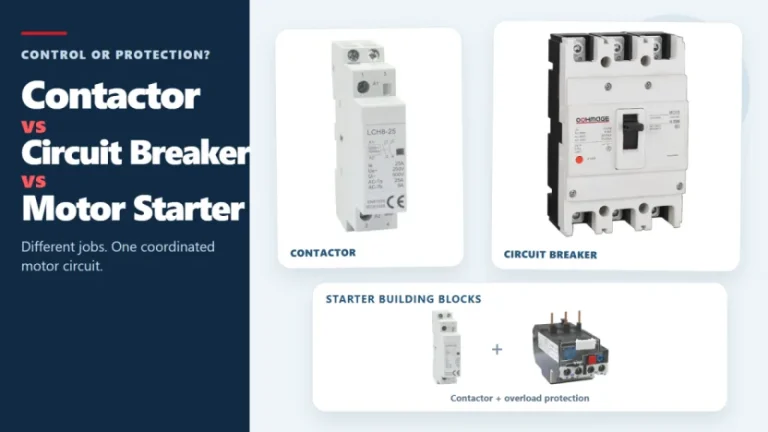
Figure 1. Contactors, circuit breakers, and motor starters solve different control and protection tasks. These three devices often appear in the same motor-control panel, but they solve different problems. A contactor handles frequent, remote, or automatic switching during normal operation. A circuit breaker interrupts abnormal current within its rated capability. A motor starter normally combines […]
Introduction The concept of remote tripping is simple, but in actual operation, project teams often encounter difficulties in specifying the components. The panel factory may require circuit breakers triggered by fire alarm relays, PLC outputs, building management system instructions, or other coordinated control. At this point, “diversion tripping” is only the first step in the […]
The main types of circuit breakers used in low-voltage distribution include miniature circuit breakers (MCBs), molded case circuit breakers (MCCBs) and residual-current devices such as RCCBs and RCBOs. They are not interchangeable. MCBs and MCCBs are selected for overcurrent protection in different circuit roles, an RCCB provides residual-current protection without integral overcurrent protection, and an […]