What Is an RCBO? Meaning, Functions and Selection Basics
Published: Author: Conor
An RCBO is a residual current operated circuit-breaker with integral overcurrent protection. In practical terms, one device combines residual-current protection with protection against overload and short-circuit current. It is commonly considered when a circuit needs both functions and the selected device is suitable for the installation.
RCBO selection is not based on the abbreviation alone. The rated voltage, rated current, number of poles, rated residual operating current, tripping characteristic, short-circuit capacity, residual-current type and terminal arrangement must be checked against the circuit design, applicable installation rules and the published data for the exact model.
What Does an RCBO Protect Against?
An RCBO combines two protection functions:
Residual-current protection: detects an imbalance associated with current flowing outside the intended conductors and disconnects the circuit under the conditions defined for the device.
Overcurrent protection: responds to overload and short-circuit current according to the device’s published characteristics.
This combination distinguishes an RCBO from an RCCB, which provides residual-current protection without integral overcurrent protection, and from an MCB, which provides overcurrent protection without residual-current protection.
An RCBO should not be described as protection against every electrical hazard. It does not replace correct system design, earthing, conductor sizing, isolation, surge protection, arc-fault protection where required, or inspection and testing by qualified personnel.
The residual-current section compares the current flowing through the active conductors. Under normal conditions, the current entering and returning through those conductors is balanced. When the difference reaches the operating conditions of the selected device, the residual-current mechanism can initiate disconnection.
The overcurrent section responds separately to overload and short-circuit conditions. The exact response depends on the model’s tripping characteristic, rated current and other published values. Do not apply a single operating time, current threshold or breaking-capacity figure to every RCBO.
The test button checks the device’s internal test function under the conditions described by the manufacturer. It is not a substitute for the electrical tests required for an installation.
RCBO vs MCB vs RCCB
Device
Residual-current protection
Integral overload and short-circuit protection
Typical selection question
RCBO
Yes
Yes
Does the circuit require both functions in one device, and which published ratings match the design?
RCCB
Yes
No
Which separate overcurrent protective device and residual-current characteristics are required?
MCB
No
Yes
Which current rating, tripping characteristic and short-circuit capacity match the circuit?
The terms RCD and RCCB are sometimes used loosely in conversation. RCD is a broad term for residual-current devices. An RCCB is one type of RCD without integral overcurrent protection, while an RCBO includes integral overcurrent protection.
The device must be suitable for the system voltage and frequency shown in its published data. Do not assume that a model intended for one system arrangement can be transferred to another.
Rated current
The RCBO’s rated current must coordinate with the circuit design, conductor capacity, connected load and applicable installation requirements. A familiar rating is not enough evidence that the model is suitable.
Number of poles and switching arrangement
Confirm how many conductors the device protects and switches, including the neutral arrangement where applicable. Product descriptions such as 1P, 1P+N, 2P or multi-pole must be read together with the wiring diagram and terminal markings of the exact model.
Rated residual operating current
The rated residual operating current is shown as an IΔn value. The required value depends on the intended protective function and the applicable installation rules. It should not be selected from a generic internet table without checking the project.
Tripping characteristic
The overcurrent tripping characteristic must suit the load and circuit conditions. Confirm the curve or other published trip information for the selected series rather than assuming every RCBO behaves the same way.
Short-circuit capacity
The device’s rated short-circuit capacity must be coordinated with the prospective fault current at the installation point and any upstream protective arrangement. This requires system information; it cannot be decided from load current alone.
Residual-current type
Residual-current types are designed to respond to different residual-current waveforms. Type AC, Type A, Type F, Type B and other designations are not interchangeable. The suitable type depends on the connected equipment, possible DC components, installation rules and the published scope of the exact device.
Supply and load connection
Use the terminal markings, wiring diagram and installation instructions for the selected model. Line/load orientation and neutral treatment can differ between products. Generic diagrams should not override the manufacturer’s document.
Where Are RCBOs Used?
RCBOs can be considered for final circuits in residential, commercial and similar installations when both residual-current and overcurrent protection are required. Examples may include lighting, socket, appliance or equipment circuits, but the correct device is determined by the actual system and local requirements.
Industrial equipment, variable-speed drives, photovoltaic systems, battery systems and electric-vehicle charging can introduce additional design considerations. A generic statement such as “use Type B” is not an adequate selection method. Confirm the equipment manufacturer’s instructions, the installation standard, possible DC residual-current components, system earthing and coordination with other protective devices.
A Practical RCBO Selection Process
Define the circuit. Record the system voltage, frequency, phase arrangement, earthing system, load type and conductor information.
Identify the required protection. Confirm why residual-current protection is required and how overcurrent protection will coordinate with the circuit.
Establish the fault conditions. Determine the prospective short-circuit current and any upstream or downstream coordination requirements.
Check the load characteristics. Consider starting current, electronic loads, variable-speed equipment and possible DC components.
Compare published model data. Review rated current, poles, IΔn, tripping characteristic, short-circuit capacity, residual-current type, terminals and dimensions.
Verify documents for the destination market. Confirm the applicable standard, declaration, certificate or technical document for the exact series and order requirement rather than assuming one document covers every model.
Use qualified design and installation. Final selection, installation and testing should be completed by qualified personnel in accordance with the applicable rules and the manufacturer’s instructions.
RCBO Installation and Testing Boundaries
RCBO work involves energized electrical systems and protective coordination. This article is a selection overview, not a wiring instruction. Installation, replacement, fault testing and verification should be handled by qualified personnel.
Before work begins, the responsible person should verify the circuit condition, isolation procedure, conductor arrangement, torque requirements, terminal markings and test method for the selected device. After installation, the required inspection and electrical tests must be completed under the applicable rules.
Follow the manufacturer and local requirements for operation of the test button. If a device trips repeatedly, does not operate as expected or shows damage, do not bypass it or repeatedly reset it without investigating the circuit and the device.
Frequently Asked Questions
What does RCBO stand for?
RCBO means residual current operated circuit-breaker with integral overcurrent protection. The device combines residual-current protection and overcurrent protection.
Is an RCBO the same as an RCD?
An RCBO belongs to the residual-current device family, but RCD is a broader term. An RCBO specifically includes integral overcurrent protection.
Does an RCBO replace an MCB and RCCB?
For a circuit where the selected RCBO provides the required residual-current and overcurrent functions, it can combine functions otherwise provided by separate devices. The final arrangement still depends on system design, coordination and applicable installation rules.
Does every RCBO have the same ratings?
No. Rated current, poles, IΔn, tripping characteristic, short-circuit capacity, residual-current type, voltage and terminal arrangement vary by series and model.
Does an RCBO provide surge protection?
No. An RCBO and a surge protective device perform different functions. Where surge protection is required, select and coordinate an appropriate SPD for the installation.
Does an RCBO provide arc-fault protection?
The term RCBO does not by itself mean that the device includes an arc-fault detection function. If arc-fault protection is required, verify the exact device functions and the applicable installation requirements.
What information should be included in an RCBO inquiry?
Include the system voltage and frequency, poles, rated current, residual-current requirement, tripping characteristic, short-circuit capacity, load or application, quantity, destination market and required documents. If some values are not yet known, provide the circuit description so the available series can be discussed.
Compare OOHMAGE RCBO Series
Use the OOHMAGE RCBO product range to compare available series and published parameters. For a model shortlist or quotation, send your circuit requirements and quantity. Certification and technical document support should be confirmed for the selected series, destination market and order requirements.
These references define general terminology and product-standard scope. They do not prove that every OOHMAGE model conforms to every listed standard; model-level documents remain the authority for a specific order.
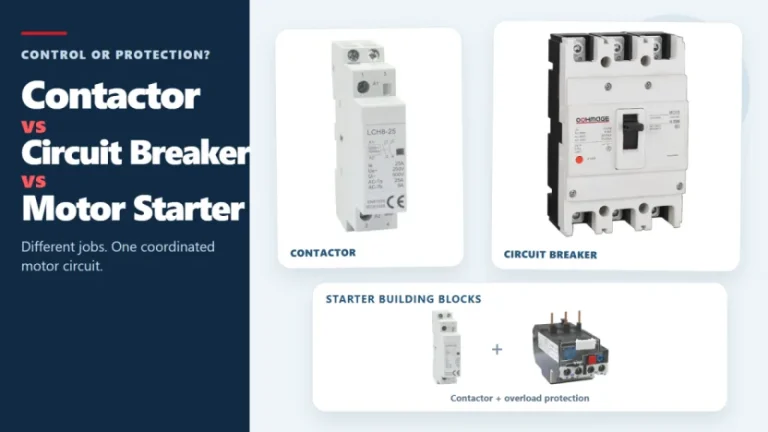
Figure 1. Contactors, circuit breakers, and motor starters solve different control and protection tasks. These three devices often appear in the same motor-control panel, but they solve different problems. A contactor handles frequent, remote, or automatic switching during normal operation. A circuit breaker interrupts abnormal current within its rated capability. A motor starter normally combines […]
Introduction The concept of remote tripping is simple, but in actual operation, project teams often encounter difficulties in specifying the components. The panel factory may require circuit breakers triggered by fire alarm relays, PLC outputs, building management system instructions, or other coordinated control. At this point, “diversion tripping” is only the first step in the […]
The main types of circuit breakers used in low-voltage distribution include miniature circuit breakers (MCBs), molded case circuit breakers (MCCBs) and residual-current devices such as RCCBs and RCBOs. They are not interchangeable. MCBs and MCCBs are selected for overcurrent protection in different circuit roles, an RCCB provides residual-current protection without integral overcurrent protection, and an […]