What Is the Difference Between GFCI and RCBO? Which One Should You Use?
Published: Author: Conor
GFCI and RCBO both prevent electric shock — but they are not the same device.
A GFCI protects against ground faults only. An RCBO protects against ground faults, overloads, and short circuits in one unit.
That single difference determines where each device belongs.
If you’re working in the United States or Canada, you’ll usually install a GFCI alongside a standard circuit breaker. If you’re working in Europe, Australia, or other IEC-based regions, you’ll typically use an RCBO that combines everything in one breaker.
Using the wrong device doesn’t just cause confusion. It can lead to inspection failures, nuisance tripping, or incomplete protection.
In this guide, we’ll break down:
What a GFCI actually does
What an RCBO includes
Why they aren’t interchangeable
Which one your system requires
Let’s break it down.
What Is a GFCI?
A GFCI (Ground Fault Circuit Interrupter) is a safety device that shuts off power when it detects a ground fault to prevent electric shock.
It constantly compares current leaving the hot wire with current returning through the neutral wire. If there is an imbalance — typically 4–6 milliamps — the device trips in about 25 milliseconds.
That fast response helps prevent serious injury.
In North America, electrical codes require GFCIs in higher-risk areas such as:
Bathrooms
Kitchens
Outdoor Circuits
Garages
Basements
GFCIs are available as:
Receptacle-Type Devices (installed at outlets)
Breaker-Type Devices (installed in the panel)
What a GFCI Does Not Do
A standard GFCI only detects ground faults.
It does not provide:
Overload Protection
Short Circuit Protection
That protection comes from a separate circuit breaker.
In typical North American systems, protection is modular:
Breaker = Overcurrent Protection
GFCI = Ground Fault Protection
This separation is one of the key differences between GFCI and RCBO.
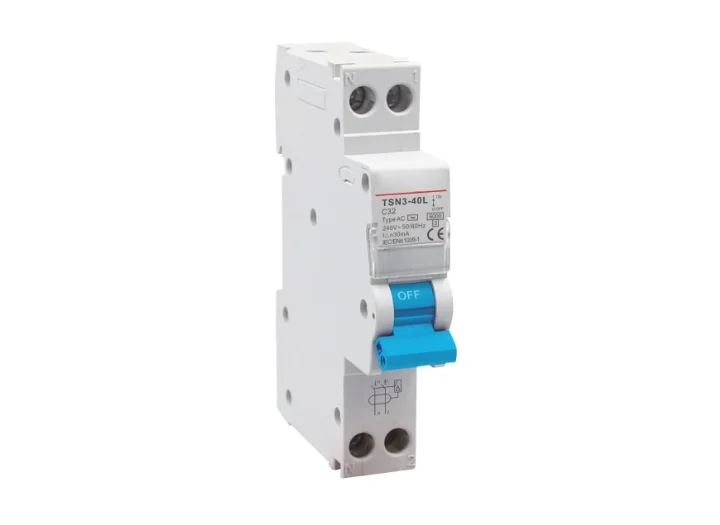
Instead of installing separate devices, you install one breaker that does everything.
An RCBO Performs Three Jobs
LAn RCBO provides:
Ground Fault Protection (Residual Current Detection)
Overload Protection (Thermal Protection)
Short Circuit Protection (Magnetic Protection)
In IEC-based systems, this simplifies the panel layout.
Rather than installing:
One RCD protecting multiple circuits
Separate MCBs for each branch
You install one RCBO per circuit.
If a kitchen circuit develops a fault, only that circuit trips — not the entire house. That’s one reason modern European installations prefer RCBOs despite slightly higher cost.
Where RCBOs Are Common
RCBOs are standard in countries following IEC standards, including:
Germany
France
Australia
Singapore
Most of Asia and South America
Open a modern European consumer unit and you’ll usually see a row of RCBOs — one for lighting, one for sockets, one for kitchen appliances, and so on.
It’s clean. It’s efficient. And it provides full protection at the circuit level.
GFCI VS RCBO: Key Differences
The main difference is simple:
GFCI protects against ground faults only. RCBO protects against ground faults and overcurrent in one breaker.
Here’s a side-by-side comparison:
Feature
GFCI
RCBO
Primary Function
Ground fault protection only
Ground fault + overcurrent protection
Overload Protection
No (requires separate breaker)
Yes (built-in)
Short Circuit Protection
No (requires separate breaker)
Yes (built-in)
Typical Installation
Outlet or branch circuit
Distribution panel
Regional Standard
North America (NEC)
IEC regions (Europe, Asia, etc.)
Physical Form
Receptacle or breaker-style
Breaker-style (similar to MCB)
Trip Sensitivity
Typically 4-6mA (Class A or Class B)
10mA, 30mA, or 100mA depending on application
Replaces
Nothing (adds protection)
MCB + RCD (two devices)
Panel Space
Varies
Single breaker position
Cost Comparison
$15-$50 for receptacle, $40-$100 for breaker
$25-$80 per RCBO
Maintenance
Test monthly (button test)
Test periodically (button test)
Compliance Standard
UL 943 (North America)
IEC 61009 (International)
Think of GFCI as a specialized guard watching for one specific danger: leakage current. It does that job extremely well but doesn’t watch for other dangers.
RCBO as a comprehensive guard watching for three dangers: leakage current, overload, and short circuit. It’s a complete protection package in one device.
Can GFCI and RCBO Be Used Interchangeably?
In most cases, no — they are not interchangeable. While both devices detect ground faults, they are designed for different system architectures and different regulatory standards.
In North American Systems (NEC-Based)
North American installations follow the National Electrical Code (NEC) and typically separate protection functions:
Circuit Breaker = Overcurrent Protection
GFCI = Ground Fault Protection
Most GFCIs are certified under UL 943, which defines trip thresholds and response times for Class A devices (4–6mA).
Installing an IEC-style RCBO in a U.S. panel often creates problems:
The breaker may not be listed for that panel
The mounting rail may not match
Inspectors may reject non-UL-listed devices
Even if an RCBO technically provides ground fault protection, it must be approved for use under local code.
In IEC-Based Systems
IEC installations follow standards such as:
IEC 61009 (RCBO Standard)
IEC 61008 (RCD Standard)
In these systems, each circuit often receives either:
An RCBO (integrated protection), or
An RCD + MCB combination
Using a GFCI alone in an IEC system leaves the circuit without proper overcurrent protection, unless paired with an MCB. That defeats the purpose of the integrated design philosophy.
Both devices detect leakage current. But their certification standards, installation methods, and protection architecture differ. Always match the device to the code and panel design of your region.
Regional Protection Philosophy: NEC vs IEC
The difference between GFCI and RCBO reflects two protection philosophies — not two safety levels.
Both approaches are safe when installed correctly. They simply organize protection differently.
NEC Approach: Modular Protection
Under the NEC framework:
Overcurrent protection is handled by individual circuit breakers
Ground fault protection is added only where required
For example, in a U.S. residential panel:
A 20A breaker protects a kitchen circuit
A GFCI receptacle protects downstream outlets near the sink
Only circuits in higher-risk areas require GFCI protection. This approach reduces hardware cost and panel complexity in lower-risk circuits such as lighting.
IEC Approach: Integrated Protection
In IEC-based systems, protection is often installed at the circuit level.
A typical European distribution board may include:
One RCBO for kitchen sockets
One RCBO for lighting
One RCBO for bathroom circuits
If a fault occurs in the kitchen, only that RCBO trips. This prevents a single ground fault from shutting down the entire installation — a common issue in older RCD-only systems.
Practical Example
Consider a small residential installation:
In the U.S.:
10 branch circuits
3 require GFCI
10 standard breakers + 3 GFCI devices
In Germany:
10 branch circuits
10 RCBOs
The NEC model is selective. The IEC model is comprehensive. Neither is inherently safer — they are structured differently.
Which One Should You Choose?
Choose based on your electrical system standard and the level of integration you need.
Follow this decision path:
Are You Working Under NEC (North America)?
Use a GFCI for circuits requiring ground fault protection under NEC rules.
Pair it with a listed circuit breaker that provides overcurrent protection.
Common scenarios:
Bathroom outlets
Kitchen countertop circuits
Outdoor receptacles
Are You Designing an IEC Distribution Board?
Use an RCBO for full circuit-level protection.
It simplifies panel layout and ensures each circuit has both:
Residual current protection
Overcurrent protection
Modern installations increasingly favor one RCBO per circuit.
Do You Need Combined Protection in One Unit?
If space is limited or equipment requires integrated protection, choose an RCBO.
This is common in:
Industrial equipment panels
Portable distribution systems
EV charging circuits (often requiring Type B devices)
Are You Retrofitting an Existing Circuit?
If the circuit already has a breaker and only needs ground fault protection, a GFCI device may be sufficient.
Always verify compatibility with your panel and local code requirements.
Common Misunderstandings About GFCI and RCBO
Several misconceptions cause confusion in field installations.
“They Are Just Different Names”
Not correct.
An RCBO includes overcurrent protection. A standard GFCI does not. The functional difference is significant.
“RCBO Is Automatically Safer”
Not necessarily.
A properly designed NEC system using a breaker plus GFCI provides equivalent protection. Safety depends on correct installation and compliance — not integration alone.
“GFCI Protects Against All Electrical Hazards”
It protects only against ground faults.
It does not protect against:
Overloads
Short circuits
Arc faults
Additional devices may be required depending on code.
“They Can Be Swapped Anywhere”
Certification matters.
GFCIs are typically listed under UL 943
RCBOs follow IEC 61009
Installing devices outside their certification environment may result in inspection failure.
Final Thoughts
GFCI and RCBO both prevent electric shock, but they fit into different protection systems.
NEC-based installations typically separate ground fault and overcurrent protection. IEC systems often integrate both functions at the circuit level through RCBOs. The right choice depends on your regional code, panel architecture, and whether you need integrated protection in a single device.
If your installation follows IEC standards or requires combined residual current and overcurrent protection, Oohmage specializes in RCBO solutions designed for modern distribution boards and equipment panels.
FAQs
What’s the difference between Type A, Type B, and Type F RCBOs?
The type refers to the kind of fault current the device can detect. Type A: Detects AC and pulsating DC (common in residential circuits) Type B: Detects AC, pulsating DC, and smooth DC (required for EV chargers and variable frequency drives) Type F: Designed for circuits with higher-frequency leakage currents Most residential installations use Type A. Equipment with power electronics often requires Type B.
If my panel already has an RCD, do I still need RCBOs for individual circuits?
Not necessarily. A main RCD combined with individual MCBs meets IEC requirements. However, using RCBOs improves selectivity. If one circuit develops a fault, only that circuit trips — not the entire installation. Many modern installations prefer one RCBO per circuit for this reason.
Can RCBOs or GFCIs be used on motor or equipment circuits?
Yes, but device selection matters. Motors and variable-speed drives can cause temporary imbalance during startup. Choose a device rated for inductive loads and verify the correct trip sensitivity. In some industrial applications, higher trip thresholds (such as 100mA) may be used where permitted by code.
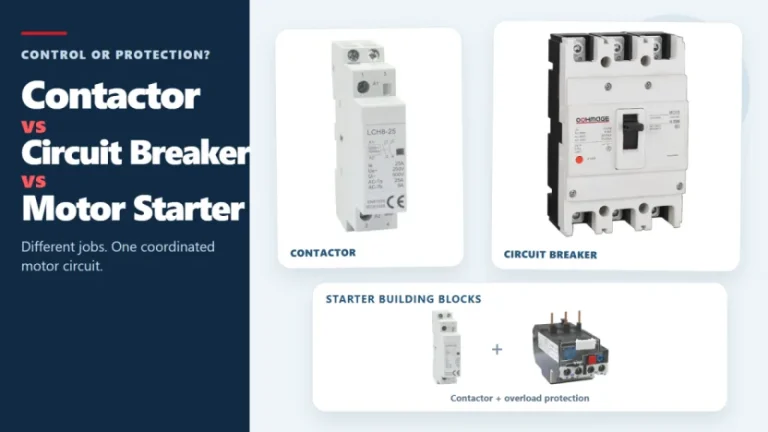
Figure 1. Contactors, circuit breakers, and motor starters solve different control and protection tasks. These three devices often appear in the same motor-control panel, but they solve different problems. A contactor handles frequent, remote, or automatic switching during normal operation. A circuit breaker interrupts abnormal current within its rated capability. A motor starter normally combines […]
Introduction The concept of remote tripping is simple, but in actual operation, project teams often encounter difficulties in specifying the components. The panel factory may require circuit breakers triggered by fire alarm relays, PLC outputs, building management system instructions, or other coordinated control. At this point, “diversion tripping” is only the first step in the […]
The main types of circuit breakers used in low-voltage distribution include miniature circuit breakers (MCBs), molded case circuit breakers (MCCBs) and residual-current devices such as RCCBs and RCBOs. They are not interchangeable. MCBs and MCCBs are selected for overcurrent protection in different circuit roles, an RCCB provides residual-current protection without integral overcurrent protection, and an […]