The Silent Protector: How a Residual Current Circuit Breaker Prevents Electrocution
Published: Author: Conor
Introduction
Modern power systems require strict electrical safety measures to function properly. Personnel protection remains the absolute highest priority for facility electrical engineers. Earth faults and leakage currents create hidden, lethal dangers in any building. Standard overload protection devices cannot detect these small, life-threatening electrical currents.
Electricity travels through conductive wires to power heavy machines and facility lights. Plastic insulation keeps the electricity safely inside the intended physical path. This protective insulation degrades over time due to high heat and physical wear. Environmental moisture also creates dangerous conductive paths directly to the earth ground.
What Is a Residual Current Circuit Breaker?
A Residual Current Circuit Breaker serves as a highly precise safety device. Engineers design this specific equipment exclusively to detect dangerous earth leakage currents. The breaker interrupts the power supply immediately upon detecting a microscopic leak. This primary purpose focuses entirely on protecting human life from sudden electrocution.
Standard breakers protect wires and industrial machines from dangerous overheating. They trip automatically when the electrical current exceeds a massive physical limit. A Residual Current Circuit Breaker operates on a completely different engineering principle. It measures the current entering and leaving a circuit to detect any imbalances.
The Critical Danger of Earth Faults and Leakage
Electrical current produces severe physiological effects on the fragile human body. Very small amounts of leaking current cause extreme physical damage quickly. The human body conducts electricity very easily under normal physical conditions. Water or sweat makes the human body an even better electrical conductor.
A person touching a live wire allows current to flow through their organs. The severity of the shock depends entirely on the specific current level. A current of just ten milliamperes causes severe muscle contractions. The victim cannot let go of the electrified wire under this dangerous condition.
Current Level (mA)
Physiological Effect on Human Body
Safety Risk Level
1 to 5 mA
Slight tingling sensation
Very Low
10 to 20 mA
Muscle contractions
High
30 to 50 mA
Breathing difficulty
Severe
50 to 100 mA
Ventricular fibrillation
Fatal
How Does a Residual Current Operated Circuit Breaker Work?
The device monitors the continuous flow of electricity through main power wires. It compares the incoming energy to the outgoing energy constantly without pausing. Any missing energy triggers an immediate mechanical reaction within the safety device. This simple logic provides highly reliable electrical safety for the entire network.
Normal Operating Conditions
The breaker utilizes the fundamental engineering principle of Kirchhoff’s Current Law. Power flows through the live phase wire directly to the connected machine. The exact same amount of power returns through the dedicated neutral wire. The magnetic fields created by these two active wires cancel each other out perfectly.
Detecting the Imbalance
A person might accidentally touch a damaged or exposed live wire. A portion of the electrical current leaks through the person into the earth. The return current in the neutral wire drops immediately due to this leak. This creates a measurable mathematical difference known as the residual current.
The Tripping Mechanism
The unbalanced magnetic field induces a rapid voltage in the internal transformer. This sudden induction of voltage energizes a highly sensitive secondary winding. The energized winding activates a powerful electromagnetic relay attached to the mechanism. The relay forces the main mechanical contacts to open violently and quickly.
Core Components of the Breaker
The breaker contains several highly specialized internal components to ensure reliability. These tiny parts translate microscopic electrical imbalances into strong mechanical force. Manufacturers build these critical components with extreme precision to guarantee absolute safety. Quality construction ensures the device reacts instantly during an actual electrical emergency.
Switch Disconnectors (Load Switches)
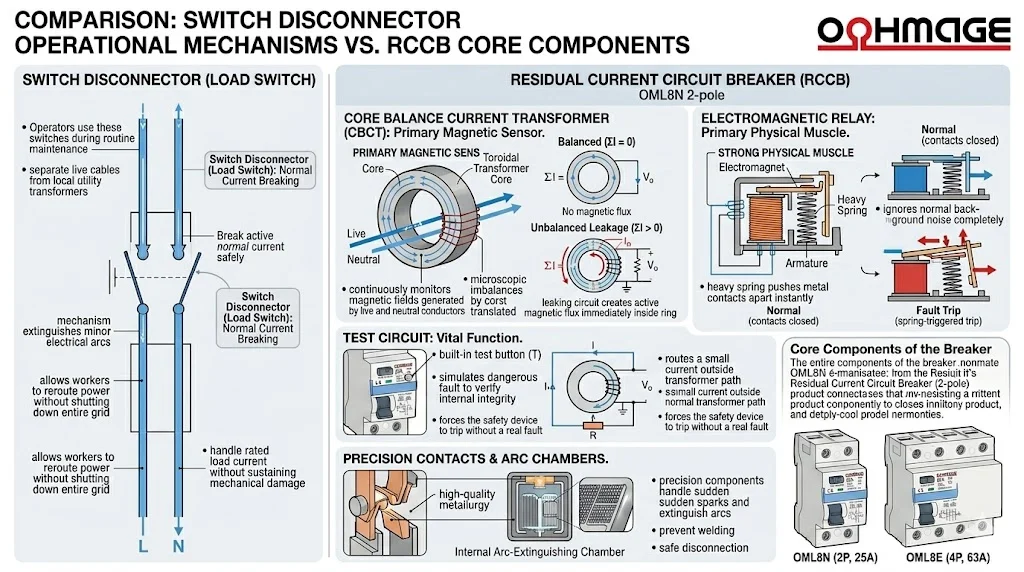
Load switches break active electrical currents safely under normal conditions. Operators use these switches during routine network maintenance procedures. The switches separate the live cables from the local utility transformers. The mechanism extinguishes minor electrical arcs during the physical separation process. This allows workers to reroute power without shutting down the entire grid. The switches handle the rated load current without sustaining mechanical damage.
Core Balance Current Transformer (CBCT)
The toroidal transformer acts as the primary magnetic sensor for the device. It continuously monitors the magnetic fields generated by the live and neutral conductors. A perfectly balanced circuit creates zero magnetic flux in the transformer core. A leaking circuit creates an active magnetic flux immediately inside the ring.
Electromagnetic Relay
The electromagnetic relay serves as the strong physical muscle of the safety device. This highly sensitive electromechanical component translates the induced voltage into mechanical action.
The heavy spring pushes the metal contacts apart instantly.
The mechanical system ignores normal background electrical noise completely.
The Test Circuit
The breaker includes a vital built-in test button on the front panel. This button simulates a dangerous fault to verify internal mechanical integrity. Pressing the button routes a small current outside the normal transformer path. This specific action forces the safety device to trip without a real fault.
Precision Contacts and Arc Chambers
The device requires high-quality metallurgy for the main electrical contacts. Internal arc-extinguishing chambers ensure safe disconnection without welding the contacts together. These precision components handle the sudden electrical sparks safely.
Enclosure and Busbars
Residual Current Device Circuit Breaker vs. Standard Protection
Standard protection devices serve entirely different purposes than sensitive leakage breakers. Engineers must understand these critical differences to design safe electrical panels. Mixing up these devices leads to catastrophic safety failures and severe fires. A complete protection strategy utilizes multiple different breaker types simultaneously.
RCCB vs. MCB (Miniature Circuit Breaker)
A Miniature Circuit Breaker protects exclusively against massive overloads and short circuits. It watches for extremely high current levels that melt copper wires. It does not detect small, lethal leakage currents at all. Relying on an MCB alone for human protection creates a fatal daily risk.
RCCB vs. RCBO
Modern electrical engineering developed the RCBO to solve strict space limitations. It combines Residual Current Breaker functions with comprehensive Overcurrent protection. The RCBO protects against massive short circuits and tiny earth leaks simultaneously. This combined unit saves valuable physical space inside crowded commercial electrical panels.
Application Integration
Engineers coordinate these different safety devices carefully within large distribution boards. They install standard MCBs to protect individual lighting and heavy power circuits. They install leakage breakers upstream to protect entire groups of circuits simultaneously. This layered strategy ensures total system and personnel safety across the entire building.
Real-World Applications of RCCBs
Various industries mandate the strict installation of leakage protection devices. These robust breakers secure critical infrastructure and protect civilian populations daily. Specific wet or outdoor environments pose much higher risks for severe electrical shocks. Engineers deploy specialized leakage breakers to mitigate these severe environmental hazards.
Industrial Facilities and Wet Environments
Manufacturing plants utilize large machinery and liquid coolants constantly during operations. Water ingress poses a constant threat to electrical wire insulation in these areas. Facilities deploy leakage breakers to prevent workers from receiving shocks near wet equipment. The sensitive breakers shut down water pumps instantly upon detecting dangerous moisture.
Commercial and Construction Sites
Construction sites rely heavily on temporary power supplies and commercial equipment. The harsh outdoor environment damages electrical extension cables very easily. Safety regulations mandate the integration of leakage protection on all temporary power boards. This strict integration protects crane operators and builders from damaged power tools.
EV Charging and Renewable Energy
Modern technology creates new electrical hazards requiring highly advanced leakage protection. Solar inverters and electric vehicle charging infrastructure demand specialized leakage monitoring. The deployment sequence for new infrastructure follows strict safety rules tightly.
Engineers assess the environmental moisture levels at the installation site.
Electricians install the main leakage breaker at the primary power feed.
Key Factors When Selecting an RCCB
Selecting the correct leakage breaker requires careful technical analysis. Engineers must evaluate the specific electrical loads connected to the distribution panel. Planners follow strict technical guidelines during the equipment procurement process. Incorrect selection leaves personnel completely unprotected from lethal electrical shocks.
Sensitivity Ratings (Tripping Current)
The internal sensitivity rating determines the exact moment the breaker trips mechanically. Engineers must select the correct milliampere rating for the specific application. A 30mA rating provides direct human life protection in residential and commercial spaces. Ratings of 100mA or 300mA protect large industrial equipment and prevent electrical fires.
Types of Leakage Current (Type AC, A, B)
Different electrical loads create completely different types of leakage currents. Type AC devices only detect basic alternating current leaks effectively. Modern environments contain many DC components and strange pulsating currents.
Breaker Class
Detection Capability
Ideal Application Area
Type AC
Alternating current only
Basic lighting
Type A
AC and pulsating DC
Household appliances
Type B
AC, pulsating DC, smooth DC
EV chargers
International Standards and Compliance
Global electrical markets enforce strict manufacturing and rigorous testing regulations. Equipment must adhere completely to IEC 61008 and CE safety certifications. These specific certifications guarantee operational reliability and long-term mechanical durability. Independent laboratories test the breakers under extreme physical conditions to verify performance.
Future Trends in Electrical Leakage Protection
The electrical protection industry continually innovates to improve overall grid safety. Manufacturers invest heavily in research to create much smarter safety devices. The traditional mechanical breaker evolves slowly into an intelligent digital sensor. These future trends focus heavily on preventing faults before they actually happen.
Digital and Smart Monitoring Systems
The transition toward digital monitoring systems changes the safety landscape completely. Smart breakers predict insulation failure before a critical mechanical trip occurs. The devices monitor the gradual degradation of electrical wires over several months. They send digital alerts to maintenance computers when the leakage current slowly rises.
Reducing Nuisance Tripping
Modern offices contain thousands of computers, servers, and digital displays. These electronic devices create heavy background electrical noise constantly. Continuous advancements in sensor technology help reduce this nuisance tripping significantly. The new smart chips distinguish perfectly between harmless electronic noise and genuine faults.
Final Thoughts
The electrical industry relies on strict safety protocols to protect workers. Leakage protection devices serve as the solid foundation of these safety protocols. The equipment operates silently for many years without requiring human intervention. It stands ready to sever dangerous power connections in a fraction of a second.
The Ultimate Safeguard
The RCCB plays a non-negotiable role in modern electrical infrastructure everywhere. It serves as the ultimate safeguard against electrocution and fatal workplace accidents. Facilities cannot operate safely without these highly precise monitoring devices. The rapid mechanical disconnection prevents small leaks from becoming massive electrical fires.
FAQs
What is the difference between an RCCB and an MCB?
An MCB protects wires and equipment from massive power overloads and short circuits. It trips mechanically when the current exceeds the physical limit of the cables. An RCCB strictly monitors for tiny, lethal leakage currents escaping to the earth. It protects human life directly from fatal electrical shocks.
Why does my RCCB keep tripping unexpectedly?
Frequent unexpected tripping usually indicates a genuine safety hazard in the facility. Damaged appliance cords leak small amounts of current constantly into the earth. Water ingress in outdoor lighting also triggers the sensitive internal magnetic sensor. High levels of normal background electronic noise occasionally trick the breaker into tripping.
How often should the test button on an RCCB be pressed?
Manufacturers strongly recommend pressing the built-in test button once every single month. This simple action verifies that the mechanical springs and metal contacts move freely. Dust causes the internal mechanical parts to stick together heavily over time. The monthly test breaks any mechanical sticking and ensures rapid emergency reaction.
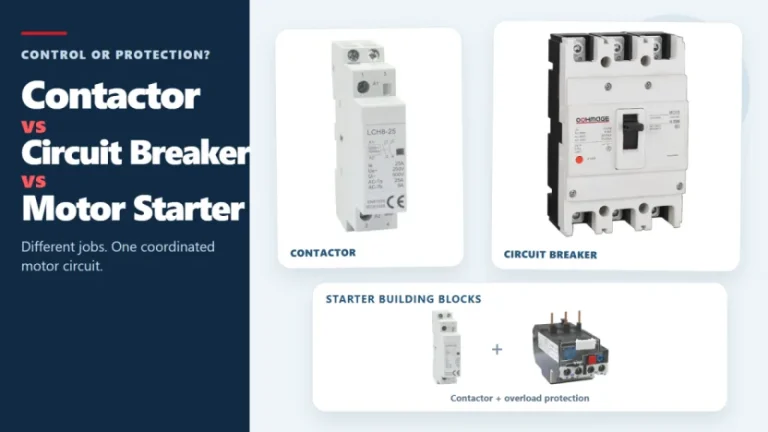
Figure 1. Contactors, circuit breakers, and motor starters solve different control and protection tasks. These three devices often appear in the same motor-control panel, but they solve different problems. A contactor handles frequent, remote, or automatic switching during normal operation. A circuit breaker interrupts abnormal current within its rated capability. A motor starter normally combines […]
Introduction The concept of remote tripping is simple, but in actual operation, project teams often encounter difficulties in specifying the components. The panel factory may require circuit breakers triggered by fire alarm relays, PLC outputs, building management system instructions, or other coordinated control. At this point, “diversion tripping” is only the first step in the […]
The main types of circuit breakers used in low-voltage distribution include miniature circuit breakers (MCBs), molded case circuit breakers (MCCBs) and residual-current devices such as RCCBs and RCBOs. They are not interchangeable. MCBs and MCCBs are selected for overcurrent protection in different circuit roles, an RCCB provides residual-current protection without integral overcurrent protection, and an […]