What Does a Standard Molded Case Circuit Breaker Contain? Key Internal Components Explained
Published: Author: Conor
A standard molded case circuit breaker (MCCB) contains five essential internal systems: a current-carrying assembly, a trip mechanism, an arc-extinguishing system, an operating mechanism, and an insulated housing.
Each component plays a specific role. Together, they detect abnormal current, interrupt fault conditions, and protect cables and equipment from damage.
Understanding these internal parts helps engineers select the right breaker, evaluate ratings, and perform effective maintenance.
In this guide, we break down the key components a standard MCCB contains and explain how each one affects overall performance.
What Is Considered a “Standard” MCCB?
A StandardMolded Case Circuit Breaker (MCCB) refers to a low-voltage circuit breaker designed primarily for overload and short-circuit protection using thermal-magnetic trip technology.
Typical operating voltage ranges include:
Up to 600V AC under UL standards
Up to 690V AC under IEC standards
Standard MCCBs focus on basic protective functions. They do not typically include advanced electronic monitoring, communication modules, or metering features found in higher-end models.
While manufacturers may vary in external design, the internal protection principle remains consistent: detect overcurrent, interrupt safely, and reset manually after fault clearance.
Main Functional Components Inside an MCCB
A standard molded case circuit breaker is built around five core internal systems. Each system performs a distinct function, but all operate together to ensure safe interruption of fault current.
1. Current-Carrying Assembly
The current-carrying assembly forms the electrical path between the line and load terminals.
It includes:
Fixed contacts
Moving contacts
Conductive copper busbars
Flexible connectors
Under normal operation, this system must carry rated current with minimal resistance and heat generation.
Contact material and contact pressure are critical. Poor contact design increases voltage drop and thermal stress, which directly affects breaker lifespan.
2. Tripping Mechanism (Protection System)
The trip mechanism detects abnormal current conditions.
In standard MCCBs, this system typically uses:
A thermal element (bimetal strip) for overload protection
A magnetic element for instantaneous short-circuit response
When current exceeds defined limits, the mechanism releases the latch and initiates contact separation. This system determines how quickly and accurately the breaker responds to faults.
3. Arc Extinguishing System
When contacts separate under load, an electrical arc forms.
The arc extinguishing system controls and suppresses this arc using an arc chute assembly made of insulated splitter plates.
The arc is divided into smaller segments, lengthened, and cooled until it collapses.
Arc control design directly influences interrupt rating. Efficient arc management allows the breaker to safely interrupt higher fault currents.
4. Operating Mechanism
The operating mechanism controls contact opening and closing.
It includes:
Energy storage springs
Latches
Levers
Manual handle assembly
During manual switching or automatic tripping, stored mechanical energy ensures rapid contact separation. Fast separation reduces arc duration and limits internal damage.
Trip indication (ON/OFF/TRIPPED) is integrated into this mechanism.
5. Insulated Housing and Structural Frame
The molded insulating case provides mechanical support and electrical isolation.
It is manufactured from high-strength thermoset or thermoplastic materials resistant to:
Heat
Impact
Electrical tracking
The housing maintains internal alignment of components and ensures safe installation inside switchboards and panels.
Although often overlooked, enclosure strength affects short-circuit withstand performance.
Components Found in Some MCCBs but Not All
While standard MCCBs rely on thermal-magnetic protection, many industrial models include additional components that enhance monitoring, coordination, and control.
These features are not required for basic protection, but they become valuable in complex electrical systems.
i. Electronic Trip Units
In advanced MCCBs, electronic trip units replace traditional thermal-magnetic elements.
They use current sensors and internal logic to provide adjustable overload, short-time, and instantaneous settings. Some models also include ground-fault protection.
Electronic trip systems improve protection accuracy and allow better coordination in installations with motors, generators, or sensitive loads.
ii. Adjustable Protection Interfaces
Some MCCBs include external adjustment dials or digital interfaces that allow fine-tuning of pickup values and delay times.
This flexibility supports engineered coordination studies and system-specific protection strategies.
However, adjustable capability requires proper analysis. Incorrect settings can reduce selectivity rather than improve it.
iii. Auxiliary Contacts and Signaling Devices
Auxiliary contacts provide status feedback, such as ON, OFF, or TRIPPED positions.
These contacts can be connected to:
PLC systems
Alarm circuits
SCADA platforms
They allow remote monitoring without altering the breaker’s core protective function.
iv. Monitoring and Communication Modules
Higher-end MCCBs may include communication modules or energy monitoring accessories.
These components enable:
Load monitoring
Event logging
Remote trip indication
Such features are common in data centers, industrial automation systems, and large distribution boards.
Standard MCCBs do not include these capabilities by default.
How Internal Components Affect MCCB Performance and Ratings
The performance ratings of an MCCB are not arbitrary numbers. They directly reflect the design and interaction of its internal components.
Understanding this relationship helps engineers interpret specifications more accurately.
Arc Control and Interrupt Rating
Interrupt rating depends largely on the effectiveness of the arc extinguishing system.
When a short circuit occurs, fault current generates a high-energy arc as contacts separate. The arc chute must lengthen, divide, and cool this arc rapidly.
The more efficient the arc control design, the higher the breaker’s ability to interrupt fault current safely. This is why breakers with similar rated currents may have different interrupt ratings — internal arc management design makes the difference.
Trip Mechanism and Protection Accuracy
The type of trip mechanism influences how precisely the breaker responds to abnormal conditions.
Thermal-magnetic systems rely on mechanical response, which can be influenced by ambient temperature. Electronic trip systems use current sensing and programmed logic, offering more consistent and adjustable protection.
Protection accuracy affects coordination, nuisance tripping, and overall system reliability.
Frame Structure and Thermal Management
Frame size and internal conductor layout determine how well the breaker dissipates heat. A properly designed frame supports rated current without excessive temperature rise. Poor thermal design can shorten insulation life and reduce performance over time. Thermal margin is not only about current rating — it is about long-term stability under continuous load.
What a Standard MCCB Does Not Include?
A standard MCCB is designed primarily for overcurrent protection. It focuses on interrupting overload and short-circuit conditions safely and reliably.
It does not replace advanced monitoring or protection systems.
No Integrated Protection Relays
Standard MCCBs rely on built-in thermal-magnetic or basic electronic trip units. They do not include external protective relays such as differential, directional, or advanced ground-fault relays.
In complex power systems, separate protection relays may be required to provide additional fault discrimination or system-level protection.
No Energy Metering Function
Basic MCCBs do not measure or record energy consumption.
Energy monitoring typically requires dedicated metering devices or advanced breaker models equipped with digital sensing modules. Standard breakers operate as protective and switching devices, not as power monitoring instruments.
No Built-In Communication or Supervisory Control
Standard MCCBs function locally. They do not include communication protocols for remote control, event logging, or real-time analytics.
Industrial installations that require SCADA integration or remote diagnostics must use breakers with dedicated communication accessories or intelligent protection platforms. Understanding these boundaries helps ensure the right device is selected for the intended level of system control.
Why Knowing MCCB Components Matters for Selection and Maintenance?
Knowing the internal structure of an MCCB improves both selection accuracy and long-term reliability.
When engineers understand how the current-carrying assembly, trip mechanism, and arc system interact, it becomes easier to evaluate ratings beyond the nameplate. Frame size, interrupt rating, and trip characteristics are not isolated specifications — they reflect internal design decisions.
This understanding also supports effective MCCB maintenance, as inspections can focus on contact wear, arc chute condition, and trip mechanism performance rather than routine checks alone. Recognizing how contacts wear, how arc chutes degrade, or how trip mechanisms respond over time allows inspections to focus on real risk areas rather than routine checks alone.
In industrial environments, breaker performance directly affects uptime and safety. Misinterpreting component capabilities can lead to undersized protection, coordination problems, or premature failure.
An MCCB is not just a switching device. It is a coordinated mechanical and electrical system. Understanding its components enables informed decisions throughout the equipment lifecycle — from selection and installation to inspection and replacement.
Final Thoughts
A standard MCCB is more than a protective switch. Its performance depends on how the current-carrying assembly, trip mechanism, arc control system, and structural design work together under fault conditions.
Understanding these internal components helps engineers interpret ratings correctly, select appropriate protection levels, and plan effective maintenance strategies.
In industrial and commercial systems, reliability depends on matching breaker design to application requirements.
If your project requires IEC-certified MCCBs built for dependable protection and global compliance, Oohmage provides engineered solutions designed to support long-term system performance.
FAQs
Are internal MCCB components replaceable?
Most standard MCCBs are not designed for internal component replacement. If contacts, arc chutes, or trip elements are significantly damaged, full breaker replacement is typically recommended to maintain rated performance.
How long do MCCB internal components typically last?
Service life depends on load conditions and fault events. Under normal operation, mechanical endurance may reach thousands of operations. However, short-circuit interruptions accelerate contact wear and arc chute degradation.
Do electronic trip MCCBs contain different internal components?
Yes. Electronic trip MCCBs replace the thermal element with current sensors and control circuits. While the arc and contact systems remain similar, the protection logic is fundamentally different.
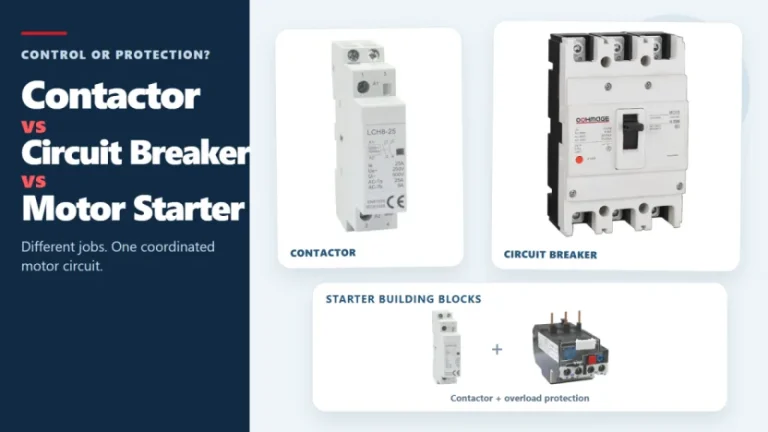
Figure 1. Contactors, circuit breakers, and motor starters solve different control and protection tasks. These three devices often appear in the same motor-control panel, but they solve different problems. A contactor handles frequent, remote, or automatic switching during normal operation. A circuit breaker interrupts abnormal current within its rated capability. A motor starter normally combines […]
Introduction The concept of remote tripping is simple, but in actual operation, project teams often encounter difficulties in specifying the components. The panel factory may require circuit breakers triggered by fire alarm relays, PLC outputs, building management system instructions, or other coordinated control. At this point, “diversion tripping” is only the first step in the […]
The main types of circuit breakers used in low-voltage distribution include miniature circuit breakers (MCBs), molded case circuit breakers (MCCBs) and residual-current devices such as RCCBs and RCBOs. They are not interchangeable. MCBs and MCCBs are selected for overcurrent protection in different circuit roles, an RCCB provides residual-current protection without integral overcurrent protection, and an […]