MCCB vs MCB vs ACB vs VCB — Which Circuit Breaker Should You Choose?
Published: Author: Conor
MCB, MCCB, ACB, and VCB are all circuit breakers — but they are not interchangeable. Each type is designed for a specific voltage range, current level, and application environment.
Selecting the wrong breaker can result in inadequate fault protection, reduced reliability, or unnecessary cost.
In practice, the selection process is straightforward once you focus on three factors:
System voltage
Load current and fault level
Application context
This guide explains the practical differences between MCB, MCCB, ACB, and VCB, and provides a clear decision framework you can apply in residential, commercial, and industrial projects.
Step 1: Determine Your System Voltage (Low Voltage vs Medium Voltage)
System voltage is the first and most decisive selection factor.
Electrical standards typically classify systems above 1000V AC as medium voltage. At this level, only medium-voltage breakers such as Vacuum Circuit Breakers (VCBs) are suitable.
VCBs use vacuum interrupters to extinguish arcs quickly and reliably, making them appropriate for voltage levels ranging from 3.3kV to 38kV and above. Low-voltage breakers — MCBs, MCCBs, and ACBs — are not designed for insulation or interruption at these voltage levels and should not be applied in medium-voltage systems.
If your installation operates at 1000V AC or below (e.g., 230V, 400V, 480V, 600V, or 690V), you will select between MCB, MCCB, or ACB. The next step is to evaluate current rating and fault level.
Step 2: Evaluate Current Rating and Interrupting Capacity
Once you confirm the system is low voltage, current rating and available fault current determine which breaker type is appropriate.
Each breaker type covers a distinct operating range:
Typically rated from 0.5A to 125A, with interrupting capacities between 6kA and 25kA depending on model. MCBs are primarily used for final branch circuits such as lighting, receptacles, and small equipment.
They are compact and economical but offer fixed trip characteristics and limited fault interruption capability.
Generally rated from 15A up to 2500A (some models higher), with interrupting capacities from 25kA to 200kA. MCCBs are commonly used for feeder protection, motor circuits, and commercial or industrial distribution panels.
Unlike MCBs, most MCCBs offer adjustable trip settings and higher fault tolerance.
ACB (Air Circuit Breaker)
Typically applied from 800A up to 6300A or higher, with interrupting capacities exceeding 50kA.
ACBs are used in main switchboards, bus-tie systems, and high-current distribution points where serviceability and reliability are critical.
VCB (Vacuum Circuit Breaker)
Although primarily defined by voltage rather than current, VCBs in medium-voltage systems typically range from 630A to 5000A and are designed to interrupt high-energy faults safely using vacuum interruption technology.
The selection at this stage is not about preference — it is about ensuring the breaker’s rated current and interrupting capacity exceed both load demand and available fault current at the installation point.
Step 3: Match the Breaker to the Application
In some current ranges, more than one breaker type may appear technically feasible. Application context resolves the overlap.
Residential and Light Commercial
MCBs are typically used for final branch circuits such as lighting, receptacles, and small appliances. Their compact size and fixed characteristics make them suitable for low-fault residential environments.
For larger residential service entrances (100A–200A), an MCCB may be used as the main breaker where higher interrupting capacity is required.
Industrial and Heavy Commercial Facilities
MCCBs are widely used for motor feeders, HVAC systems, compressors, and sub-distribution panels. Adjustable magnetic settings allow coordination with motor inrush currents and upstream protection devices.
MCBs may still be used for small auxiliary circuits, but industrial environments generally demand the higher interrupting capacity of MCCBs.
Main Low-Voltage Switchboards
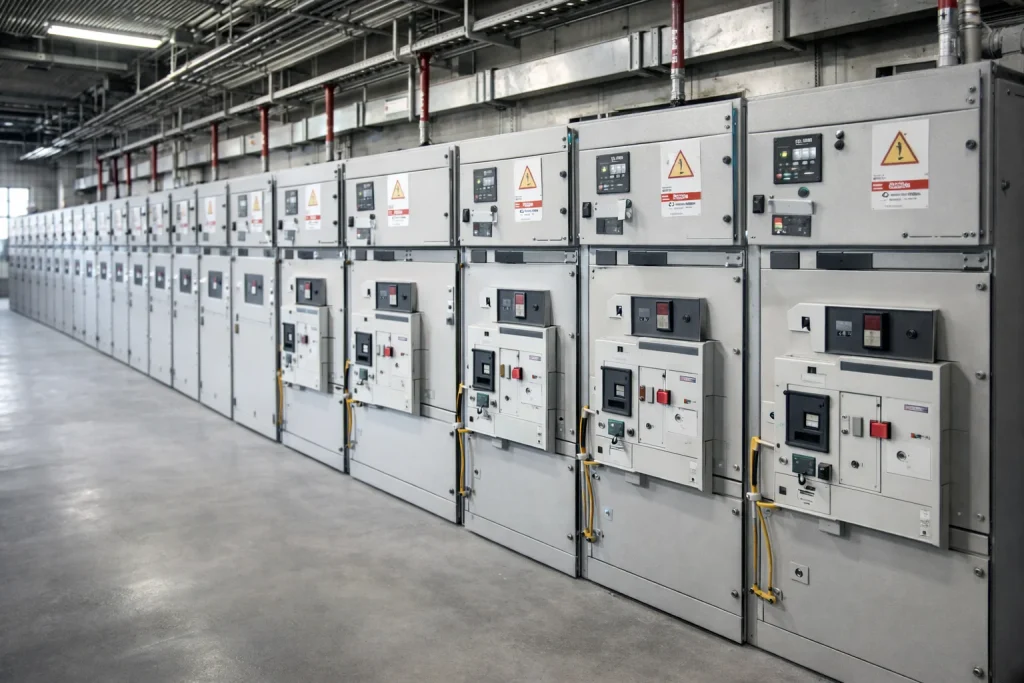
ACBs are commonly installed as main incoming breakers or bus-tie breakers in high-current distribution systems. Their withdrawable design and serviceability make them suitable for critical infrastructure where maintenance without full shutdown is required.
Medium-Voltage Distribution Systems
VCBs are used in substations, generator step-up systems, transformer primary protection, and large MV motor applications. At these voltage levels, vacuum interruption technology is standard practice.
Application selection is not only about current rating — it involves coordination, maintainability, and system criticality.
Why These Breakers Differ in Size, Complexity, and Cost?
The differences between MCB, MCCB, ACB, and VCB are driven by electrical stress and interruption requirements — not by branding or product positioning.
As current and voltage increase, the arc energy during a fault rises dramatically. Larger breakers require more advanced arc control systems to safely extinguish this energy.
MCBs use compact air arc chambers suitable for low fault levels.
MCCBs incorporate enhanced arc chutes and magnetic blow-out mechanisms to handle higher interruption capacities.
ACBs employ larger arc runners and sophisticated contact systems designed for high-current main distribution.
VCBs use vacuum interrupters, where arcs extinguish rapidly due to the absence of ionizable gas — making them ideal for medium-voltage systems.
Mechanical structure scales accordingly.
MCBs are fixed and non-repairable.
MCCBs offer limited serviceability depending on model.
ACBs and VCBs are typically withdrawable and designed for inspection, maintenance, and component replacement in critical systems.
As system capacity increases, so do mechanical strength, insulation requirements, and service demands — which explains the size and cost differences between breaker types.
Can MCB, MCCB, ACB, and VCB Be Interchanged?
These breaker types are not interchangeable due to fundamental differences in voltage rating, interrupting capacity, insulation design, and application purpose.
An MCB cannot replace an MCCB simply because the current rating matches. In many industrial systems, available fault current exceeds the interrupting capacity of standard MCBs. Installing an underrated device can result in failure to safely clear high-magnitude faults.
Similarly, MCCBs are not substitutes for ACBs in main switchgear applications. ACBs provide higher interruption ratings, serviceability, and withdrawable construction required for critical distribution systems.
ACBs and VCBs operate in entirely different voltage classes. ACBs are low-voltage devices (up to 1000V), while VCBs are designed for medium-voltage systems. Insulation coordination, arc interruption methods, and mechanical design differ substantially.
Breaker selection must consider not only rated current, but also available fault level, voltage class, system criticality, and maintenance strategy. Substitution based solely on cost or familiarity introduces significant technical risk.
MCB vs MCCB vs ACB vs VCB — Comparison Table
Parameter
MCB
MCCB
ACB
VCB
Voltage Class
Low voltage (≤600V)
Low voltage (≤1000V)
Low voltage (≤1000V)
Medium voltage (3.3kV–38kV+)
Current Range
0.5A–125A
15A–3200A
800A–6300A+
630A–5000A+
Interrupting Capacity
6kA–25kA
25kA–200kA
50kA–150kA+
Up to 63kA+
Trip Characteristics
Fixed
Adjustable (most models)
Fully adjustable
Adjustable
Installation Type
Fixed
Fixed / Plug-in
Withdrawable
Withdrawable
Typical Application
Final branch circuits
Feeders, motors, distribution panels
Main switchgear, bus tie
MV distribution, substations
Arc Interruption Medium
Air (compact chamber)
Air (enhanced arc chute)
Air (advanced arc control)
Vacuum
The table highlights one fundamental principle: breaker selection is primarily driven by voltage class and available fault current. When selecting a breaker, always confirm that voltage rating, interrupting capacity, and trip characteristics match both load requirements and system fault levels.
Which Breaker Should You Choose? A Structured Decision Path
Breaker selection follows a logical hierarchy. Evaluate each factor in order.
1. Determine the Voltage Class
If the system operates above 1000V AC, select a VCB. Medium-voltage systems require vacuum interruption technology and appropriate insulation coordination.
If the system is 1000V AC or below, proceed to current evaluation.
2. Assess Current Rating and Available Fault Level
For branch circuits typically below 125A with limited fault levels, MCBs are generally sufficient.
For feeder circuits, motor protection, and higher interrupting capacity requirements, MCCBs are appropriate.
For main low-voltage distribution systems above approximately 800A — especially where high fault currents are present — ACBs are typically used.
3. Consider Application Criticality and Service Requirements
Critical main switchboards often require withdrawable breakers (ACB or VCB) to support maintenance and system continuity.
Industrial installations typically require adjustable trip settings and coordination capability, favoring MCCBs or ACBs over MCBs.
Breaker selection should always confirm that voltage rating, interrupting capacity, and coordination strategy align with system requirements.
Final Thoughts
Selecting between MCB, MCCB, ACB, and VCB is not a matter of preference — it is a matter of system requirements.
Voltage class determines the technology.
Current rating and fault level define the protection range.
Application criticality influences serviceability and coordination strategy.
When these factors are evaluated systematically, breaker selection becomes straightforward and technically sound.
For projects requiring IEC-compliant circuit breakers and engineered protection solutions, Oohmage provides technical support to help match breaker type to real operating conditions.
Proper selection ensures safety, reliability, and long-term performance.
FAQs
Can I use an MCCB instead of multiple MCBs to save panel space?
No. Each final branch circuit requires individual protection. A single MCCB protecting multiple circuits does not meet code requirements and compromises selective protection.
How do I determine whether I need an ACB or an MCCB?
Evaluate main service current and available fault current. Systems above roughly 800A, or installations requiring withdrawable construction and high interrupting capacity, typically use ACBs. MCCBs are generally sufficient for feeder and sub-distribution applications.
Can I replace MCBs with MCCBs in residential panels?
Most residential panels are designed specifically for MCB mounting systems. Upgrading to MCCBs usually requires panel replacement due to physical and busbar compatibility limitations.
What happens if interrupting capacity is too low?
If a breaker’s interrupting capacity is below the available fault current, it may fail to clear the fault safely, potentially leading to equipment damage or arc-flash hazards. Always verify available fault current before specifying a breaker.
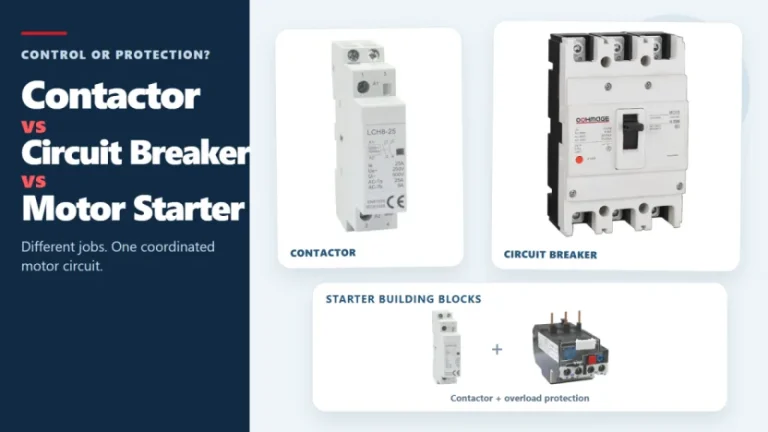
Figure 1. Contactors, circuit breakers, and motor starters solve different control and protection tasks. These three devices often appear in the same motor-control panel, but they solve different problems. A contactor handles frequent, remote, or automatic switching during normal operation. A circuit breaker interrupts abnormal current within its rated capability. A motor starter normally combines […]
Introduction The concept of remote tripping is simple, but in actual operation, project teams often encounter difficulties in specifying the components. The panel factory may require circuit breakers triggered by fire alarm relays, PLC outputs, building management system instructions, or other coordinated control. At this point, “diversion tripping” is only the first step in the […]
The main types of circuit breakers used in low-voltage distribution include miniature circuit breakers (MCBs), molded case circuit breakers (MCCBs) and residual-current devices such as RCCBs and RCBOs. They are not interchangeable. MCBs and MCCBs are selected for overcurrent protection in different circuit roles, an RCCB provides residual-current protection without integral overcurrent protection, and an […]