AC vs DC Contactors: Key Differences, Applications, and Selection Tips
Published: Author: Conor
AC and DC contactors are not interchangeable. Choosing the wrong type can lead to excessive arcing, contact welding, shortened service life, or even system failure.
If you are designing, upgrading, or maintaining an electrical system, the first question you should ask is simple: is this an AC or a DC load? The answer determines which contactor you must use.
In this guide, we break down the key differences between AC and DC contactors, explain where each one is used in real projects, and show you why their internal designs are fundamentally different—so you can select the right contactor with confidence.
AC Contactor vs DC Contactor — Quick Comparison for Selection
The main difference between AC and DC contactors lies in how they interrupt current and control electrical arcs. This single factor drives major differences in structure, durability, and application.
Before diving into technical details, the table below gives you a fast, selection-focused comparison.
Use an AC contactor when your system operates on alternating current and requires frequent switching, such as motors, HVAC equipment, or automation panels.
Use a DC contactor when your system involves direct current with high arc energy, such as batteries, solar systems, EV circuits, or UPS systems.
Never replace a DC contactor with an AC contactor in a DC circuit. This is one of the most common causes of premature contact failure in DC applications.
If you’re ever unsure, the current type of the load—not the coil voltage—is the deciding factor.
Where Are AC and DC Contactors Used in Real Projects?
The fastest way to choose between an AC and a DC contactor is to look at the type of load and power source in your system. In real projects, the application usually makes the decision obvious—as long as you know what to look for.
Below, we break down where each type is used and why mixing them causes problems.
i) Typical Applications of AC Contactors
AC contactors are used in systems powered by alternating current, especially where switching happens often and reliably.
Common AC contactor applications include:
AC Motors: Pumps, fans, conveyors, and compressors in industrial and commercial equipment.
HVAC Systems: Air conditioners, chillers, and refrigeration units that cycle on and off throughout the day.
Lighting Circuits: Large lighting panels in factories, warehouses, and commercial buildings.
Industrial Automation Panels: Control cabinets where frequent, repeated switching is required.
Why AC contactors work well here: Alternating current naturally passes through zero every cycle. This helps the arc weaken when contacts open, allowing AC contactors to switch loads frequently without excessive contact wear.
Practical tip: If your application involves frequent start-stop cycles, AC contactors usually deliver longer service life at a lower cost.
ii) Typical Applications of DC Contactors
DC contactors are designed for systems where direct current flows continuously and arc energy is much harder to control.
Common DC contactor applications include:
Electric Vehicles (EVs): Battery packs, motor circuits, and high-voltage DC distribution.
Solar PV Systems and Battery Banks: Energy storage systems where current does not naturally drop to zero.
UPS Systems: Backup power circuits that must remain stable under load.
Telecom and Data Power Systems: DC distribution racks supplying critical equipment.
Why DC contactors are mandatory here: Direct current does not have a zero-crossing point. When contacts open, the arc stays strong unless it is actively forced away and extinguished. DC contactors use larger contact gaps and arc suppression structures to handle this safely.
iii) What Happens If You Use the Wrong Contactor?
This is where many real-world failures happen.
Using an AC contactor in a DC circuit:
Contacts erode quickly
Arcing lasts longer than the contact design can handle
Contacts may weld together, leading to unsafe operation or system failure
Using a DC contactor in an AC circuit:
Usually works electrically, but increases cost and size unnecessarily
Not economical for high-frequency switching applications
Always match the contactor type to the load current, not just the control voltage.
Why AC and DC Contactors Are Designed Differently?
AC and DC contactors look similar from the outside, but internally they are built for very different electrical behaviors. The key reason comes down to how current behaves when contacts open—and how dangerous the arc can become.
To understand this, it helps to look at three design areas together instead of treating them as isolated topics.
Arc Control — The Real Reason They Are Not Interchangeable
The biggest design difference between AC and DC contactors is how they control electrical arcs.
AC contactors rely on natural current zero crossings and arc chutes to extinguish arcs, while DC contactors require magnetic blowouts or extended arc paths to control continuous DC arcs.
In AC circuits: Alternating current naturally drops to zero every cycle. When the contacts open, the arc weakens on its own. AC contactors take advantage of this behavior by using arc chutes to guide and cool the arc until it extinguishes.
In DC circuits: Direct current does not pass through zero. Once an arc forms, it keeps burning unless it is actively forced away from the contacts. DC contactors use magnetic blowouts or large arc chambers to stretch and extinguish the arc safely.
Why this matters: This is the main reason an AC contactor should never be used in a DC circuit. The arc lasts longer than the contact design can handle, which leads to rapid erosion or welded contacts.
Coil and Core Design — Matching the Magnetic Behavior
The coil and core design also reflects how AC and DC power behave.
AC contactors use laminated iron cores and shading rings to reduce vibration and noise caused by alternating magnetic fields, while DC contactors rely on solid iron cores to maintain constant holding force under continuous current.
AC contactors: Use a laminated iron core with a shading ring. This reduces vibration and noise caused by the alternating magnetic field and keeps the contactor stable during frequent switching.
DC contactors: Use a solid iron core to maintain a constant magnetic force. Since DC current is steady, the coil must reliably hold the contacts closed under continuous load without chatter.
Design takeaway: AC designs focus on efficiency and quiet operation. DC designs focus on holding force and stability.
Contact Structure and Mechanical Strength
Contact construction is another area where the design intent becomes obvious.
AC contactors use smaller contact gaps and lighter materials to support fast, frequent switching, while DC contactors require larger, heavier contacts to withstand stronger and longer-lasting arcs.
AC contactors: Smaller contact gaps and lighter contacts allow fast switching and compact size. This works well because AC arcs extinguish quickly.
DC contactors: Larger contact gaps and heavier contact material are required to survive stronger, longer-lasting arcs. This makes DC contactors bulkier, but far more durable under DC loads.
Why size increases in DC contactors: It is not overengineering—it is a safety requirement.
In general, AC and DC contactors are designed differently because the physics of current interruption is different. Once you understand arc behavior, the differences in coil design, contact size, and overall construction all make sense. This is also why cost, size, and switching capability vary so much between the two.
How AC Contactors Work?
An AC contactor uses an electromagnetic coil to open and close contacts in an alternating-current circuit. Its design focuses on fast response, frequent switching, and controlled arc extinction—all optimized for AC behavior.
Step-by-Step: AC Contactor Operation
Coil Energizes (AC Supply) When AC voltage is applied to the coil, an alternating magnetic field forms around the laminated iron core.
Magnetic Force Pulls the Armature The magnetic field attracts the armature, closing the main contacts and allowing current to flow to the load.
Shading Ring Stabilizes the Hold A shading ring maintains magnetic flux during zero crossings. This prevents chatter, vibration, and audible hum.
Contacts Open When Coil De-energizes When the control signal is removed, the spring releases the armature and opens the contacts.
Arc Extinguishes at Zero Crossing As current passes through zero, the arc weakens naturally and is guided into the arc chute, where it cools and breaks apart.
Why This Design Works for AC Loads
Zero crossings reduce arc energy: Each AC cycle helps extinguish the arc naturally.
Laminated cores reduce heat and noise: Lower eddy current losses improve efficiency.
Smaller contact gaps enable speed: Fast opening and closing support frequent start-stop cycles.
AC contactors are optimized for high switching frequency, compact size, and long service life in AC systems—not for continuous DC arcing.
Common AC Use Cases (and Why They Fit)
Motors & Compressors: Frequent cycling with manageable arc energy.
HVAC Systems: Reliable switching across thousands of operations per day.
Automation Panels: Predictable behavior under AC control logic.
If your application demands frequent switching and runs on AC power, this operating principle is exactly what you want.
How DC Contactors Work?
A DC contactor is designed to switch and isolate direct current circuits where current flows continuously and arcs do not extinguish on their own. Its operation prioritizes arc control, holding stability, and mechanical durability, rather than switching speed.
Step-by-Step: DC Contactor Operation
Coil Energizes (DC Supply) When DC voltage is applied to the coil, a constant magnetic field forms around the solid iron core.
Stable Magnetic Force Pulls the Armature The steady magnetic field pulls and holds the armature firmly, closing the main contacts without vibration or chatter.
Contacts Carry Continuous DC Load Once closed, the contacts conduct direct current that does not pass through zero. The contactor must maintain stable pressure under constant electrical and thermal stress.
Contacts Open When Coil De-energizes When control power is removed, the return spring opens the contacts. At this moment, a strong electrical arc forms immediately.
Arc Is Forced Away and Extinguished Magnetic blowouts, permanent magnets, or extended arc chambers stretch and cool the arc until it breaks. Without these features, the arc would persist and damage the contacts.
Why DC Contactors Are Built This Way
No zero crossing: DC arcs do not weaken naturally and must be actively controlled.
Solid iron core: Provides constant holding force under continuous current.
Larger contact gaps and heavier materials: Required to survive stronger, longer-lasting arcs.
DC contactors trade speed and compact size for safety, durability, and arc resistance.
What DC Contactors Do Well—and What They Don’t
DC contactors excel at:
Handling battery-based systems with continuous current
Switching high-energy DC loads safely
Maintaining contact stability under long duty cycles
DC contactors are not ideal for:
High-frequency switching
Compact control panels where space is critical
Cost-sensitive applications that only use AC power
This is why DC contactors are common in EVs, solar storage systems, UPS units, and telecom power racks, but rarely used as drop-in replacements for AC contactors.
Note: If your system involves stored energy—such as batteries or capacitors—assume DC arc energy will be high. In these cases, a DC contactor is not optional; it is a safety requirement.
Conclusion
Selecting the right contactor starts with one decision: is your load AC or DC?
AC contactors are designed for frequent switching in alternating-current systems, while DC contactors are built to handle continuous current and stronger arc energy. Treating them as interchangeable often leads to premature failure or unsafe operation.
If you match the contactor to the load’s current type and operating conditions, most reliability issues are avoided before installation.
At Oohmage, we support engineers and system integrators with reliable AC and DC contactors for industrial, energy, and power applications. If you’re unsure which contactor fits your system, our team can help you select the right solution based on your load, duty cycle, and safety requirements.
Figure 1. Contactors, circuit breakers, and motor starters solve different control and protection tasks. These three devices often appear in the same motor-control panel, but they solve different problems. A contactor handles frequent, remote, or automatic switching during normal operation. A circuit breaker interrupts abnormal current within its rated capability. A motor starter normally combines […]
The main types of circuit breakers used in low-voltage distribution include miniature circuit breakers (MCBs), molded case circuit breakers (MCCBs) and residual-current devices such as RCCBs and RCBOs. They are not interchangeable. MCBs and MCCBs are selected for overcurrent protection in different circuit roles, an RCCB provides residual-current protection without integral overcurrent protection, and an […]
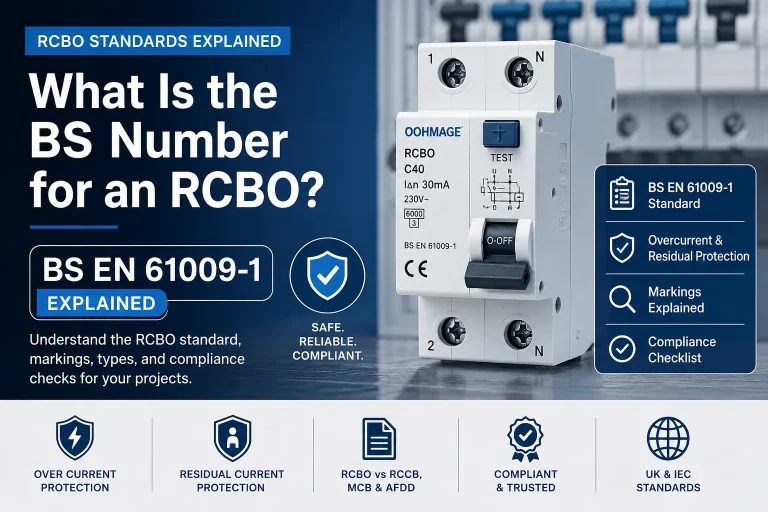
Introduction If you are searching for the RCBO BS number, the answer most commonly required in UK and IEC-based electrical procurement is BS EN 61009-1. This is the principal product standard associated with residual current circuit breakers with overcurrent protection used in residential, commercial, and similar installations. However, merely the BS number is not sufficient […]