1 Pole vs 2 Pole Contactor: Differences, Applications & How to Choose
Published: Author: Conor
If you’re working on HVAC systems, motors, heaters, or any 240V equipment, sooner or later you’ll face the classic question: “Should I use a 1-pole or 2-pole contactor?” And for many engineers or procurement teams, choosing the wrong pole count is one of the easiest ways to create nuisance trips, half-powered circuits, or unsafe maintenance conditions.
This guide focuses on what actually matters in real projects — the true differences, where each pole type is used, and how to select the correct one without guesswork.
What’s the Difference Between a 1-Pole and 2-Pole Contactor?
A 1-pole contactor switches one live line, while a 2-pole contactor switches two live lines at the same time. That’s the core difference — but in the field, it affects safety, isolation, project compliance, and equipment performance. Here’s what that means in practice:
If your system has two energized hot wires, both must be disconnected during shutdown. That’s where the 2-pole contactor becomes the only safe choice.
When Should You Use a 1-Pole Contactor?
A 1-pole contactor works best when your system uses one active conductor and does not require complete multi-line disconnection. You’ll see them everywhere in residential and light commercial equipment.
Residential HVAC (most common case)
Many home AC systems only switch one hot leg while the neutral stays tied in the circuit. A 1-pole contactor is the standard choice for:
Split AC outdoor units
AC fan motors
Low-power compressors
Residential heat pumps(in certain regions)
One advantage engineers like: simpler wiring + fewer failure points.
Small Motors & Pumps
If you’re controlling:
1–2 HP pumps
Condenser fans
Blowers
Light-duty circulation motors
A 1-pole contactor is usually enough.
Lighting Circuits
Commercial lighting often uses a 1-pole contactor for switching single-line loads.
Small Heating Loads
Low-power heating rods or small underfloor heating units typically use single-line control.
Why engineers pick 1-pole contactor when possible
Fewer terminals = faster wiring
Lower cost
Neutral continuity is acceptable for the application
Simplifies troubleshooting (less digging inside panels — a blessing when you’re on a rooftop in summer heat)
When Should You Use a 2-Pole Contactor?
A 2-pole contactor is designed for dual-line or high-power systems that require complete shutdown, especially those running on 208–240V. You’ll find them used much more heavily in commercial and industrial equipment.
Water Heaters & Boilers (240V)
Electric heaters require both hot wires to disconnect. Using only one pole leaves the second leg energized — a major safety hazard during service.
Large HVAC Systems
Most commercial compressors and rooftop units depend on 2-pole contactors for:
Higher current handling
Balanced switching
Safe servicing conditions
Resistive Heating Loads (High Wattage)
Industrial heaters rely on complete isolation to avoid overheating, arcing, or partial power faults.
Regions With Mandatory Dual-Line Disconnect Codes
In certain countries and states, 2-pole is legally required for specific equipment ratings.
If your equipment manual says: “disconnect all hot legs before servicing”. It means a 2-pole contactor is required. No exceptions.
1 Pole vs 2 Pole Contactor
Field scenarios are where the difference between 1-pole and 2-pole contactors becomes obvious. Below are detailed, real engineering situations that show exactly why one pole type works—and why the other does not.
These examples come from HVAC service work, industrial panel design, hot-water systems, and motor protection setups that many technicians deal with every day.
Case 1 — Residential AC Outdoor Unit
Load Type: Compressor + condenser fan
Voltage: 230V (one hot + neutral)
Correct Contactor: 1-Pole
Most residential AC systems in North America run on single-phase 230V where only one conductor is a true hot leg. The neutral remains bonded and does not need to be switched. The compressor and fan simply require control of the L1 conductor.
Case 2 — Domestic Electric Water Heater
Load Type: Resistive heater element
Voltage: 240V (L1 + L2, both hot)
Correct Contactor: 2-Pole (required)
240V heaters operate with two energized hot wires. If you only switch one hot leg using a 1-pole contactor, the other leg stays energized. This creates:
Hidden shock hazards
Half-heated heating elements
Unexpected standby voltages
Higher fire risk under fault conditions
During maintenance, the tank must be 100% de-energized. If only one pole disconnects, the element may still have live potential even though one conductor is open. This violates safety standards in most regions.
Case 3 — Medium-Large HVAC Rooftop Unit (Commercial)
Load Type: 3–5 ton compressor + industrial blower
Voltage: 208–240V (dual hot)
Correct Contactor: 2-Pole
Commercial compressors draw heavy inrush currents. They require balanced disconnection to avoid:
Uneven magnetic flux during restart
Contact welding
Partial energization that stresses the windings
Misleading voltage readings during troubleshooting
A 2-pole contactor ensures both hot legs disengage together, keeping the compressor fully isolated.
This setup dramatically extends compressor lifespan.
Case 4 — Industrial Air Heater
Load Type: Large electric heater
Voltage: 240V / 480V
Correct Contactor: 2-Pole (or 3-pole if 3-phase)
Industrial heaters cycle on/off frequently. Contacts face high heat, high current, and thermal shock. If only one leg disconnects (1-pole):
the heater receives partial current
heating element hotspots develop
contactors weld due to constant mini-arcs
temperature controllers behave unpredictably
These Panels Usually Goes into:
2-pole contactor for full line isolation
thermal overload relay to prevent element burnout
mechanical interlock or PID temperature controller
When designed properly, the heater cycles cleanly for thousands of hours.
Case 5 — Small Pump Motor (0.5–1.5 HP) in a Workshop
Load Type: Inductive
Voltage: 120V or 230V single hot
Correct Contactor: 1-Pole (if single hot)
Small pumps (like coolant pumps, circulation pumps, or condensate pumps) often only need one hot conductor controlled. If the pump is 240V with dual hot legs, a 2-pole becomes mandatory.
How to Choose Between a 1-Pole and 2-Pole Contactor?
Here’s the selection guideline used by many field technicians and project engineers.
i) Check the Voltage Type
120V / 230V single-line → 1-pole
208–240V dual-line → 2-pole
If the equipment has two hot legs, you need to switch both.
ii) Identify the Load Type
Load
Recommended Pole
Small fan motors
1-pole
Light pumps or blowers
1-pole
Compressors (medium/high HP)
2-pole
Water heaters
2-pole
Large HVAC
2-pole
iii) Evaluate Safety Requirements
Check list:
Must the device be completely de-energized during service?
Does the equipment manual require full isolation?
Does your region mandate dual-line disconnect?
If yes, you must use a 2-pole contactor.
iv) Consider Your Protection Setup
For motor protection, a 2-pole paired with a thermal overload relay.This offers better coverage for dual-line currents.
v) Check Local Standards & Codes
Many jurisdictions clearly define when two poles are required.
For example:
Certain North American states mandate 2-pole switches for electric heaters and commercial HVAC.
vi) Follow Equipment Manufacturer Recommendations
If the datasheet says “disconnect both lines,” you cannot safely use a 1-pole.
⚠️Electrical Safety Warning
Always remember that contactor installation should be handled by qualified personnel. If you’re not certified or experienced with electrical systems, bring in a licensed technician to handle the final setup.
Common Selection Mistakes
Mistake 1 — Using a 1-pole on a 240V heater
Only one leg disconnects → second leg stays live → serious shock risk.
Mistake 2 — Underrating the contactor
Leads to welded contacts, frequent overheating, or nuisance failures.
Mistake 3 — No overload protection for motors
Motors need a thermal overload relay to prevent burnout during stalls or overcurrent events.
Mistake 4 — Ignoring local installation codes
This often becomes an inspection failure.
Mistake 5 — Confusing neutral with a second hot wire
Engineers see this issue often in DIY-installed HVAC systems.
Conclusion
Choosing between a 1-pole and 2-pole contactor comes down to how your system is powered and how much isolation you need.
Use a 1-pole contactor when you only need to switch one hot leg—like small motors, residential HVAC units, condenser fans, or other light loads.
Use a 2-pole contactor when you’re working with 240V equipment, commercial HVAC compressors, resistive heaters, or any setup where both hot legs must be disconnected for safe servicing.
If you’re gearing up for a new build or upgrading older equipment, feel free to browse our industrial-grade ac contactor. And when you need components that meet real engineering standards (not just catalog specs) you can count on oohmage for reliable, safety-rated hardware. Your system will run smoother, last longer, and stay safer when you start with the right pole count.
FAQs
1. Do I always need to disconnect both hot legs on a 240V system?
Yes. A 240V system has two energized hot legs, and both must be disconnected for safe servicing, inspection, and compliance with most electrical codes. Using only a 1-pole contactor leaves one leg live, which can create shock hazards, uneven heater loading, and dangerous “half-powered” conditions when equipment looks off but isn’t actually isolated.
2. Can I replace a 2-pole contactor with a 1-pole if one side is still working?
No. Replacing a 2-pole with a 1-pole will leave one hot wire permanently energized, which violates electrical codes and creates a major safety risk. If a 2-pole contactor fails on one side, replace the entire contactor—never convert it to 1-pole operation.
3. Can I use a contactor without a thermal overload relay?
Yes for heaters (resistive load), but not recommended for motors. Motors generate high inrush current and can overheat during jams or voltage drops. A thermal overload relay detects overload conditions that a contactor cannot.
Related Product Categories
Modular Contactors — Compare available pole configurations after confirming the load and control voltage.
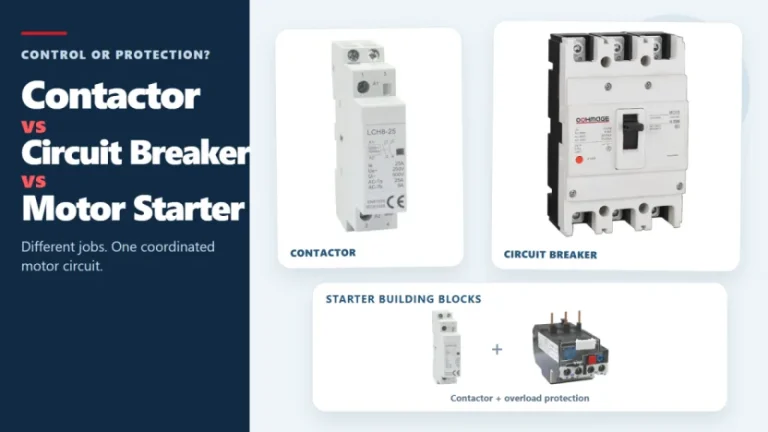
Figure 1. Contactors, circuit breakers, and motor starters solve different control and protection tasks. These three devices often appear in the same motor-control panel, but they solve different problems. A contactor handles frequent, remote, or automatic switching during normal operation. A circuit breaker interrupts abnormal current within its rated capability. A motor starter normally combines […]
The main types of circuit breakers used in low-voltage distribution include miniature circuit breakers (MCBs), molded case circuit breakers (MCCBs) and residual-current devices such as RCCBs and RCBOs. They are not interchangeable. MCBs and MCCBs are selected for overcurrent protection in different circuit roles, an RCCB provides residual-current protection without integral overcurrent protection, and an […]
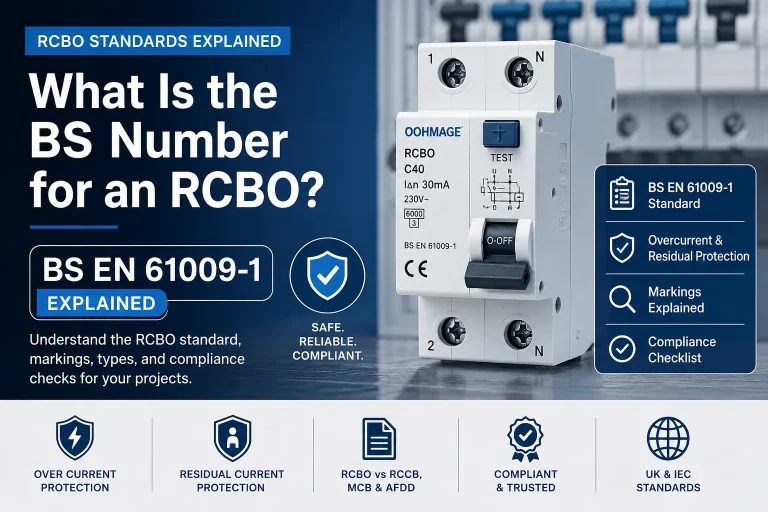
Introduction If you are searching for the RCBO BS number, the answer most commonly required in UK and IEC-based electrical procurement is BS EN 61009-1. This is the principal product standard associated with residual current circuit breakers with overcurrent protection used in residential, commercial, and similar installations. However, merely the BS number is not sufficient […]